
The read · 2026 General
Trump is underwater in Kentucky. Here is where that actually buys Democrats a seat.
He has fallen 35 points in net approval here since January 2025, the steepest drop in the country. The Republicans souring on him mostly live where Democrats aren't on the ballot, and the weather alone flips no House seat. Seat by seat, here is where turnout can, and how many votes it takes in the last eight days.
LOUISVILLE — When Donald Trump took office in January 2025, the Civiqs tracker had him at plus 23 in Kentucky. As of October 21 it has him at 38 approve, 50 disapprove. That is minus 12, a 35-point fall, the steepest of any state Civiqs tracks, in a state he carried by 30.6 points eleven weeks before he took the oath.
Now the honest version. Civiqs is a modeled estimate from an opt-in online panel, and it runs a little Democratic. The last independent Kentucky-only poll, Emerson at the end of March, had him at plus 10. Nobody independent has polled the state since. So the size of the drop is soft. The direction is not.
And approval is not a vote. Kentucky settled that in 2023, when it gave Andy Beshear a five-point win and elected Republicans to all five of the other statewide offices on the same ballot. I wrote about that split in July; it is the Beshear plus five, Trump plus thirty problem, and it has not gone anywhere. Kentucky can dislike a Republican and still vote for the next one down the ballot.
So the useful question isn't whether Trump is underwater. It's where his slide runs into a Democrat whose name is actually on the ballot, and how many votes it would take to turn a bad number for him into a seat for them.
The slide is real. Most of it is happening in seats where nobody is standing to catch it.
What the weather can do on its own. I ran every contested state House seat through the two real environments Kentucky has handed Democrats since Trump left the ballot: the 2022 midterm, and 2023's statewide down-ballot races. Each seat starts from the last time a Democrat and a Republican actually fought over it, then moves with the statewide environment. I ran it two ways. The first assumes every seat moves the same amount. The second moves each region the way its seats actually moved in 2022, which, as I'll show below, is not the same at all. Every margin is two-party.
| Weather | Statewide | House seats for Democrats (now 20 of 100), if every seat moves alike | If each region moves the way it did in 2022 |
|---|---|---|---|
| A normal midterm: 2022, repeated | R +23.6 | 21 (adds HD 31, Tim Hall) | 20 |
| 2023's statewide down-ballot weather (AG, SOS, Treasurer, Auditor, Ag) | R +18.4 | 22 (adds HD 31, Hall; HD 48, Suhas Kulkarni) | 20 |
There were no House races in 2023; it was a statewide year. But on the night Beshear won, the five Democrats running for the other statewide offices averaged R +18.4, the best weather a Kentucky Democrat below the top of the ticket has had in years. Carry it onto this year's House map, generously, and it flips two seats. Carry it the way Kentucky actually behaves, and it flips none.
So here is the honest read before the rest of the arithmetic: the weather does not win Democrats a single House seat this year by itself. Not a normal midterm, not the best down-ballot night in recent memory. Every seat on the board is a turnout race. I did run Trump's full 35-point slide through the same model, and I'm not printing a seat count for it, because no down-ballot Democrat in Kentucky has run anywhere near that environment and a number like that gets quoted as a forecast. The useful thing it shows is where those seats would be: mostly outside Louisville, Lexington and Northern Kentucky, in places like Paducah, Henderson and Owensboro, which is the next point.
R +18.4
The average margin for the five Democrats running for Kentucky's other statewide offices in 2023
The same night Beshear won by 5.1. Beshear's coattails were real for Beshear and nobody else. Statewide two-party margins, all 120 counties.
Does the suburban Republican leave first? He already left. This is the part most people get backwards. The Republican voter in Louisville's eastern suburban House districts did not wait for 2026 to turn on Trump. He voted against Trump in 2024, and then he voted for his Republican state representative on the same ballot.
The receipts are in two districts. Kamala Harris carried House District 31 by 3.2 points and District 48 by 2.3, and Republicans won both House seats anyway. Enough voters in each said no to Trump and yes to their state rep to decide the race. Those voters already disapprove of Trump. Another bad poll for him gives them nothing new to act on.
The 2022 midterm, the last time Trump was off the ballot, says the same thing. Here is how the same seats moved between 2022 and 2024, using only seats a Democrat and a Republican contested both times:
| Region | Seats compared | How much better Democrats did in 2022 than in 2024 |
|---|---|---|
| Louisville | 6 | +0.4 |
| Northern Kentucky | 6 | +5.5 |
| Lexington area | 3 | +3.3 |
| Rest of the state | 3 | +7.5 |
Statewide, the top of the ticket moved 7.4 points between those two elections. In Louisville's contested House seats it barely moved at all. The samples are small and some of the candidates changed, so read this as a pattern rather than a law. But the pattern points one way. The Republicans a bad Trump number can still move live in the rest of the state, rural and small-town Kentucky, the same voters who put Kentucky at the top of the Civiqs chart.
And 43 of the 100 House seats this year have no Democrat on the ballot. A Republican souring on Trump in one of those has nobody to vote for.
Louisville is a turnout race, not a persuasion race. If the suburban Republican is already priced in, the Louisville seats come down to one number: how many more Democrats show up than showed up in 2022. Here it is, seat by seat, with Republicans voting at their 2022 level.
| Seat | Democrat | Republican incumbent | Democrats lost by in 2022 | Democrats lost by in 2024 |
|---|---|---|---|---|
| HD 31 | Tim Hall | Susan Tyler Witten | 785 votes | 340 votes |
| HD 28 | Almaria Baker | Jared Bauman | 1,872 | 3,402 |
| HD 48 | Suhas Kulkarni | Ken Fleming | 1,892 | 2,114 |
| HD 33 | Jennifer Hardin | Jason Nemes | 2,042 | 3,467 |
| HD 29 | Cassie Blausey | Chris Lewis | no 2022 race | 3,680 |
| HD 36 | William "Woody" Zorn | John Hodgson | no 2022 race | 4,237 |
Tim Hall's race in the 31st is the only one inside a normal week's reach, and I laid out its precincts in August. The rest need the kind of midterm turnout gap Kentucky Democrats have not produced.
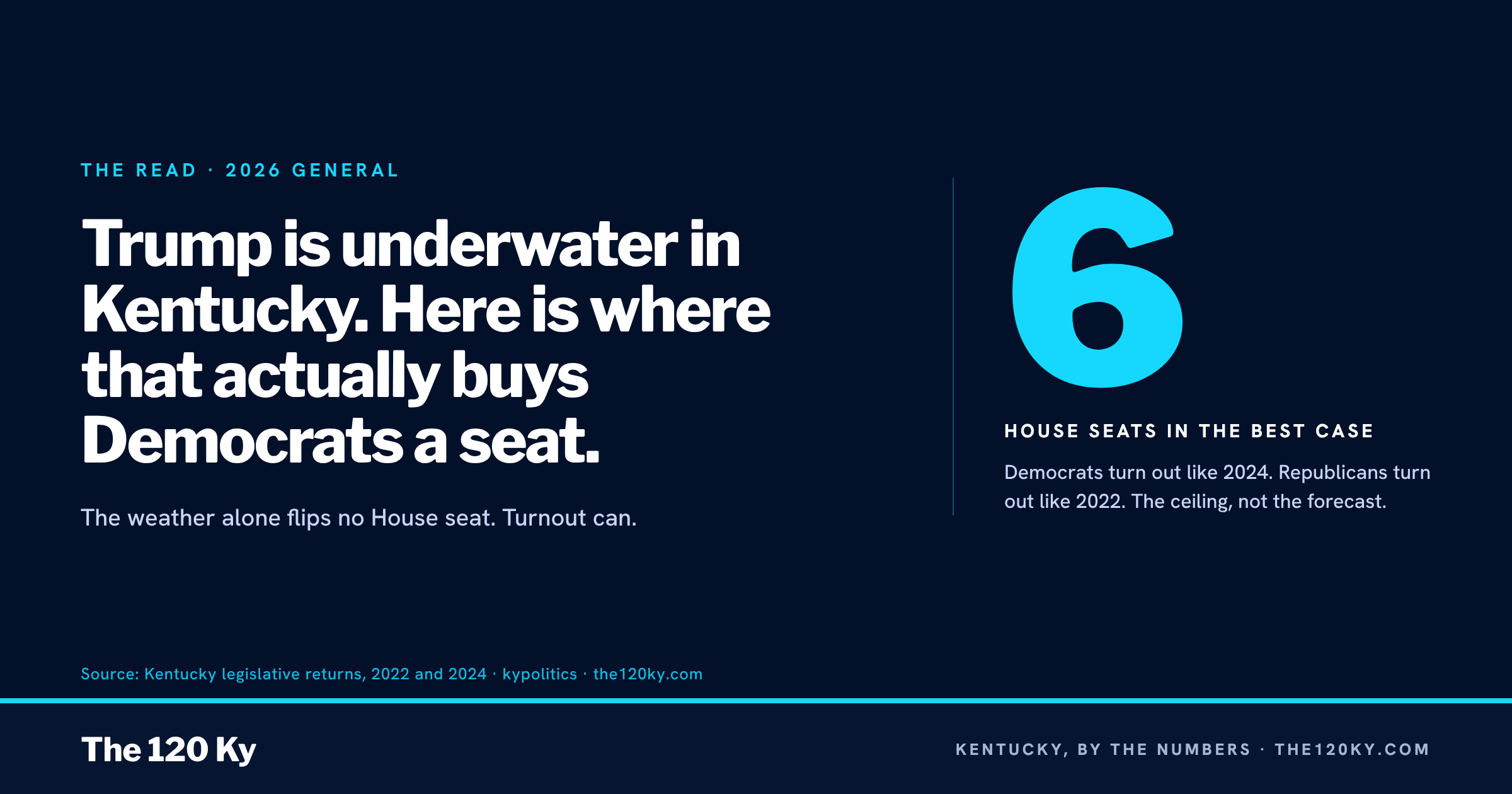
6 seats
The best case: Democrats turn out like 2024, Republicans turn out like 2022
Louisville: HD 31 (Tim Hall), 33 (Jennifer Hardin), 48 (Suhas Kulkarni) · Jessamine: HD 39 (Ryan Stanford) · Covington: HD 65 (Aaron John Currin) · Kenton: HD 69 (Wilanne Stangel). That electorate has never existed in Kentucky. It is the ceiling, not the forecast.
That card is the most optimistic number in this piece, and I'm putting it on a card so you can see exactly what it takes: Democrats voting at their presidential-year levels in a midterm, Republicans staying home at midterm rates. Kentucky has never produced that electorate. But it shows which doors the votes are behind, and none of those six seats needs persuasion. Every one of them is already there on turnout alone.
Then there's defense, and defense is closer than anything on offense.
30 · 172 · 249
Democratic margins of victory in 2024: Matthew Lehman, HD 67 (Campbell) · Adam Moore, HD 45 (Lexington) · Rachel Roarx, HD 38 (Louisville)
Three seats won by a combined 451 votes. A normal midterm should help all three. None of them is safe, and losing any one turns a pickup into a wash.
This year Lehman faces Terry Hatton, Moore faces Killian Timoney, and Roarx faces Carrie Sanders McKeehan.
Northern Kentucky has the best target in the state. House District 65, Covington and the Kenton river cities. Republican Stephanie Dietz holds it, and Democrat Aaron John Currin is running against her. In 2022, the last midterm, she won it by 283 votes. In 2024, with Trump on the ballot, she won it by 2,531.
That swing is what a midterm does in Northern Kentucky, where contested seats moved 5.5 points toward Democrats in 2022. Beshear carried the 65th by 19. It is the one seat in Kentucky where the midterm bump and Democratic turnout point at the same front porches, and the only seat on the board that a Trump slide moves even on Kentucky's real 2022 pattern. If I had one more week of volunteers to place anywhere in the state, they would be in Covington.
Across the county line, the 30-vote seat in Campbell County is the 67th, Matthew Lehman's seat, and it is the Democrats' to lose.
Lexington, and the 6th. Lexington carries two jobs this year.
The first is the House. Adam Moore holds the 45th by 172 votes and faces Killian Timoney. Beyond it, the 39th (Jessamine, where Ryan Stanford is running against Matt Lockett) and the 73rd (Clark County, open, Chelsea Kirk against Daniel Konstantopoulos) both sit at R +19 or worse on their 2024 legislative results. That is a 19-point swing, more than any midterm has delivered here. The 56th, Woodford and part of Frankfort, where David Graves is running against Daniel Fister, sits between them at R +14.9.
The second is the 6th Congressional District, open since Andy Barr went after the Senate seat: Democrat Zach Dembo against Republican Ralph Alvarado. This is the one federal race in Kentucky where Trump's number is close to the whole ballgame.
Barr won the 6th by 26 points in 2024, two-party. Trump carried it by about 15. Barr's 26 included an incumbent's personal vote, and that left with him. Start from Trump's number instead.
The receipt is 2018, the last midterm with Trump unpopular. Barr held the old 6th by 3.2 points, 154,468 to 144,736, in a district Trump had carried by 15: a 12-point move off Trump's number. Make that move again from 15 and the 6th is a three-point race, with no incumbent this time. Every version of this race runs through Fayette County turnout.
The state Senate: two seats in reach, no path past the supermajority. Nineteen Senate seats are up this year, and nine have both a Democrat and a Republican on the ballot. Republicans hold 32 of the 38.
- SD 36, eastern Jefferson County. Julie Raque Adams against Sarah Cole McIntosh. Rand Paul carried it by 4.9 in 2022, and Harris lost it by 2. It flips on a swing of under five points from 2022, and it shares precincts with the 31st and 48th, so it is the same turnout race. It is the best Senate target on the map, and I covered its money on Friday.
- SD 6, Jefferson, Oldham and Trimble. Lindsey Tichenor against Christian Furman. Paul won it by 10.1 in 2022. That is a 10-point swing in a seat with nearly half its precincts in Oldham County, and suburban seats here have not been moving.
- SD 20 (Frankfort and five counties), Stella Pollard against Gex Williams, and SD 34 (Madison and part of Fayette), Jessica McIntosh against Jared Carpenter, sit at R +12.6 and R +18.2 on their last legislative results. Neither is in reach of any environment Kentucky has produced since 2020.
The Senate supermajority line is 23 seats. Republicans hold 32. A clean sweep of all four still leaves them well over it.
The supermajority question, straight. Three-fifths of the House is 60 seats. That is the vote it takes to pass a revenue bill in an odd-year session and to put a constitutional amendment on the ballot. To bring Republicans below it, Democrats need 41 seats: hold all 20 and pick up 21 more.
Only 37 Republican-held seats have a Democrat on the ballot this year, and on any real-world weather the model moves Democrats from 20 to 22 at most. The supermajority does not break this cycle.
What can happen is smaller, and still worth the week. Roarx, Moore and Lehman hold the 38th, 45th and 67th. Hall takes the 31st and Currin takes the 65th. McIntosh takes Senate District 36. That is a real, plausible night, and every seat on it moves the caucus closer to the number that matters in 2028.
Where the top of the ticket fits. This is not a piece about the U.S. Senate race, but it runs through the same map. Charles Booker's strongest counties are Jefferson and Fayette, and those are the counties where almost every seat above lives: Hall in the 31st, Roarx in the 38th, Moore in the 45th, Kulkarni in the 48th, McIntosh in the 36th Senate, and Dembo in the Lexington half of the 6th. A Louisville and Lexington turnout surge doesn't help one race. It helps every race on this list at once.
The variable the model can't see: doors. Everything above is built from election returns, and returns can't tell you the one thing that decides a turnout race: who is knocking.
Here is what I can tell you from watching this cycle. I have checked in with most of the Democratic campaigns in these seats, and every one of them has been on the doors for months, not weeks. There are more volunteers this fall who understand why a door matters than I have seen in a Kentucky midterm in a long time. From what I have seen, a lot of the Republican campaigns in these same seats are not knocking. They are on television.
The Louisville air has been full of Republican ads this fall. I have seen every one of them, most of them more than once, and of all of them, the only one with anything to do with a race on my own ballot is the one against Charles Booker. The rest are buying an entire media market to reach a few thousand voters in a handful of districts. In Senate District 36 alone, Julie Raque Adams spent $372,516 on television, mail and digital between September 5 and October 4. Most of the people who saw those ads cannot vote in the 36th.
The money leans Republican. The doors lean Democratic. Only one of those knows who lives behind them.
There is one hard number that points the same way. From June 1 to August 1, Republicans added 4,332 registered voters in Kentucky and Democrats added 228. Then it turned. In August, Democrats out-registered Republicans, 2,486 to 2,227. From September 1 to the day the books closed, it was 2,339 to 1,122. That is the first time Democrats have won a month of registration in any State Board of Elections report since at least last November.
4,825 to 3,349
New Democratic and Republican registrations in Kentucky, August 1 to the October books closing
State Board of Elections monthly voter statistics, all 120 counties. Republicans still lead registration statewide, 1,627,854 to 1,375,839. A 1,476-vote edge does not touch a 252,015-voter gap. It does tell you who has been out signing people up.
Now the honest version of that one, too. The edge is small, it starts from a deficit of a quarter million, and unaffiliated registrations grew almost as fast. It is not a wave. It is a sign that somebody has been at the doors with a clipboard, and that is the same sign this whole section is about.
On a campaign, this is where I would pull the door numbers: attempts, contacts, contact rate, how many of my supporters we had touched and how many times. I don't have those for these races, and nobody outside the campaigns does. So treat doors as the unknown in every number above. It is the one variable that can move a seat past what the returns say, and this fall it is moving one way. A Democrat who has been on the doors in one of these seats has a shot at beating the table. A Democrat who hasn't does not win, in any weather.
Eight days. Election Day is Tuesday, November 3. No-excuse early in-person voting runs Thursday through Saturday, October 29 to 31.
The field research on door-knocking (Gerber and Green's is the standard reference) puts the yield at roughly one additional vote for every 14 face-to-face conversations with your own supporters. Run the 65th through that. Closing 283 votes takes about 4,000 real conversations. At eight an hour, that is 500 volunteer hours: a hard week, not a fantasy. The 31st, at 785, takes nearly three times that.
So the list for the last eight days is short.
- HD 65, Covington: Aaron John Currin against Stephanie Dietz. The best ratio of votes needed to votes available in Kentucky.
- HD 31, Louisville: Tim Hall against Susan Tyler Witten. Lost by 340 in a presidential year. A turnout race, door by door.
- HD 67, 45 and 38: Lehman, Moore and Roarx. Lose one of these and a pickup only gets you back to even.
- SD 36: Sarah Cole McIntosh against Julie Raque Adams. It overlaps the 31st and 48th. Every door knocked there works twice.
- Fayette County, for the 6th: Zach Dembo against Ralph Alvarado. The only federal seat where the national environment is doing most of the lifting.
Everything else on the map is a 2028 project, and the honest thing is to say so now, while there is still time to put this week's volunteers where they count.
If I were running one of these races this week. Here is what I would be doing between now and the polls closing, in this order.
1. Keep knocking doors through Friday. Not lit drops. A lit drop is a piece of paper on a porch. A door knock is a conversation with a voter, and the conversation is the thing that moves turnout. If your volunteers can knock, they knock. Save the lit drop for the next step.
2. Run a full get-out-the-vote program in every seat. Anyone can vote early Thursday, Friday and Saturday this week, no excuse needed, and then everyone else votes Tuesday. So the turnout push starts now, not Monday night. This is where a lit drop finally earns its place, with one condition: the door hanger has to carry the early voting locations and that voter's own Election Day polling place, printed on it, when they are different places. In Louisville they almost always are. Not "find your polling place." The addresses, so they are the first thing the voter sees.
3. Know your turnout before the polls close. Before Tuesday, sort your precincts into the ones where you need high turnout, the ones where regular turnout is fine, and the ones where you would be happy with low. Then on Election Day, watch them. Line up supporters in each of those precincts to vote at different times through the day, and have each one call you with their ballot number right after they vote. A ballot number at 10 in the morning against one at 2 in the afternoon tells you whether that precinct is running hot or cold, hours before any result posts.
If your high-turnout precincts aren't putting up big numbers by early afternoon, it's time for what field organizers call knock and drag. It is exactly what it sounds like. You knock on the doors of your supporters who haven't voted yet, and you get them to the polls. The person at the door calls for a ride for that voter, or, if there's no ride program, drives them there themselves. It is the oldest move in field, and nothing works better in the last six hours of a close race.
You don't win a supermajority back in eight days. You win the five seats that are close enough to hear you knocking.
Election night, I'll be reading the Covington precincts first. That's where the slide either lands or it doesn't.
Disclosure: I work in Kentucky Democratic politics and consult campaigns in this state. I have no client in any 2026 race. Charles Booker is a friend, and I intend to support Chelsea Kirk in the 73rd. I read these races the same way regardless, and that's the job.