
The read · split-ticket
Beshear +5. Trump +30. Same voters, twelve months apart.
A state that elected a Democratic governor handed Donald Trump a thirty-point landslide the next November. Kentuckians split their ticket — and that gap is the most important, and most misread, number in the state.
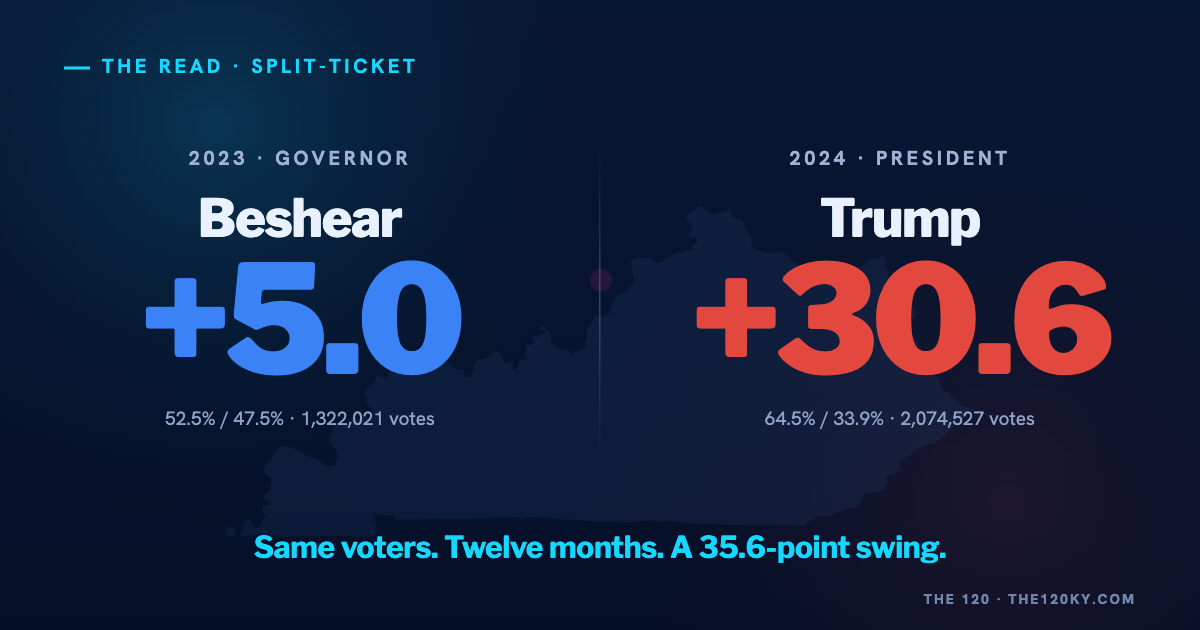
LOUISVILLE — In November 2023, Kentucky re-elected Andy Beshear, a Democrat, governor. In November 2024 — the same voters, twelve months later — the state gave Donald Trump one of his biggest margins in the country. Those two facts are usually told as two stories. They are one story, and the gap between them is the most useful number in Kentucky politics.
Beshear +5.0
2023 governor — Beshear 52.5% / Cameron 47.5%
1,322,021 votes cast. A clean statewide Democratic win.
Trump +30.6
2024 president — Trump 64.5% / Harris 33.9%
2,074,527 votes cast. A thirty-point Republican landslide in the same state, one year later.
That is a thirty-five-point swing in the partisan result of a single state in twelve months. It did not happen because Kentucky changed its mind about anything. It happened because a vote for Beshear was never a vote for the Democratic Party. It was a vote for Beshear.
Beshear didn't have coattails. He had a personal vote — and a personal vote doesn't transfer to anyone, not down the ballot in his own year and not up the ballot the next one.
The map is where this stops being an abstraction. Shade every county by how far its Democratic share fell from the 2023 governor's race to the 2024 presidential race, and the collapse isn't spread evenly. It is concentrated exactly where you'd expect if Beshear's vote was personal: the ancestral-Democratic counties of eastern Kentucky, where people still register Democratic and have voted Republican at the top of the ticket for years.
−41.3 points
Breathitt County — the steepest drop in the state
Beshear took Breathitt with 61.2% in 2023. Harris got 19.9% there in 2024. Right behind it: Floyd −37.2, Perry −35.9, Elliott −34.9, Letcher −34.8, Knott −34.5. The mountains gave Beshear majorities and gave Harris one vote in five.
Now read the other end of the same map — the counties where the drop was smallest:
Under 13 points
Where the floor held — the blue islands
Jefferson fell just 11.6 points (70.0% → 58.4%), Oldham 11.1, and Fayette 12.5 (71.8% → 59.3%). Louisville and Lexington barely moved. The coalfields fell off a cliff.
That contrast is the whole lesson. In Louisville and Lexington, the Democratic vote is a party vote — it shows up for a governor and a presidential candidate at close to the same rate, because those voters are voting for the D. In the mountains, the Democratic vote is increasingly a candidate vote — available to a Beshear who runs on flood recovery and kitchen tables, gone the instant a national Democrat is on the ballot.
This is the part most national coverage gets wrong about Kentucky, and it's worth saying plainly: Kentuckians split their ticket, on purpose, and they will pick a candidate over a party. It's in the state's DNA — the same voters who gave Mitch McConnell six terms gave Andy Beshear two, and tens of thousands of them did it on the same ballot. Party label here is a weak predictor of how a Kentuckian actually votes. The right candidate, running the right way, pulls voters the registration table says shouldn't be reachable. That's not a hope. It's the documented behavior of this electorate for decades.
Which leads to the number everyone is about to over-read for the next two years: Trump's 64.5%.
64.5% vs 47.5%
Trump's 2024 share — and what a Republican gets when Trump isn't on the ballot
One year before Trump's 64.5%, the Republican nominee for governor, Daniel Cameron, took 47.5% in this same state. Seventeen points lower. When Trump is not the name on the ballot, the Republican number falls — sometimes far enough to lose.
That gap is the whole warning. Trump's 64.5% is a Trump number, not a Republican number. Treat it as the baseline any other Republican inherits and you will misjudge race after race — because the voter who gave Trump 80% in Breathitt gave Beshear 61% twelve months earlier, and will be available again the moment the ballot doesn't say Trump. The Republicans running in 2026 and beyond do not get to bank Trump's ceiling. The honest planning number for a generic Republican in Kentucky is well south of it — closer to Cameron's 47.5% statewide than to Trump's 64.5%, and lower still wherever the Democrat is a real candidate.
For anyone reading these numbers to plan a campaign, the operative reading is blunt: do not put a 2023 Beshear county in your win column for a 2026 federal or partisan race. The map will lie to you. A county that gave Beshear 55% is not a 55% Democratic county; it's a county that liked one man. The transferable Democratic vote in Kentucky lives in the places where the line between the governor's race and the president's race is flat — and that's a much shorter list than the governor's map suggests.
What this map can't tell you on its own is why the personal vote held where it did — how much is flood-recovery goodwill, how much is the Beshear family name that's run statewide since his father, how much is the simple absence of a national brand to vote against. Those are the next questions, and they decide whether 2027's governor's race looks like 2023 or like 2024. I'll read those when the candidates are set.
Until then, this is the map I'd put in front of anyone who thinks Kentucky is more winnable than it is — or anyone who thinks it's hopeless. Both are reading the wrong year.
I read the numbers straight. This one's straighter than most.