
Field notes · 2026 Legislature
Who is actually paying for doors in Kentucky's legislative races
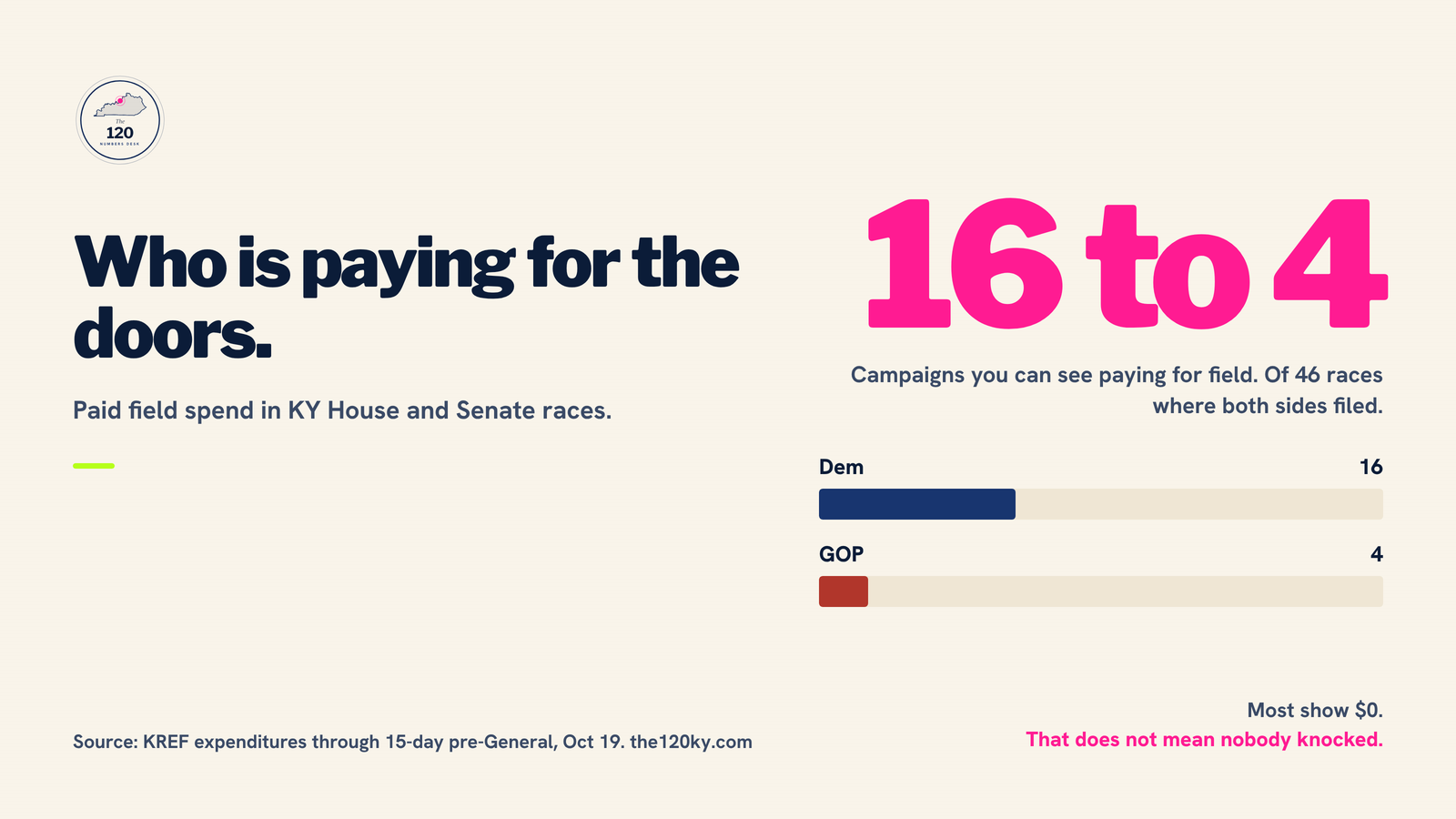
In races where both sides filed spend, Democrats put a higher field share in 16 seats, Republicans in 4. Most campaigns still show zero. Volunteers do not file invoices.
LOUISVILLE — LOUISVILLE. Here's the take I keep hearing on both sides of the aisle: Republicans aren't at the doors like Democrats are. I went to the expenditure lines to see if the receipts say that, or if they're just saying mail is louder.
The comparison that matters is the head-to-head where both candidates filed spend. Non-filers are missing, not zero. In those 46 races, Democrats put a higher share of their reported spend into field in 16, Republicans in 4, and 26 tied. Almost every tie is both sides at 0%. Count dollars instead of share and you get 17 to 5, with 24 even. Same story either way: when someone is paying for doors, it is usually the Democrat.
A mail piece is not a door. Confuse the two and you'll stack a fortune and still miss the porch.
Across every House and Senate general campaign with reports through October 19, Democrats' mean field share is 3.4%. Republicans' is 1.4%. Democrats booked about $73,200 in classified field spend; Republicans about $22,200. The median for both parties is still 0%. Paid ground game is the exception, not the rule.
Now the honest version of that Democratic edge. Volunteers never show up in KREF. A campaign can knock every porch in the district and still file $0 for field. $0 is not proof nobody walked. It is also not proof they did. And the labeled ground language across 2024-2026 purpose lines that say canvass, door knock, walk cards, phone bank, or GOTV is only about $56,000 in the live expenditure table. Deliver Strategies alone shows about $2.63 million in Democratic direct mail on the consultant sheet. Blue Dot Consulting, the biggest shop that publicly sells doors and phones, is about $254,000, and a lot of those invoices still read consulting, call time, and digital.
The clearest paid-field calibration is Senate 6. Christian Furman (D) spent $29,160 on field, 21% of about $137,000 through October 19, mostly Civic Voice Partners lines labeled Campaign Organizing, plus campaign food. Lindsey Tichenor (R) spent $1,985 on field, under 1% of about $233,000, and those lines are a doorknocker dinner, a team lunch, and a gas stop. Same race. Different invoices. Every individual payment for that race is on The 120's Senate 6 money page.
Find your race on The 120's 2026 general money pages and open every individual payment for that seat. Ask whether the campaign paid someone to organize, or paid someone to print. Then remember what the filing can't see: the volunteer with a clipboard who never got a check.
I'll be reading the last week the same way. Not who raised. Who paid for a door.
Disclosure: I work in Kentucky Democratic politics. I'm not paid by, and don't advise, any candidate named above. I read this chamber the same way whether or not it's good news for my side; that's the job. Field and category figures are candidate GENERAL House and Senate expenditure lines from the Kentucky Registry of Election Finance through the 15-day pre-General cutoff (October 19, 2026), classified by purpose and payee. Head-to-head counts use only races where both major-party candidates reported expenditure lines; non-filers are treated as missing, not $0. Labeled ground-purpose totals and consultant payee totals (Deliver Strategies, Blue Dot) are from KREF expenditure rows for 2024-2026. Ballot and Secretary of State spelling: Christian Furman, State Senator, district 6.