
2026 · The electorate
Kentucky has 3.4 million voters on paper. Here's who's actually there.
The Democratic column has lost 16 points of the state since 2010, and most of it never cast a Democratic vote. Who's gone, who's new, why the headline number predicts the least — and what to do about it before the books close October 5.
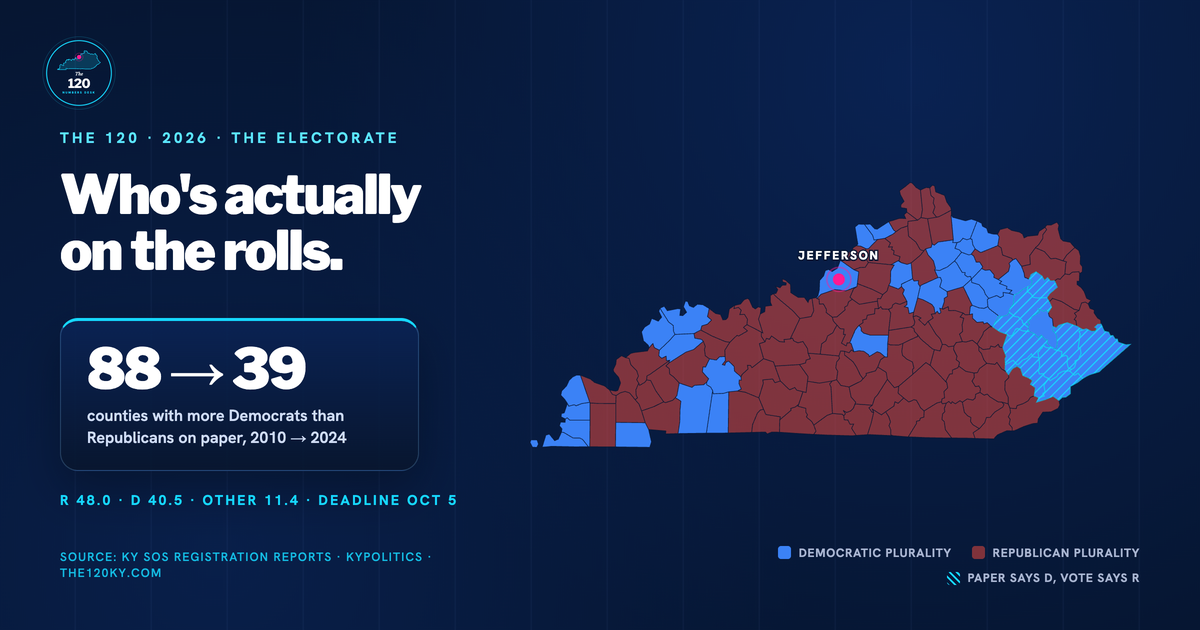
FRANKFORT — Every month the Secretary of State publishes three numbers, and every month most of Kentucky reads the wrong one. The September report, out last week: 1,624,505 registered Republicans, 1,371,014 Democrats, 386,382 registered as something else. Add them and the state has 3,381,901 voters on the rolls — 48.0% Republican, 40.5% Democratic, 11.4% neither.
Sixteen years ago the Democratic column was 56%. I have the county-by-county file for every election since 2010, so here is what actually happened to it, who is gone, who is new, and why the number everyone quotes is the one that predicts the least.
88 → 39
Counties where Democrats outnumber Republicans on the rolls, 2010 to 2024
Statewide, the Republican column passed the Democratic one by the November 2022 election. It hasn't looked back: 44.8 / 45.4 that year, 42.5 / 46.8 by November 2024, 40.5 / 48.0 this month.
Start with what the paper is worth, because it is worth less than you think in both directions.
In November 2023 Democrats were 43.8% of the rolls and Andy Beshear took 52.5% of the vote. Twelve months later Democrats were 42.5% of the rolls and Kamala Harris took 33.9%. Same file, same year, a nine-point miss in each direction. Registration is not a forecast. It's a photograph of who your grandparents voted for, and in a lot of Kentucky it's still hanging on the wall.
Look at where the 39 Democratic-plurality counties are. Jefferson and Fayette, yes — 55.9% and 52.0% Democratic on paper, and Harris carried them with 57.3% and 57.9%. There the paper is fresh and it works. Then the rest of the list: Breathitt County is 78.2% registered Democrat, and Trump took 78.9% of its vote. Wolfe, 74.6% Democrat on paper, Trump 74.2. Knott, 70.9 and 78.8. Elliott, 69.2 and 80.2. Floyd, 66.2 and 78.8. Pike, still Democratic by registration at 51.1%, gave Trump 82.2% — his best county on this list.
A registration card is a photograph of who your grandparents voted for. In the mountains, it's still on the wall.
That is the whole reason the Democratic column is shrinking, and it is the part the cable read will get backwards. It is not mostly people changing their minds. It is the list finally catching up to the electorate.
Here is who is gone. Since January 2020 the Secretary of State has removed 753,181 registrations — 318,918 of them dead. In August alone: 3,233 deceased, 258 moved out of state, 74 duplicates, 65 adjudged incompetent, 18 who asked off, 9 non-citizens, 7 felons. Between the November 2024 report and this one, the rolls shrank by 166,235 — and 137,603 of that came out of the Democratic column. Republicans lost 34,583. "Other" grew by 5,951.
Read that against the county list above. A registration that dies in Breathitt County is, on the odds, a Democratic registration that had been voting Republican for twenty years. Removing it doesn't move a single vote. It makes the paper more honest.
Now turn the knife, because that's not the whole story either. The county association's April read, comparing the same month four years apart: Democrats down 243,524 — 15.1% of the column — while Republicans gained 11,604 and "Other" gained 36,849, in a file that shrank by 194,909 overall. Purges don't add Republicans. Eleven thousand net new Republicans in a file that lost 195,000 people means real switching is happening underneath the cleanup, and the "Other" line is growing faster than either party. Some of the Democratic decline is the dead being counted correctly. Some of it is the living changing their minds. The paper can't tell you the split. The returns can, and 2024 already did.
Who's new is the more useful question, and August answered it. 8,266 new registrations. Net of removals, the file grew by 4,602 — and the growth went 2,493 to "Other," 1,849 Republican, 260 Democratic. Those are net figures, so the Democratic line is carrying the month's removals — but the direction isn't in doubt. More than half the growth went to no party at all. New Kentucky voters are not picking a team, and when they do, it mostly isn't mine.
That has a mechanical consequence most first-time voters don't know they've chosen. Kentucky's primary is closed. The 386,382 people registered as "Other" cannot vote in May for anybody, in either party. They are general-election-only voters by law, and they are now more than one voter in nine. For a campaign, that is the persuasion pool nobody has a party file on — 386,000 people whose only political act is November, sitting next to the Democratic-registered voters who skip primaries and show up in generals, the pool I've called sleepers in every Jefferson County piece on this desk. Between those two groups is most of the movable vote in this state, and neither one is described by the number in the headline.
October 5
The registration deadline for November 3 — twenty-five days from today
Online by 4:00 p.m. local time, by mail postmarked October 5, or at the county clerk by close of business. Absentee requests close October 20. Early in-person voting is October 29, 30, and 31. Election Day polls run 6 a.m. to 6 p.m. local time.
So what's the job in twenty-five days. Not "register Democrats" — the August numbers say that isn't what new registrants mostly do. The job is two lists. First, everyone who moved inside Kentucky since 2024 and is still registered at the old address, because an address change is a registration, and a voter who shows up at the wrong precinct on November 3 is a vote you already earned and then lost. Second, the never-registered — who, on August's evidence, are growing the "Other" column faster than both parties combined, and who will not be in any party's file until somebody knocks on the door and puts them there. Both lists are cheap. Both lists have a hard stop on October 5.
Then the benchmark, since 2026 is a midterm. In 2022, 1,502,626 Kentuckians voted — 41.9% of the 3,590,227 on the rolls that November. Run that rate on this month's smaller, cleaner file and you get about 1.42 million ballots. That is the electorate every campaign in this state should be planning against: not 2024's 2.09 million, not the primary's 864,000. A million four, give or take a wave.
What I'm watching is the October 1 report — the last one before the books close. Two lines. Whether the Democratic column has stopped falling, which would tell me the cleanup is mostly done and what's left is the real number. And whether "Other" clears 390,000, which would tell me the fastest-growing bloc in Kentucky politics is the one that can't vote in a primary and has never been asked to vote in a general.
I read the rolls the same way I read the returns: straight, and then against a door.