Field notes
VoteBuilder has two doors. Most campaigns only open one.
MyVoters is the file. MyCampaign is your people. Seven weeks out, the campaigns that will use October well are the ones running the two against each other now — and the first thing the join turns up is a number nobody wants to see.
LOUISVILLE — Nobody is getting VoteBuilder this week. It's the middle of September; every Democratic campaign in Kentucky that was going to pay the party for it paid in the spring, and the ones that didn't have made their peace with that. So this isn't a piece about getting the login. It's about the campaigns that wrote the check in April, opened it once, saw a search screen with more checkboxes than a tax form, and have been running off a spreadsheet and a vendor list ever since. I have watched that happen for twenty years. The list they bought was pulled from the database they closed.
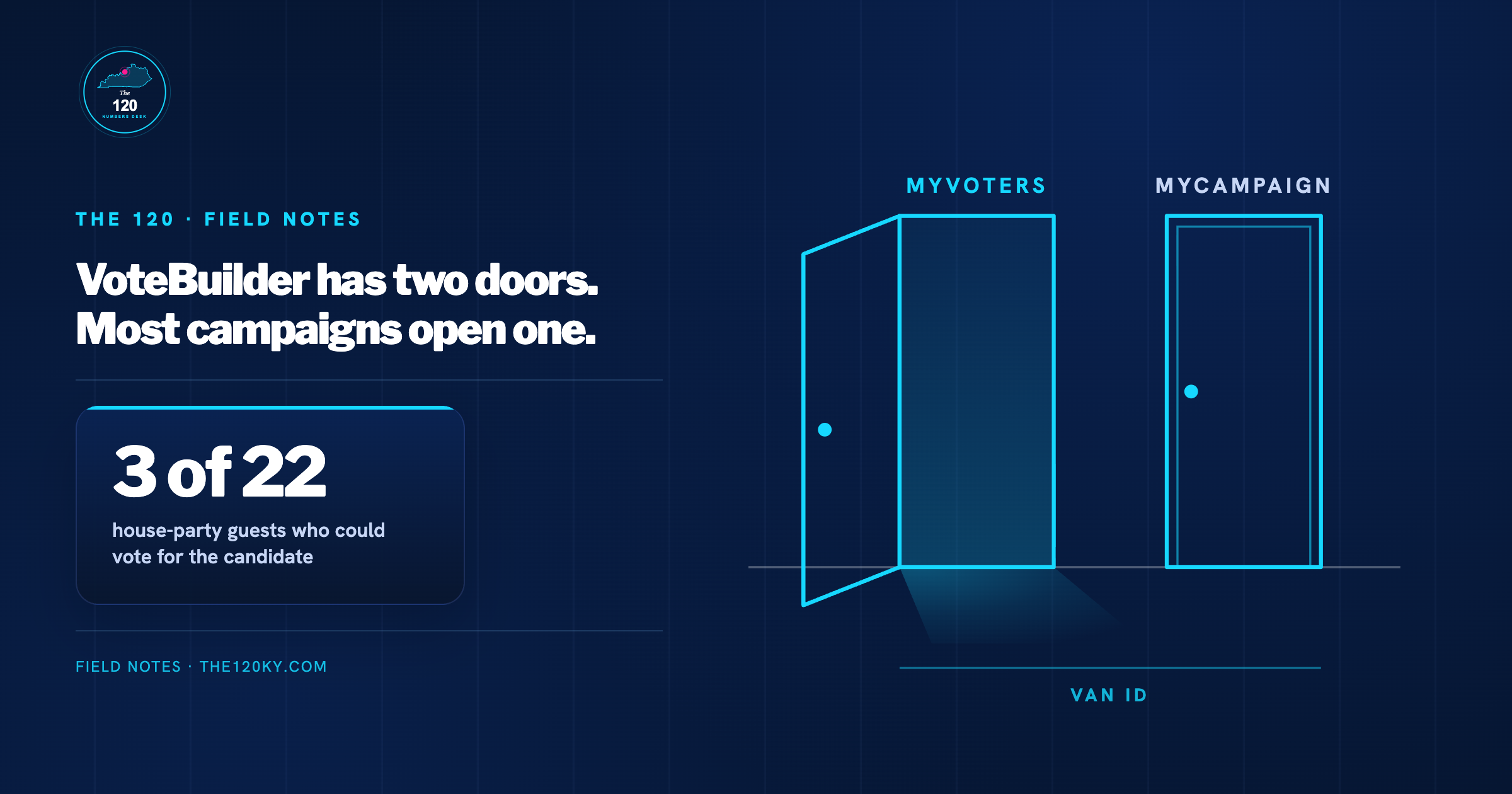
Here's what they closed. VoteBuilder has two doors, and almost every campaign I've walked into has only ever opened one of them.
The first door is MyVoters. That's the file: every registered Kentuckian, their address, their party, their district, and whether they cast a ballot in each election going back a decade or more. The Secretary of State sells the same thing to anyone with a check. What the party's copy adds is the margins — every door a Democrat knocked, every "strong support" or "wrong number" or "moved" that a volunteer recorded, going back cycles, sitting in the same record next to the same voter. The file tells you who exists. The margins tell you what happened the last time somebody talked to them.
The voter file is a phone book. VoteBuilder is a phone book where somebody wrote in the margins for fifteen years. Campaigns pay for the margins and then read the phone book.
The second door is MyCampaign. That's your people, not the state's: the volunteers, the donors, the RSVPs, the sign-up sheet from the fish fry, the woman who said she'd host, the county chair's cousin who runs the church. Most campaigns treat MyCampaign as a Rolodex and MyVoters as a list machine, and never once let the two meet. Which is the whole mistake, because they are the same records. A person in MyCampaign carries the same VAN ID as her record in the file. The software was built to run them against each other. Almost nobody does.
So here's the secret, and I'm giving this one away whole: the join. Three runs, one afternoon, and it will change what your October looks like.
Run one: find out who can't vote for you. Take everyone in MyCampaign — every volunteer, every donor, every event RSVP — and match them to the district in MyVoters. I learned this one standing in a living room. A host in a race I ran invited twenty-two people to a house party for the candidate. Three of them could vote for him. Her entire family and friend circle lived one county over, and because she was driving the invites there was no data trail to catch it until I was looking at a room full of somebody's in-laws from the wrong side of the line. That check takes a minute in the software now. It took me a living room then.
3 of 22
Guests at a house party who could actually vote for the candidate
A real host's invite list, from a race I'm not going to name. Her warmth was real and pointed at the wrong county. Run everyone in MyCampaign against the district before you count a single one of them as a vote.
You don't cut those people. An out-of-district volunteer knocks doors just fine. You stop counting them as votes, you stop mailing them, and you stop letting anybody's friend list stand in for a universe. The campaign drives the bus. The host hosts.
Run two: pull your own people's vote history. Your MyCampaign list is your first GOTV list, and it's the one you'll be most embarrassed by. Every cycle I find a volunteer who gave the campaign forty hours and did not vote in the last midterm, a donor whose spouse is registered inactive, a precinct captain whose own mother is a registered Democrat with no primary history since 2014. Nobody checked, because nobody thinks to run the file on their own side. Run it. The people who already love you are the cheapest votes you will ever turn out, and half of them are sitting in a door you never opened.
Run three: reverse it. Every strong-support ID that comes back from the doors is a MyCampaign record waiting to happen. A strong supporter who has voted in every primary since 2010 and lives in a precinct where you're short a captain is not a voter; she's a captain, a host, a yard sign, a phone-bank shift. Code her. The ID list is the recruitment list nobody reads, and in a state where a legislative race lives or dies on forty volunteers, it's the difference between a campaign that has to keep begging the county party for bodies and one that grew its own.
Now the money, because this is where the join pays for itself. A knocked universe is a poll you paid for in shoe leather, and every ID that comes back is a voter who just told you which budget line she belongs to. The strong supporters come out of the persuasion mail entirely — GOTV pieces in the last two weeks, nothing before, because a persuasion letter to someone who already told you yes is money spent twice to learn nothing. The undecideds and the leans are the persuasion mail universe, and they're also the digital audience, because a list of a few thousand named voters is exactly what the social platforms and the streaming buys are built to match against. The opposed come off every list you pay for. And the not-homes after two attempts are the tier you can no longer afford to walk; they go mail-and-digital-only, which is a decision you can only make because you tried the door first.
A door you knocked and then mailed like a stranger is a door you paid for twice. The whole point of the ID is that the next dollar goes somewhere else.
That is the signature failure of modern campaigns in one paragraph: they gather all this data and then spend the same money they'd have spent without it. Layers are supposed to multiply. They only multiply if each one reads the one before it.
One thing has changed since I first ran the join, and it makes the excuse for skipping it worse. Five years ago the doors came back on paper and sat in a folder until the campaign was over. MiniVAN killed that. A volunteer with the app on her phone syncs the door before she's back in the car, and the paper packet is a relic. So the data is in the database the same night whether anybody planned for it or not. The problem moved: it used to be that the doors never got in. Now the doors get in and nobody runs anything against them.
And here is the case against all of it, because honesty means naming it. A state House race with four volunteers and seven weeks can win without opening either door, if the four of them knock the right ones. That's true. It's also how a campaign finds out in November that they knocked the wrong ones — and that two of the four couldn't vote for the candidate.
Here is the part I'll say halfway, because the rest of it is the job. Once the join is run, the database can tell you which of your supporters skips midterms, which precincts your candidate ran ahead of the top of the ticket, which IDs to weight when the mail budget won't cover the whole undecided list, and which doors have been knocked three times with no answer and should come off everything. The order you do those in, and the weight you put on each, is the difference between a program that moves votes and one that moves volunteers around. I don't give that one away on the internet. If you've been one of my clients, you already have it.
What I'm watching this fall is a simpler tell than any of that: whether the mail universe a Kentucky campaign drops in October is smaller than the one it would have dropped in August. That's the whole test of whether the doors got used. A campaign that knocked five thousand of them and mailed the same list it always mails learned nothing it was willing to pay for. Most years, most of them don't.
Open the second door. Run your people against the file. The database will do the rest, because that's the only thing it was ever built to do.
Disclosure: I work in Kentucky Democratic politics and consult campaigns in this state. The house-party story is from a race I ran years ago, told without names. Nothing else in this piece comes from any client's data or any party committee's file — it's how the tool works, which anyone with a login can see.