
The read · Kentucky House
Twenty seats, five tossups, and 44 the Democrats didn't contest.
Republicans hold 80 seats to 20. But the chamber turns less on the five tossups everyone watches than on the 44 races where no Democrat even filed.
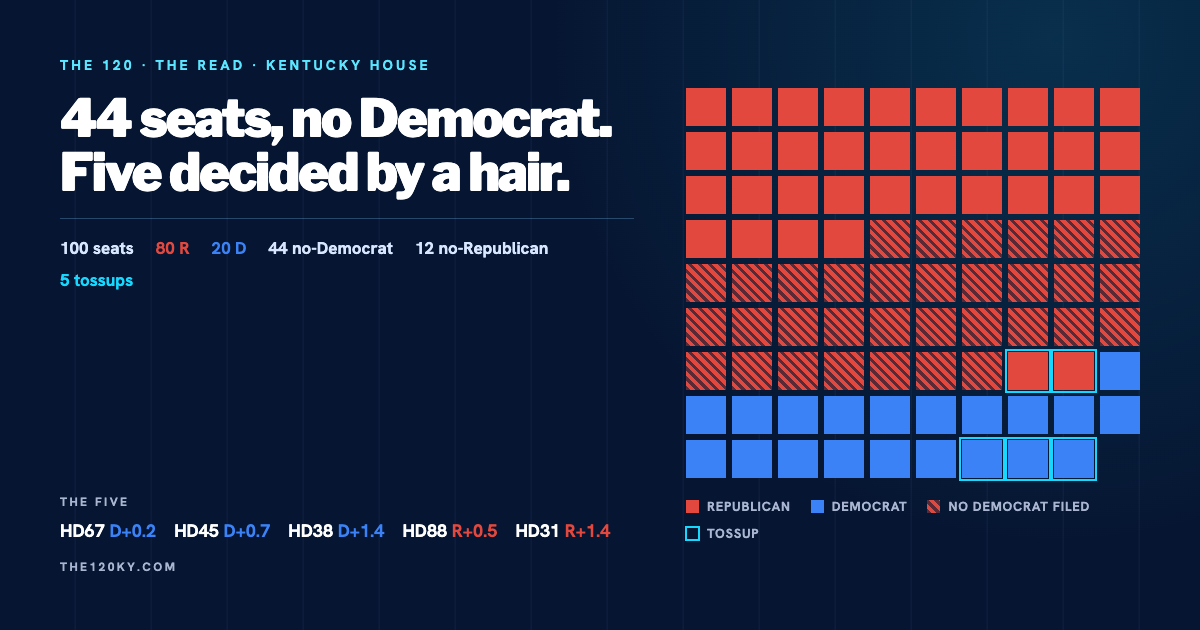
FRANKFORT — FRANKFORT — Everyone repeats the topline: Republicans 80, Democrats 20 — a veto-proof supermajority. It's true, and it hides the two numbers that actually run this chamber.
44 seats, no opponent
Republican wins in 2024 with no Democrat on the ballot
Of 100 State House seats, 44 had no Democrat on the ballot in 2024 — and Republicans won all 44. Another 12 had no Republican. Only 44 races were genuinely two-way, a Democrat against a Republican.
Sit with that before anyone says "winnable." More than half the Republican caucus didn't have to beat a Democrat in 2024 — there wasn't one to beat. The supermajority is not only a story about red Kentucky. It's substantially a story about a party that stopped showing up in half the state. You can't lose a race you contest, and you can't win one you don't.
Now the opposite end of the same chamber — the seats so close they decide which direction the minority moves. Strip out the forfeits and the blowouts and the whole fight for the floor of this chamber comes down to five seats decided by less than a point and a half.
5 seats under 1.5 points
The 2024 tossups — three to defend, two to flip
Democrats hold District 67 (Lehman, +0.2), 45 (Moore, +0.7), and 38 (Roarx, +1.4) by a hair. Republicans hold District 88 (Grossl, +0.5) and 31 (Witten, +1.4) by the same hair. The five span Louisville, Lexington, and Northern Kentucky.
Read those five exactly right or you'll waste the cycle. District 88 is the single best pickup in the state — Cherlynn Stevenson lost it by half a point, 49.7%, in 2024. District 31 is the next one over the line. And the three Democratic-held tossups aren't trophies, they're exposure: lose 67, 45, or 38 and a flip somewhere else only treads water. The honest 2026 goal isn't "even the chamber." It's: defend the three blue coin-flips, take 88 and 31, and net what the climate allows.
Five seats were decided by under a point and a half. Forty-four had no Democrat at all. Those two numbers are the whole Kentucky House — the close fight everyone watches, and the empty half nobody talks about.
So the real 2026 battlefield is small, and it cuts both ways: three Democratic-held coin-flips to defend, two Republican-held ones to take, and a short list of reaches beyond them. Everything else in the chamber is a blowout or a forfeit.
39 → 25 → 20 → 20
Democratic House seats, 2018 / 2020 / 2022 / 2024
Down 19 across two cycles, flat since. And in Kentucky there is no cheaper intermediate target: overriding a veto here takes 51 votes — the same constitutional majority it takes to run the chamber. "Even the chamber" and "stop the overrides" are the same number, netting 31 seats. With five seats truly in play and 44 left uncontested, that's a decade's project, not a cycle's.
Here's the read you won't get on a political show. The competitive seats get fought over every cycle, and the math on them is incremental — five tossups, a few reaches, a net of a seat or two in a normal year. The chamber doesn't actually turn on those. It turns on the 44. Not all of them are winnable — plenty are 75–25 districts where a Democrat loses no matter what, and pretending otherwise is how you waste money. But a real share could be put in play in a wave year by a credible local candidate — and there's no one there to catch a wave, because nobody recruited one three years early. The supermajority looks permanent partly because it's measured against an empty Democratic bench.
And here's the part for the people who actually live in these districts, because that's who decides it. None of this gets fixed from Frankfort or a consultant's spreadsheet. The five tossups get won by local people in local races — the precinct captain who knows her neighbors, the county party that stands up a credible name. The 44 forfeits get contested the same way, three years before they're winnable. Find your district. If you're in or next to one of the five, that's the most valuable political ground in Kentucky. If you're in one of the 44, the job isn't to win in 2026 — it's to make sure there's a name on the ballot so the seat is never free again.
I read the numbers straight, even when twenty is the number — and the straight read is that twenty is partly a number Democrats handed themselves. Find your district, and the first question isn't "can we win it." It's "are we even on the ballot."