
Primary recap
Turnout didn't just run low. It ran late.
Four in five Jefferson voters waited for Election Day. That doesn't just describe the primary — it hands the fall back to the oldest program in the book: get-out-the-vote weekend, the good old definition.
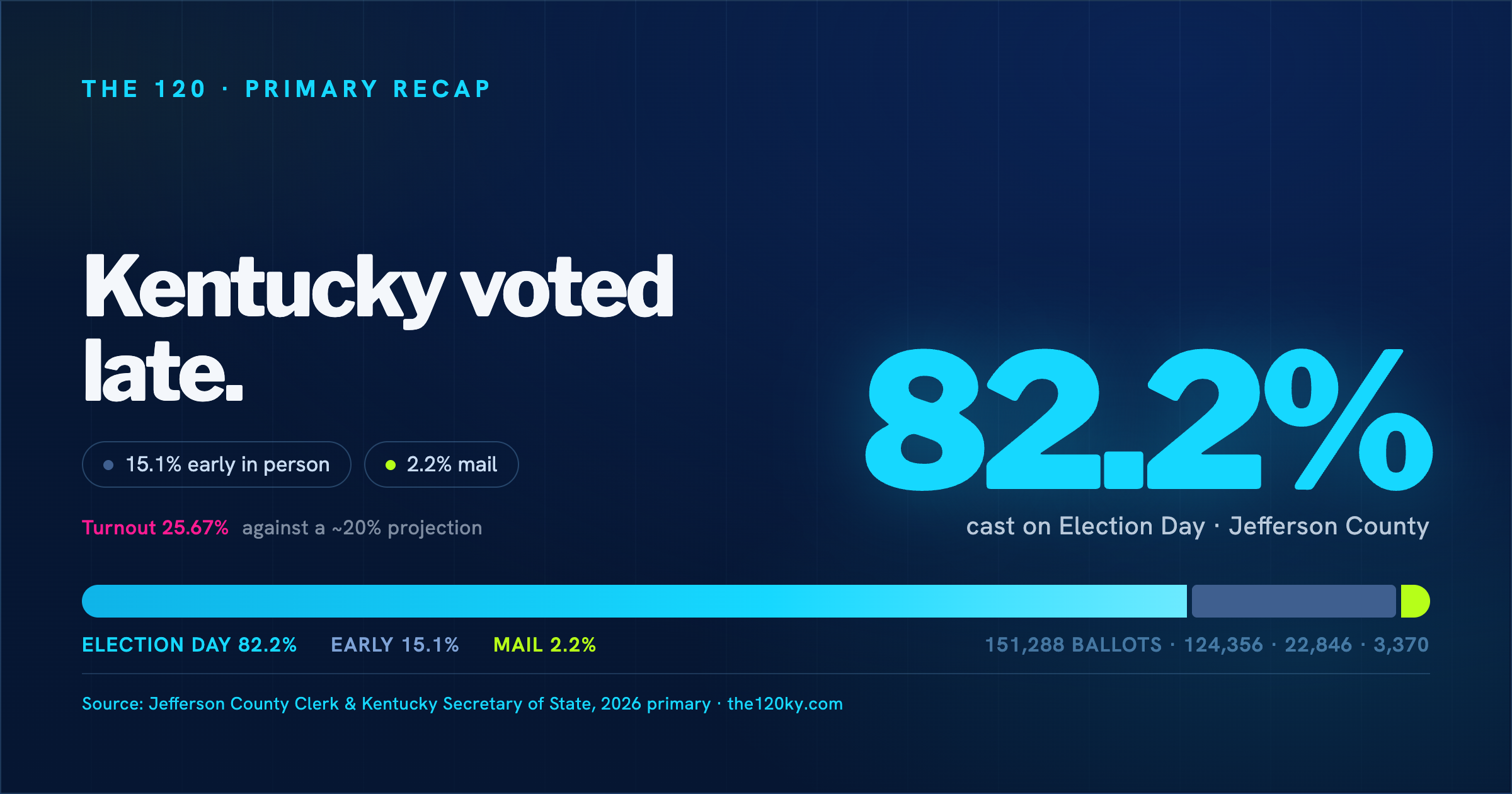
LOUISVILLE — LOUISVILLE — Kentucky's May primary is in the books, and the number everyone reached for was turnout: 25.67% statewide, against a Secretary of State projection of about 20%. So the story got written as low, but not as low as feared.
That's the wrong number to lead with. What decides a Kentucky race isn't how many people vote. It's when.
82.2% · 15.1% · 2.2%
Election Day · early in-person · mail — how Jefferson's 151,288 primary ballots arrived
Early in-person voting was open for three days. More than four in five voters walked past it and waited for the one day.
In Jefferson County, 151,288 people cast a primary ballot, and 124,356 of them — 82.2% — waited for Election Day itself. Early in-person, open for three days, drew 22,846, or 15.1%. Mail drew 3,370. That is 2.2%. Statewide the shape held: 78.6% of the Kentuckians who voted did it on the one day, by the Secretary of State's reported figures.
For a decade the trend ran the other way, and it rewired how a campaign spends a fall. Early voting stretched the calendar, so the smart money built three-week programs to match — bank the reliable supporters the day early voting opened, then spend the closing stretch chasing the rest. The vote came in over weeks, so the field program ran over weeks. This electorate ran that tape backward. The early window sat open, and four in five Jefferson voters walked right past it to Tuesday.
That hands Kentucky back the oldest field program there is. GOTV weekend — the get-out-the-vote sprint from the final Saturday through the close of polls, the job of dragging every identified supporter to a booth — spent the last decade demoted to the finale of a much longer chase. When 82% of the vote is still sitting in voters' hands on Monday night, that weekend is not the finale of the program. It is the program.
You can't bank a vote that won't be cast until Tuesday. In Kentucky, GOTV weekend is a weekend again.
That reorders where a dollar goes. A budget poured into chasing a 15% early slice is aimed at the smallest door in the room while the other 82% comes down to one Tuesday. The vote is late, so the resources are late — the final weekend and the day itself, not the mail piece that landed in October.
And here is the part a Democrat should not file away as good news, because it is not a partisan edge.
80.3% · 86.0%
Jefferson Democrats · Republicans who cast their ballot on Election Day
By the County Clerk's official breakdown. Both parties ran late — but Republicans ran later, and the side that runs the closing weekend better is the side that banks the late vote.
Both sides ran late; the Republican vote ran latest, 86.0% on Election Day against 80.3% for Democrats. So "the weekend is a weekend again" is not an insight to file under good news for one side. It is a warning to whoever brings the weaker closing operation to that weekend.
What I am watching into November is whether the general reverts. Presidential-year voters carry deeper early-and-mail habits, and if the fall snaps back to a bigger early share, this is a midterm-primary artifact, not a trend. If it does not — if Kentucky keeps voting on the day — then every plan built for a three-week bank is built for the wrong election, and the campaigns that win are the ones that treat the final weekend like the whole ballgame, because it is.
Here's the part I'll only say halfway. Knowing the vote runs late is the easy half. The hard half is building a closing weekend that banks it — which doors in which order, who gets a knock and who gets a ride, how you layer the final seventy-two hours so the program peaks on Tuesday instead of burning out on Saturday. That sequencing is the part I don't give away on the internet. Reach out — or, if you've run a program with me, you already have it.
Turnout didn't just run low this spring. It ran late — and a vote that waits for Tuesday is a vote you win on the final weekend or you don't win at all. I'll be reading the fall for whether Kentucky votes early again, or whether the weekend is the whole ballgame now.