
Field notes
"Can we just do postcards?" is a better question than you think.
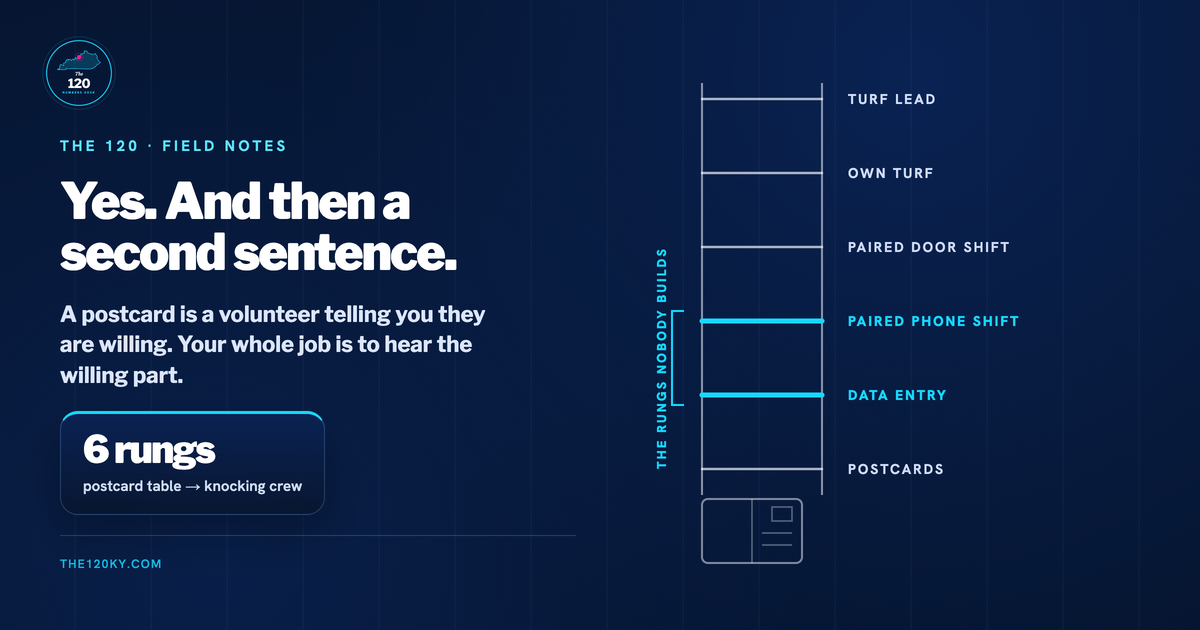
It's the question every campaign gets in September, and most of them answer it wrong in one of two directions. Here's the ladder that turns a postcard table into a knocking crew — and the one rung almost nobody builds.
LOUISVILLE — It is the last week of August, which means somewhere in Kentucky a volunteer just asked a campaign manager whether the group could maybe just do postcards instead. And somewhere in Kentucky a campaign manager just answered that question badly.
There are two bad answers. The first is no, which costs you the volunteer. The second is yes, full stop, which costs you everything the volunteer might have become. I have watched both for twenty years and I am not sure which one wastes more.
A postcard is a volunteer telling you they are willing. Your whole job is to hear the willing part.
Start with why the question gets asked, because campaigns tend to hear it as laziness and it is almost never laziness. Postcards are the only volunteer job in politics with no strangers in it. You sit at your own table, at your own hour, with your own handwriting, and nobody looks at you funny. Doors and phones both require the one thing most people are genuinely afraid of, which is an unscripted conversation with someone who did not ask to be interrupted. The postcard question is not "how little can I do." It is "give me the version of this that I am not scared of." Those are completely different questions and only one of them deserves a no.
So the answer is yes. And then the answer is a second sentence, and the second sentence is the whole ballgame.
The ladder, rung by rung. Postcards. Then data entry — turning walk-sheet scrawl into clean records, which is quiet, indoor, and teaches a volunteer what the file actually is. Then a phone shift paired with an experienced caller, on your best list, calling supporters about the location of their polling place rather than persuading a stranger. Then a door shift, paired, on friendly turf. Then their own turf. Then, if you are lucky and paying attention, a turf lead who runs four other people and texts you on a Saturday morning asking for more packets.
Every campaign I have ever walked into has rung one. Most have rung four. Almost nobody builds rungs two and three, and rungs two and three are the entire ladder. The gap between "I write postcards" and "I knock doors" is not a gap of willingness. It is a gap of two evenings and one person willing to sit next to you the first time.
Three things make the ladder work, and they are all small.
Pair everyone on their first shift of anything. Not a training video. A person, in the passenger seat or the next chair, who does the first three and then hands it over. The dropout happens in the first twenty minutes or it does not happen.
Make the first shift short and the first list easy. Ninety minutes, supporters only, a script with an actual purpose that is not persuasion. A volunteer whose first door is a hostile one does not come back, and you have not just lost a shift, you have lost every shift they were going to work in October.
Tell them what happened. The single most common reason volunteers stop coming is that nobody ever told them their work mattered — not in the thank-you-email sense, in the "your turf came back 61% supportive and here is what we are doing with that" sense. This is where postcards fail on their own terms, by the way, and it is the honest case against them: a postcard produces no conversation, no answer, and no record. It cannot feed the file, so it cannot ever come back to the volunteer as a result. Doors and phones generate data. Data generates feedback. Feedback generates the next shift.
Now the honest other direction, because I said there were two bad answers and I have spent most of this piece on the first one.
Postcards are not worthless. They are a low-cost, low-risk on-ramp, they give a large and genuinely enthusiastic group of people something real to do, and a campaign that sneers at them ends up with a very pure and very small volunteer list. The mistake is not running a postcard program. The mistake is running one that goes nowhere — a table that exists in perpetuity, staffed by the same nine people in October who were there in June, none of whom has ever been asked to do anything else. That is not a volunteer program. That is a craft night with a logo.
And I will say the harder thing too: if it is late October and you are still recruiting people onto rung one, the ladder is not going to help you. There is no time left to climb it. That is an argument for building this in the spring, which is the same argument I make about everything, and it is the same argument because it is the same problem.
What I am watching over the next three weeks, which is exactly when the fall volunteer push either happens or doesn''t: which Kentucky campaigns answer the postcard question with a second sentence. You can hear it in how they run their first September volunteer meeting. The ones who say "yes, and here is what is after that" will have knockers in October. The ones who just say yes will have postcards.