The read · The electorate
Ten days until the books close. Here's what moved.
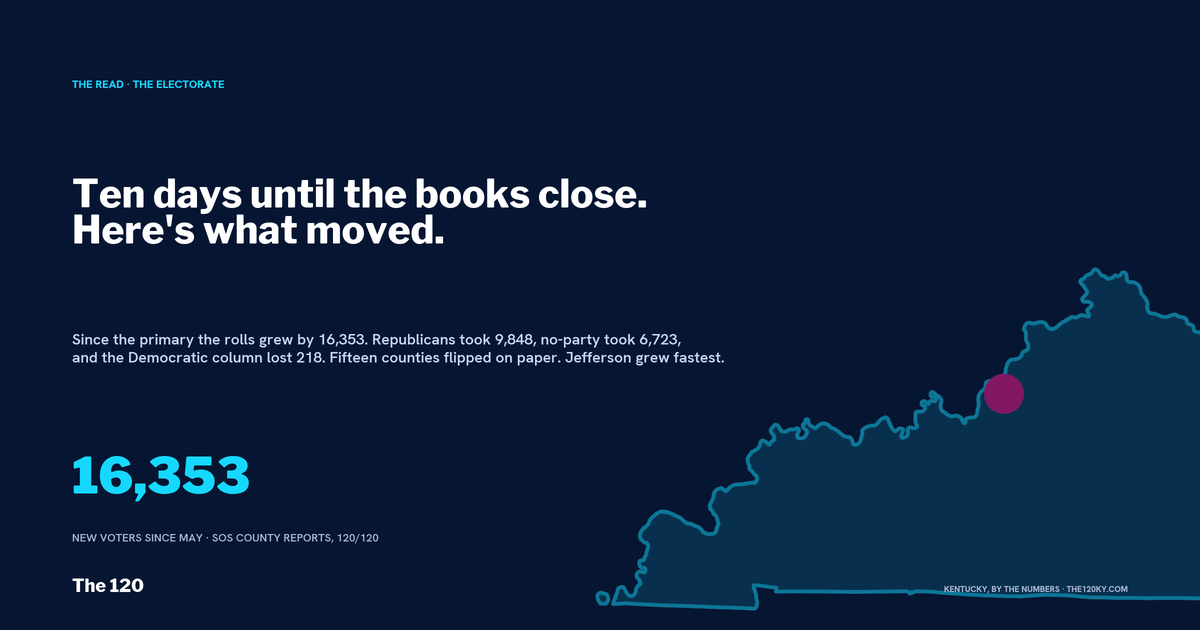
Registration for November ends October 5. Since the primary the rolls grew by 16,353 — and the Democratic column didn't get a single one of them. Fifteen counties have flipped to Republican on paper since 2024, including Pike and Woodford. The map of where the new voters actually landed says something else.
LOUISVILLE — Kentucky's voter rolls close for the November election on Monday, October 5 — ten days from the day this posts. Postmarked by the fifth, or in a clerk's office by four o'clock. After that the electorate is whoever is on the list, and every campaign in the state stops persuading people to register and starts persuading the people who did.
So this is the last useful read of the registration file before it freezes. I have the county-by-county reports for the May primary and for August, the one the Secretary of State released this month, and I've put them next to the November 2024 file. Three things moved. One of them is the headline everyone will write. The other two are the ones that matter for October.
First, the headline. Since the May primary the rolls grew by 16,353 voters, to 3,381,901. Republicans took 9,848 of the gain. The no-party and minor-party column took 6,723. The Democratic column, statewide, lost 218. In a stretch when the state added sixteen thousand names, the Democratic Party did not net one of them.
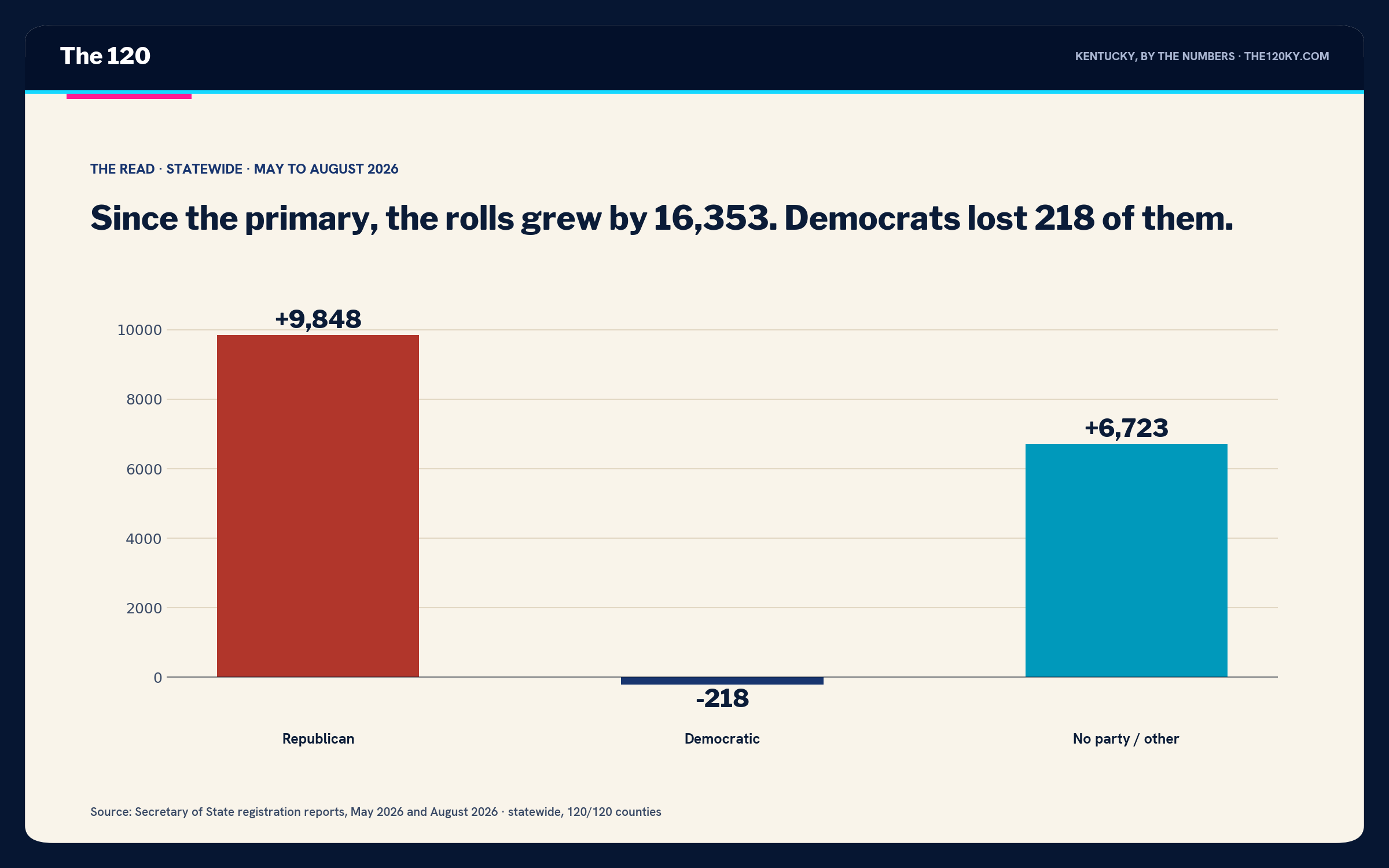
That number is the honest one and I'm not going to soften it. It's also the least surprising thing in the file, because it is the same story I wrote two weeks ago, still running: the Democratic column is full of people who stopped voting Democratic a decade ago, and the clerks are slowly catching the list up to the electorate. Since November 2024 the state has removed 166,235 names and 137,603 of them were Democrats. That's not a wave. It's a filing cabinet.
Here is what the catch-up looks like on a map, and this is the part that will get quoted.
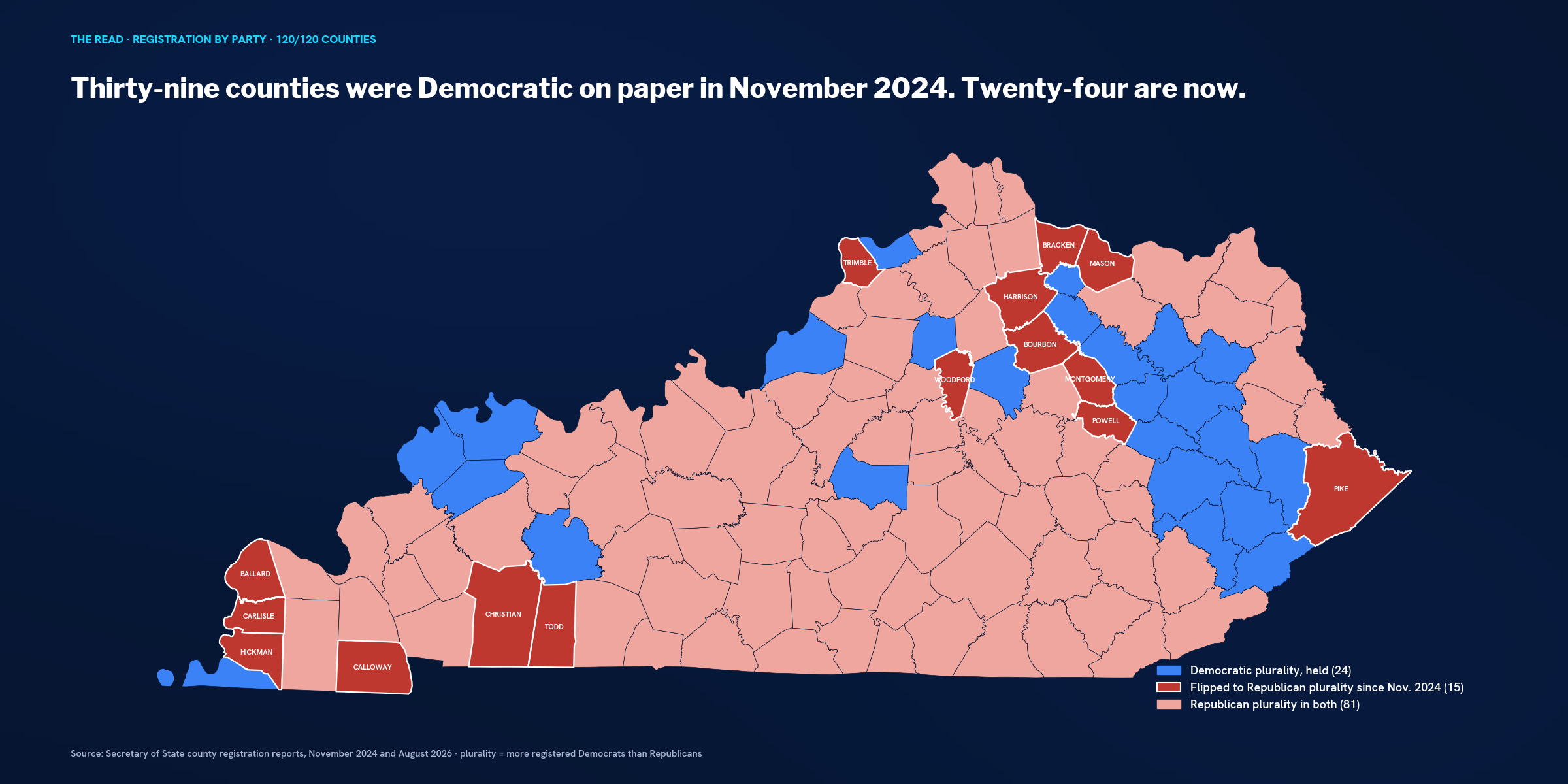
In November 2024, thirty-nine Kentucky counties had more registered Democrats than Republicans. This month it's twenty-four. Fifteen counties crossed the line: Pike, Christian, Woodford, Bourbon, Montgomery, Calloway, Mason, Harrison, Powell, Todd, Ballard, Carlisle, Hickman, Bracken, Trimble. Pike County, the biggest Democratic registration in eastern Kentucky for my entire career, is now 19,238 Democrats to 19,514 Republicans. Woodford — Versailles, the horse farms, the county that gave Beshear 59% — is 9,622 to 9,791.
Read those two the way I read Breathitt two weeks ago. Pike gave Trump 82% and Booker 26%; the registration flipping is the paper finally saying what the ballots have said since 2016. Nothing changed in Pike County this year except the label. Woodford is a different animal: it went Beshear 59, Trump 56 in consecutive years, its registered Democrats out-voted its Republicans in 2022 and again in 2023, and the flip there is a hundred and seventy names. That's a county where the Democratic column is real and just got outgrown, and it's the kind of county where a registration drive in the last ten days actually shows up in November.
A county flipping on paper tells you one of two things: the voters left a long time ago, or the party just got outgrown. Pike is the first. Woodford is the second. Only one of them is a problem you can fix by October 5.
Second, the thing that matters more: where the sixteen thousand went. Ninety-two of 120 counties grew since May. But the growth wasn't spread out.
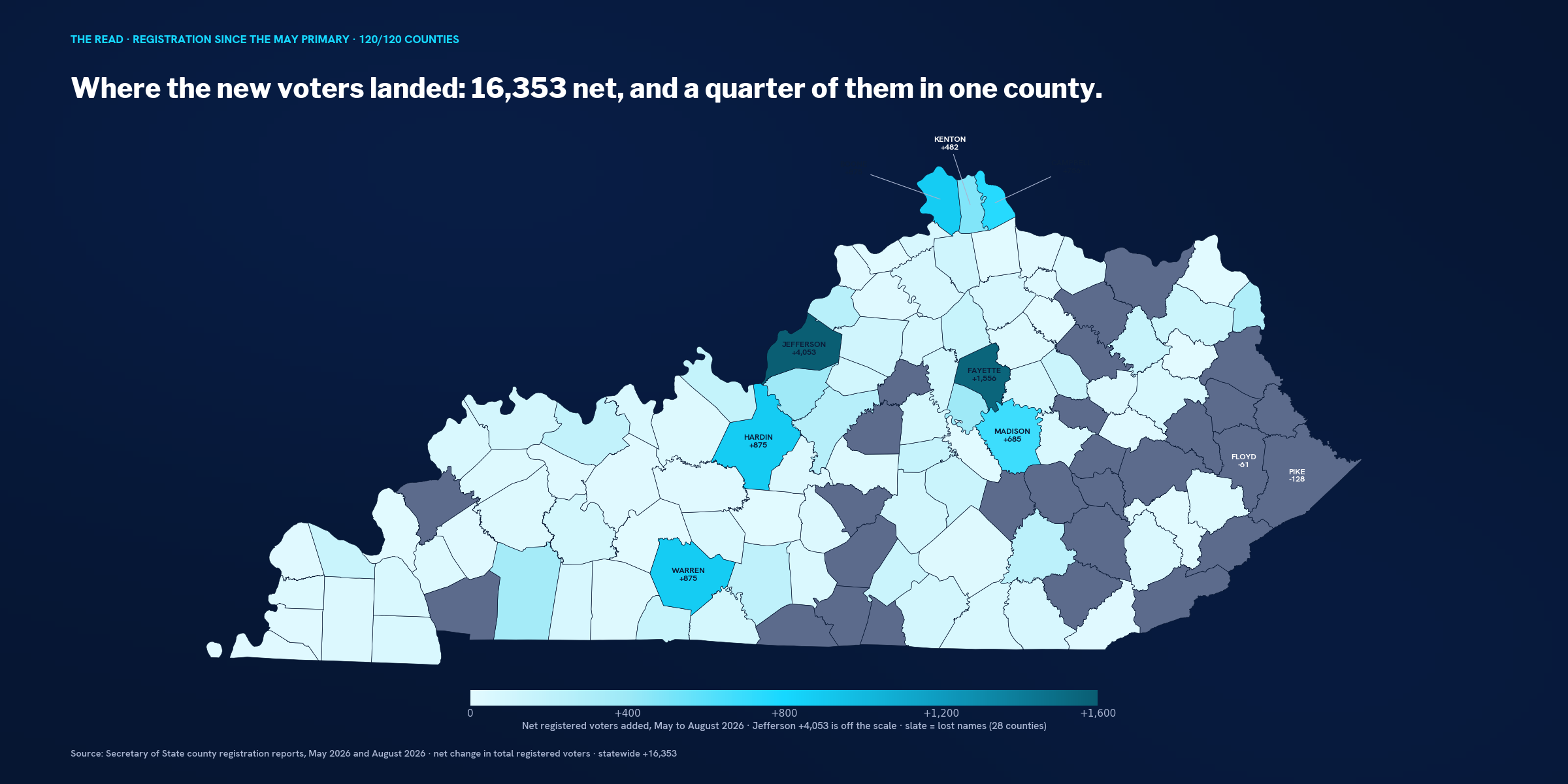
Jefferson County added 4,053 voters since the primary, a quarter of the statewide net. Fayette added 1,556. Boone, Hardin, and Warren added 875 apiece; Campbell 756; Madison 685; Kenton 482. Eight counties, all of them cities or the suburbs of cities, are 10,157 of the 16,353 — sixty-two percent of the growth in seven percent of the counties. Pike lost 128. Floyd lost 61.
Now look at the party split inside that growth, because it is not the statewide split. In Jefferson the new voters were 1,986 Democrats, 539 Republicans, 1,528 with no party. In Fayette, 925 Democrats to 84 Republicans. In Campbell and Boone the Democratic column grew too — 253 and 230 — about even with the Republican column. The Democratic Party's statewide net of minus 218 is two different numbers added together: real growth in the cities and the inner suburbs, and the filing-cabinet losses everywhere else.
Which brings me back to the number I'd carry into the last ten days. Statewide, the no-party column is now 386,382 voters — 11.4% of the file, up from 10.7% two years ago, and it grew in 113 of 120 counties since May. Those people could not vote in the primary. Every one of them can vote in November. In Jefferson County they were the second-largest share of the new registrations. A campaign that is only reading the D and R columns is not reading a ninth of its electorate.
Third, the honest planning number. The primary drew 863,999 ballots, by the Secretary of State's certified count, on a file of 3.37 million. The last midterm general, in 2022, drew 1,502,626 on a file of 3.59 million — 41.9%. The rolls are smaller and cleaner now than they were then, which means the same turnout rate produces fewer ballots and a higher percentage. My planning number for November hasn't moved since the rolls piece: about 1.42 million ballots — that's the 2022 rate on this year's file — and it runs up toward 1.6 million only if the year turns out 2018-shaped. Anyone using 2.09 million — the 2024 presidential figure — as a baseline is planning a different election.
And the honest version, pointed the usual direction. A registration number is a photograph, not a forecast. Fifteen counties flipping on paper doesn't move a single vote that wasn't already moving; the state was going to vote the way it votes with or without the relabeling. The only registrations that change a November result are the ones that didn't exist in May — the 16,353 — and the only ones a Democrat can do anything about in the next ten days are the ones in Jefferson, Fayette, and the collar counties where the Democratic column is still growing. That's a narrow lane. It's also the one that decides the 340-vote House seats.
So here's the job, if you're running something. The deadline is October 5. Online at govoteky.com, postmarked, or in the clerk's office by four. The absentee portal closes October 20. Excused in-person voting runs October 22 through 28; no-excuse early voting is October 29, 30, and 31; election day is November 3. Between now and the fifth, every voter-contact program in a Democratic-growing county should be carrying a registration form, and every one in a Pike-shaped county should stop pretending the column is a universe.
What I'm watching: the October file, when the clerks post it. If Jefferson's no-party column grows faster than either party's again, the general electorate in Louisville is going to look less like the primary than any year I've watched. I'll have the map the week it drops.
Ten days. The paper freezes on the fifth. The math doesn't.
Disclosure: I work in Kentucky Democratic politics and consult campaigns in this state. I read this file the same way whether or not it's good news for my side — that's the job. Registration figures are the Secretary of State's county reports for November 2024, May 2026 and August 2026, all 120 counties; "no party / other" is total registration less the two major-party columns.