2026 · U.S. House
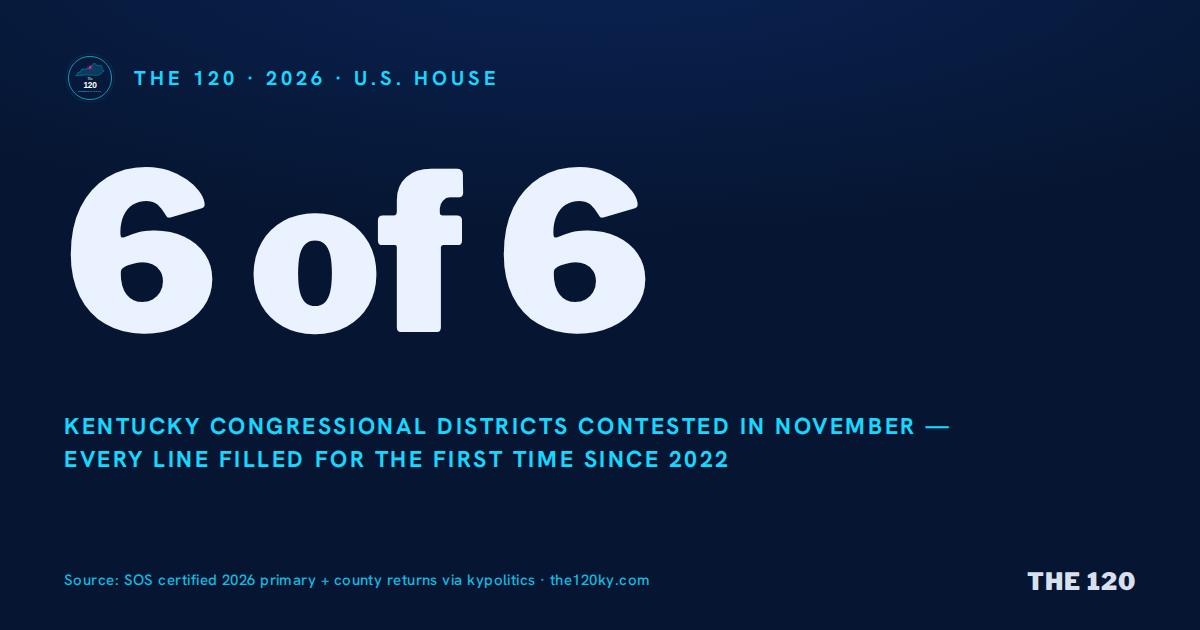
Six districts. Every line filled. Two real fights.
For the first time since 2022, every Kentucky congressional ballot has a Democrat on it. Here's the math on all six — including the seat Republicans spent $32 million taking away from their own incumbent.
LOUISVILLE — Start with the thing that did not happen last cycle. In 2024, Kentucky's 4th Congressional District had no Democrat on the ballot at all, and the 5th was a walkover — Hal Rogers, unopposed, 261,407 votes. Two of six districts, forfeited before a single door got knocked.
In 2026, all six lines are filled. That is not a prediction of anything. It is a precondition for everything.
An uncontested seat isn't a loss on the scoreboard. It's a forfeit — and Kentucky Democrats forfeited two of six last cycle. Not this year.
Here is the November map, district by district, with the honest benchmark next to each name. 2026 is a midterm, so the fair comparison is 2022 — the last midterm — not the presidential year you just lived through. I'll show both.
The 1st: James Comer (R, incumbent) vs. John "Drew" Williams (D). Comer won 2022 by 49.8 points and 2024 by 49.4. The most Republican terrain in the state outside the 5th. The job here is showing up and building — nobody serious says otherwise.
The 2nd: Brett Guthrie (R, incumbent) vs. Megan Wingfield (D). Guthrie: +43.8 in 2022, +46.2 in 2024. Wingfield won her primary with 16,330 votes over a four-way field. Same read as the 1st, with more suburban edge to work.
The 3rd: Morgan McGarvey (D, incumbent) vs. Maria Rodriguez (R). The one blue island. McGarvey has now posted 62.0% twice in a row — 2022 and 2024, identical to the decimal. That is what a settled seat looks like.
The 4th: Ed Gallrein (R) vs. Melissa Strange (D). This is the wild card, and it deserves its own section. Thomas Massie represented this district for thirteen years and won his last contested general by 34 points. Then his own party spent north of $32 million — the most expensive U.S. House primary in American history — to take the seat away from him. Gallrein beat Massie 54.9 to 45.1, a 10,283-vote margin. So the November ballot carries no incumbent, a nominee who just spent a year in a knife fight with his own base, and the first Democrat on a 4th District general ballot since 2022.
Here's the part the spending story misses, and I'll say it as someone who first worked this district in 2010: the 4th is the most expensive place in Kentucky to talk to your own voters. Its 21 counties split across four television markets — Cincinnati, Louisville, Lexington, and Huntington–Ashland — and the biggest of them, Cincinnati, sells you an audience that mostly lives in Ohio and Indiana. A television dollar spent covering this district pays largely to reach people who cannot vote in it. That arithmetic is part of how a House primary reached $32 million, and it is exactly what makes the unfashionable alternative interesting: a knock never bleeds across a state line.
So run the doors math honestly. The district holds roughly 620,000 registered voters, about 222,000 of them registered Democrats — and here is the number the conventional map misses: Boone, Kenton, and Campbell, the three counties everyone pictures when they picture the 4th, hold only about 52% of those Democrats. Nearly half the party's registered voters live in the other eighteen counties, from Oldham and Shelby up the river to Greenup, where a Democratic field program hasn't knocked in years. Call it roughly 145,000 Democratic households; at a blended 14 doors an hour — 18 in the NKY suburbs, 10 on the river roads — one full pass runs about 10,000 volunteer-hours. No single campaign staffs that. Twenty-one county committees plus a nominee's operation, holding a combined 600 steady hours a week, cover it in a season. The caveat cuts hard, as it should: the 2022 midterm margin here was 87,564 votes, and registration is not performance — Carroll County registers majority-Democratic and votes Republican by wide margins, and it is not alone on the river. Doors do not close a 34-point gap in one cycle. What they do, in a district where television money burns off across two state lines, is buy the cheapest votes available — and leave something standing for the next cycle that a media buy never does.
The terrain is still R+34 by the midterm benchmark. But a primary that expensive leaves marks, and I'll be reading the returns for them.
The 5th: Hal Rogers (R, incumbent) vs. Ned Pillersdorf (D). Rogers won 2022 by 64.4 points and 2024 without an opponent. He has held this seat since 1981. The math here is the steepest in the state.
The 6th: Ralph Alvarado (R) vs. Zach Dembo (D). The open seat, and the real fight. Andy Barr left it to run for Senate; I mapped the county math in June and the headline still holds — the gap to make up is about 26 points on the 2024 result, 29 on the midterm benchmark. Alvarado took the Republican primary by 19,320 votes over Ryan Dotson. Dembo won the Democratic side by 5,546 over Cherlynn Stevenson. An open seat, a midterm, and the strongest Democratic county infrastructure outside Louisville sitting in Fayette. It is still uphill. It is also the only district where the hill has a top you can see.
6 of 6 · $32M · +26
Contested districts in 2026 · what the GOP spent unseating its own CD4 incumbent · the CD6 gap on the 2024 result
Benchmarks: 2022 general (midterm) and 2024 general (presidential), county-certified results via kypolitics. 2026 lineups per the Secretary of State's certified primary results.
The honest ledger, both directions: four of these six districts sit 40-plus points away by the midterm benchmark, and filling a ballot line does not move a single vote by itself. What it does is make the other five layers possible — a name to organize around, a line to fund, a reason to knock. A party that contests everything loses most of it and builds anyway. A party that forfeits builds nothing.
What I'm watching between now and November: whether the 4th's $32 million primary shows up as a unity problem in the fall returns, and whether the 6th's two nominees run it like the single-digit race the spending says they both think it is.
I'll keep reading it straight — all six districts, every county, all the way to November.