
The read · Kentucky Senate
Thirty to seven. The Senate math, and the ten seats nobody contested.
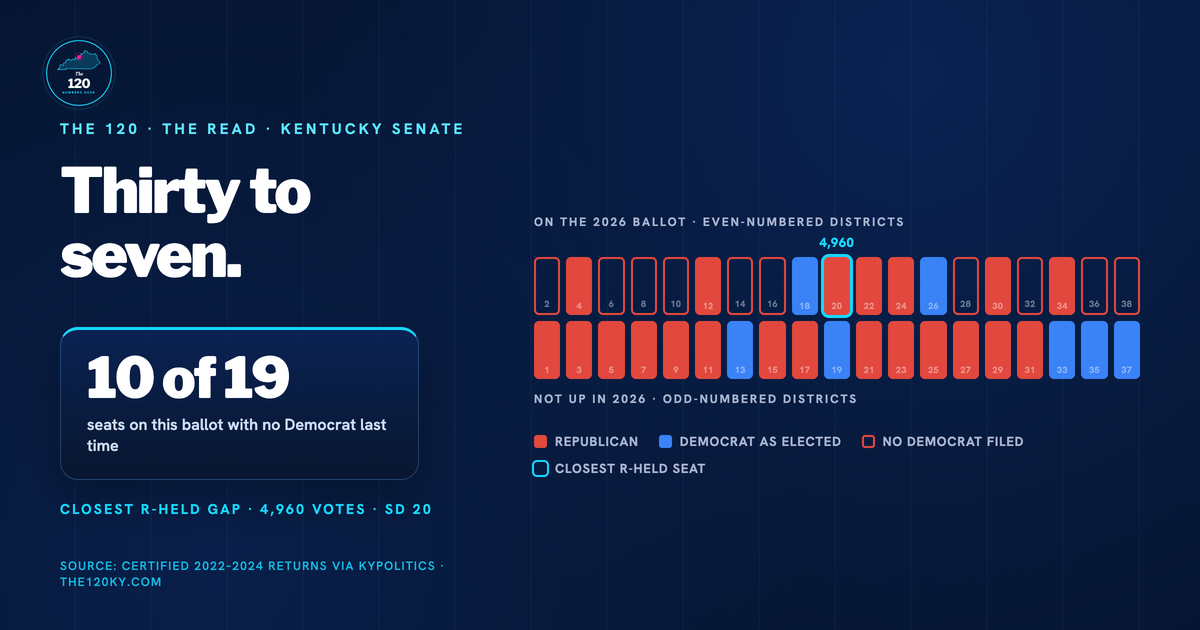
Kentucky's Senate is 30 Republicans to 7 Democrats. No turnout year fixes that. But nineteen seats are on the ballot in November, ten of them drew no Democrat at all last time, and three of those ten finally have one.
LOUISVILLE — Three weeks ago I ran the honest math on the Kentucky House. A reader wrote to ask the obvious follow-up: what about the Senate? Here it is, and I''ll give you the verdict before the arithmetic, because the arithmetic takes a while and the verdict does not.
As elected across the last two cycles, the Kentucky Senate is 30 Republicans, 7 Democrats, and one independent. Democrats are not winning that chamber in 2026. They are not winning it in 2028. Anyone who tells you otherwise is selling something, and I would like to know what.
A caucus of seven is not a majority problem. It''s a recruitment problem wearing a majority problem''s clothes.
So let''s ask the question that actually has a useful answer. Nineteen of the thirty-eight seats are on the ballot this November — the even-numbered districts, the same set that ran in 2022. That means the 2022 returns are not a rough guide to this year''s terrain. They are the terrain, four years older.
Here is what happened the last time these nineteen seats were contested.
Democrats did not field a candidate in ten of them. Districts 2, 8, 10, 14, 16, 32, 36 and 38 went to a Republican with no opponent on the ballot at all. Two more — the 6th and the 28th — drew only an unaffiliated candidate, which is the same thing wearing a different hat. Ten of nineteen. Better than half the seats up this year were conceded before a single vote was counted.
Democrats won two of the nineteen: Robin Webb in the 18th, unopposed, and Karen Berg in the 26th, who beat a Republican 60.5 to 39.5.
10 of 19 · 4,960 · 30–7
Seats on this year''s ballot with no Democrat in 2022 · the closest Republican-held margin · the chamber as elected
Certified 2022 and 2024 general returns via kypolitics. The Senate runs four-year terms on a stagger; the even-numbered districts on the ballot this November are the same nineteen that ran in 2022.
Now the part a campaign can use. Of the seven Republican seats Democrats did contest in 2022, five finished inside about ten thousand votes:
The 20th — Gex Williams 22,166, Teresa Barton 17,206. A gap of 4,960 votes, the closest Republican-held Senate seat on this year''s ballot. The 22nd — Douglas 23,486, Eddy 15,843. Gap 7,643. The 34th — Carpenter 25,049, Cintra 17,322. Gap 7,727. The 12th — Bledsoe 29,181, O''Brien 19,046. Gap 10,135. The 24th — Frommeyer 27,346, Heinrich 16,960. Gap 10,386.
Five seats, none of them a blowout, all of them on the ballot again in eleven weeks. That is a target list. It is not a majority, and I am not going to pretend a 4,960-vote gap in a midterm is a coin flip. It is a real number that a real program could move, which is more than can be said for the ten seats where nobody ran.
And now I have to turn the knife on my own side of the ledger, because the honest version of this story is not one-directional.
Democrats hold seven Senate seats. Five of those seven were won with no Republican on the ballot. In the 2024 half of the chamber, Democrats won five seats — and four of them, the 13th, the 19th, the 33rd and the 35th, drew no Republican opponent. Exactly one Democratic senator elected in 2024 beat an actual Republican: David Yates in the 37th, 60.4 to 39.6. Add Robin Webb''s unopposed win in 2022 and the picture is clear enough. Both parties are conceding seats they have decided not to want. The Republicans can afford it. A caucus of seven cannot.
Which brings me to the only genuinely new thing in this piece, and it is good news, so I want to be careful with it.
Three of the ten seats that drew no Democrat in 2022 — the 6th, the 14th, and the 36th — have a Democratic nominee this year. All three came through a contested May primary, so these are not paper filings; somebody ran, somebody spent, somebody won. The 14th is the most interesting of the three: nine Republicans filed for that primary, which is what an open seat looks like from the outside.
I want to be honest about the size of that. Three recruited candidates in seats that were blank four years ago does not move the chamber. It moves the floor. The difference between a party that contests nine of nineteen and one that contests twelve is not a Senate majority — it is a turnout machine that has a reason to knock in three more counties, a ballot that gives a straight-ticket voter somewhere to go, and a bench that exists in four years. Contested races build all three. Blank lines build nothing.
The bear case deserves equal air. Those three seats were blank in 2022 for a reason: they are hard. Filing a candidate is the cheapest part of contesting a district, and a nominee with no money and no field program is a name on a ballot, not a campaign. I have watched that movie enough times to know how it ends. The question I''d ask about the 6th, the 14th and the 36th between now and November is not whether someone filed. It''s whether anyone is knocking.
What I''m watching: the 20th, because 4,960 votes is the smallest real number on this board, and the 14th, because an open seat with nine Republicans fighting over it is the only place on the 2026 Senate map where the terrain and the timing might arrive together. I''ll read the returns straight, the same as always — including if they say what they said in 2022.
Disclosure: I work in Kentucky Democratic politics and consult campaigns in this state. I read these races the same way whether or not the numbers are good news for my side — that''s the job.