The Read · Operator
Organizing 101 — the primer nobody wrote
Everyone says the party needs to organize. Almost no one says what the word means on a Tuesday afternoon when there's work to do. Here's the unglamorous version — what organizing actually is, and the handful of fundamentals that move a vote.
LOUISVILLE — "We need to organize" is the most-said, least-defined sentence in politics. Everyone nods along. Almost nobody could tell you what the word means on a Tuesday afternoon when there is real work on the table. So here is the primer nobody wrote — organizing with the romance stripped off.
Start with what it is not. It is not a rally, a viral post, or one big event with a good turnout photo. Those are outputs, and the last decade taught campaigns to worship outputs. By the party's own 2026 organizing post-mortem, 2024 ran more than 300 million phone calls — and something like 3% of them reached a live human being. That is not a program. That is motion mistaken for progress, at a cost that would have funded a real one.
Organizing is smaller and harder than a rally. It is building a list of specific people who will each do a specific thing, and then making sure they do it. That is the entire discipline. Everything else is decoration.
Here is what it looks like on the ground — the fundamentals, in the order they matter.
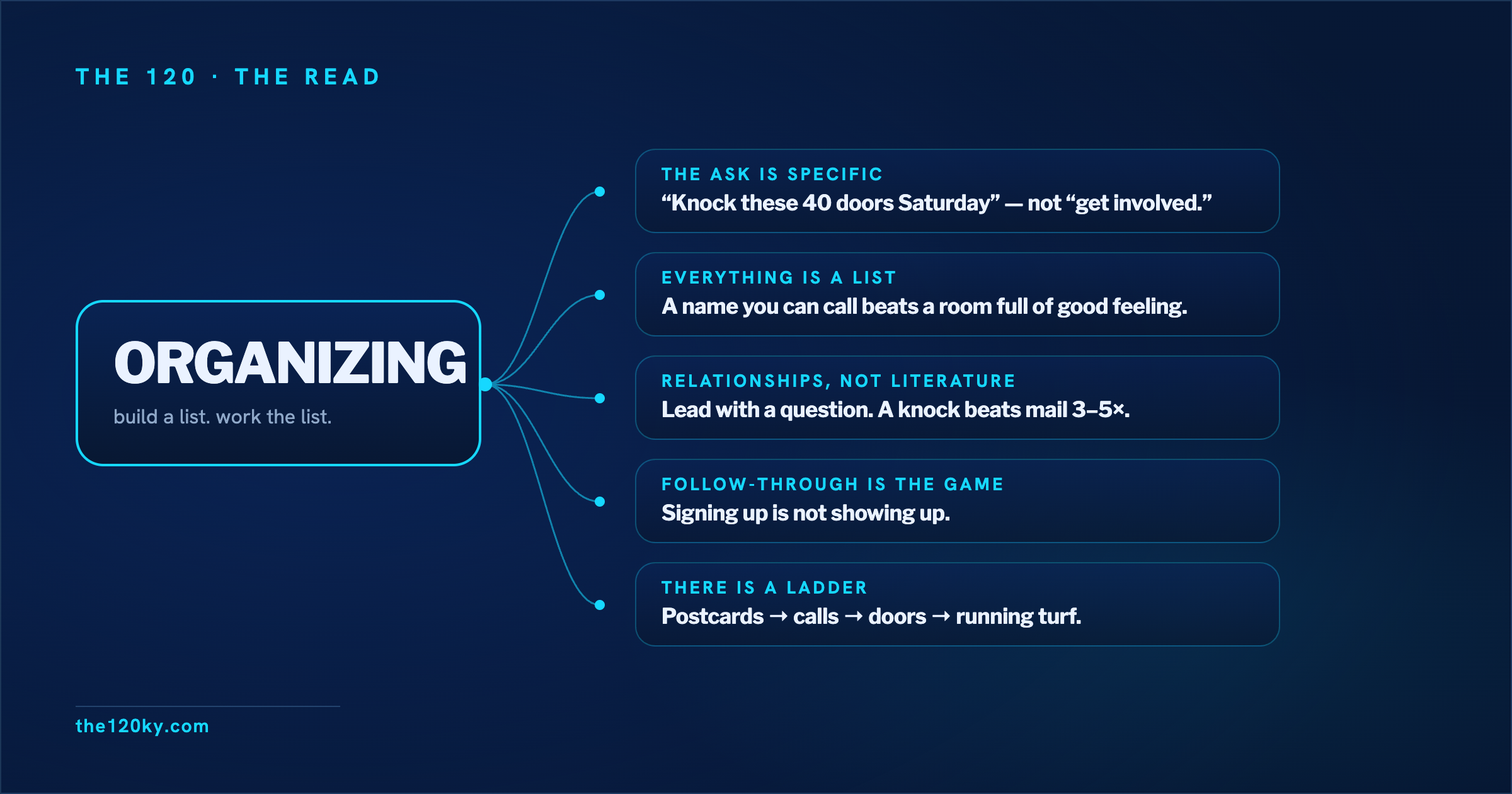
- The ask is specific. "Get involved" recruits no one. "Knock these forty doors Saturday morning, I'll meet you at nine" recruits someone, because it can be said yes to. A vague ask is a no with extra steps.
- Everything is a list. A name you can call on Election Day is worth more than a room full of good feeling. Sentiment does not turn out; a list does. If the conversation did not end with a name and a next step written down, it did not happen.
- Relationships move people, not literature — and the relationship starts by listening. A knock from a neighbor who leads with a question about what you are worried about moves a vote three to five times better than a cold call reading a script, and a mail piece barely moves it at all. The programs piling up "pieces dropped" are counting the cheapest, weakest contact there is.
- Follow-through is the entire game. Signing up is not showing up. The person who said yes on Tuesday is a maybe until you text them Thursday, remind them Saturday, and are standing at the meeting spot at nine. Most programs recruit once and never circle back, then wonder where their volunteers went.
- There is a ladder. Nobody starts by running turf. They start on postcards, because postcards are safe. Then a few calls. Then a door shift beside someone who has done it. Then, one cycle later, they are the one running the shift. Moving people up that ladder is the job — not leaving them on postcards for three years because that is where they happened to start.
None of this is inspiring. It is tedious, it is mostly follow-up, and that is exactly why campaigns skip it: follow-up does not photograph well, and a specific ask is harder to make than a general one.
Skip the follow-up and you don't have a ground game. You have a committee that meets.
And here is where it meets everything else on this desk. A campaign can hold the best targeting data in the state — every precinct scored, every skipped voter flagged — and none of it moves a single vote until a person with a list walks up to a door. The data tells you which door. It cannot knock. That gap, between the spreadsheet and the doorstep, is the most expensive one in politics, and it is the one almost nobody funds.
The part I will only say halfway. Anyone can tell you where to start: the voters who turn out every cycle, and the on-and-off voters who need a reason to. That much is free, and it is on the internet already. What comes after that — the version that stops a campaign from spending its last dollar in the wrong place — is a system I have spent years building, and the part I do not hand out on the internet. Reach out, or, if you have built a program with me, you already have it.
Organizing 101 is not complicated. It is just unglamorous, and unglamorous is the hardest thing to get a campaign to fund. Every race in Kentucky is a math problem, and this is the variable most of them leave blank — not how many voters there are, but how many people you have who will go get them. A list nobody works is a spreadsheet with good intentions. I read the numbers straight, and the straightest one here is that the numbers never move themselves.