
The take
Your campaign already paid for the answers. Use them.
In June I wrote that campaigns gather all the data and then don't use it. This is the follow-up nobody asked for and everybody needs: the five moves that turn a voter file from a receipt into a weapon.
LOUISVILLE — Back in June I wrote the angriest thing I believe about this business: campaigns gather all the data — the file, the IDs, the door answers, the polling — and then don't use any of it to make a single decision. The data gets opened once, admired, and quietly ignored while the campaign goes back to doing whatever it already felt like doing. That piece was the diagnosis. This one is the treatment plan: five moves, in order, each one worth real money.
Move one: cut turf from every list you pull. A voter file query is not a plan; it's an inventory. The plan is what you remove — the unreachable, the hostile, the already-banked — until what's left fits the hours you actually have. I said it before and it holds:
A targeting list you don't cut turf from is just an expensive apology you wrote to yourself in advance.
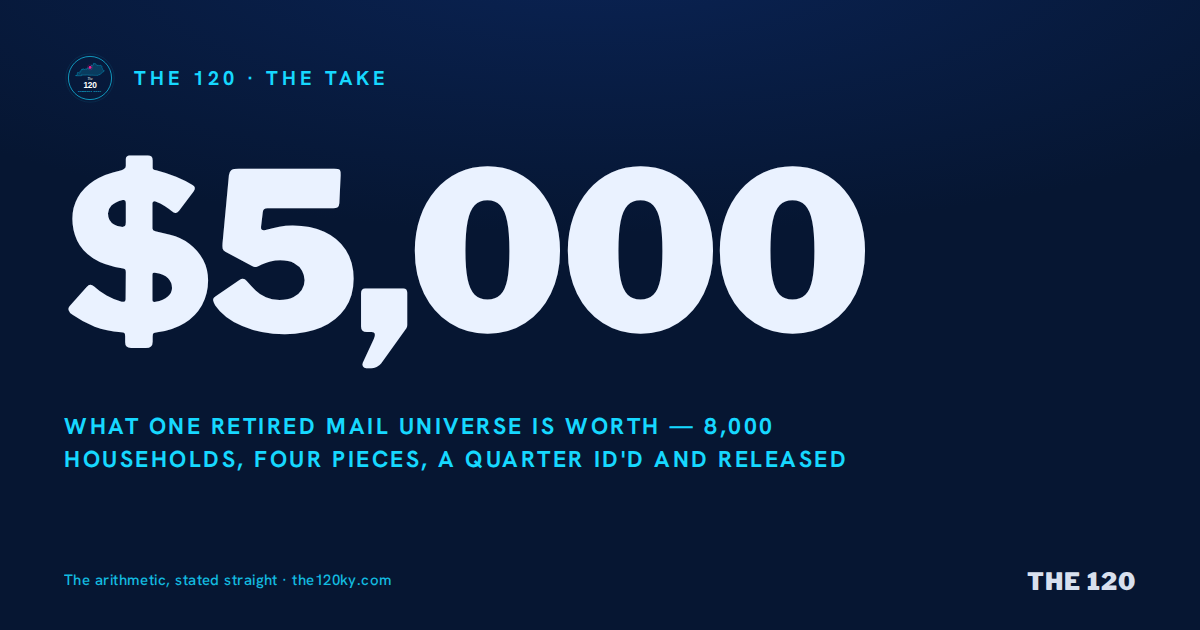
Move two: retire people as you learn about them. This is the one that pays the fastest. The supporter you identified at the door in June does not need your persuasion mail in October — she needs a GOTV touch in the last week and nothing else. Every ID that comes back should move somebody: out of persuasion, into turnout; out of the universe entirely. Run the arithmetic on a modest race: a persuasion mail universe of 8,000 households getting four pieces is 32,000 pieces. Identify and retire a quarter of them by September and you just cut 8,000 pieces — at the sixty-odd cents a piece all-in that mail actually costs, that's roughly five thousand dollars, found money, in a race where five thousand dollars is a real week of program. The campaigns that never retire anybody mail their own yard-sign households four times and call it discipline.
Move three: the data comes home every night. A file updated weekly is a diary. A file updated nightly is an instrument. The difference shows up in week ten, when the nightly campaign knows exactly how many votes it has banked and the weekly campaign is guessing with old numbers.
Move four: spend against the gap, not against the fear. Every campaign knows two numbers, or should: the votes it needs, and the votes it has identified. The distance between them is the gap, and the gap — not the candidate's anxiety — is what the last month's budget should chase. The classic failure has a shape I've watched for twenty years: unspent money panics in mid-October and dumps itself on whatever can be bought fastest, sprayed at an electorate that is 95% decided. Fear takes the wheel, and fear always buys the same things: more mail to the same houses, and reach nobody can measure. The gap doesn't want reach. It wants the specific doors of the specific people who haven't decided or haven't committed to voting, and you already know their names. That's the point of the file.
Move five: count the real number, not the flattering one. Doors knocked is a vanity metric; contacts made is the number. Rally headcount is vanity; IDs harvested is the number. Every metric your campaign reports to itself should survive one question: does this count something that moves a vote, or something that felt good to do? Campaigns don't lie to the public half as often as they lie to their own morning meeting.
The honest read, both directions, as always: data doesn't win races by itself. A clean file won't fix a bad candidate, won't write the message, won't sit in a living room and listen to a voter. And the reverse error is real too — I've seen campaigns so in love with their dashboard they forgot the dashboard describes a war someone still has to go fight. The data is not the campaign. The data is how the campaign stops wasting the parts of itself that actually touch voters.
But between those two failures sits the thing I'm actually asking for, and it is not sophisticated: make the file the first screen open in every budget meeting. Let the vote-gap number veto the panic buy. Retire your supporters from persuasion the night you find them. None of this needs a consultant. It needs a campaign willing to be told by its own evidence.
What I'm watching this fall: which Kentucky campaigns shrink their mail universes as their ID counts grow. That single tell — universes getting leaner while knowledge gets deeper — separates the operations using their data from the ones performing it. I'll be reading for it, race by race, all the way to November.