The read · Jefferson County
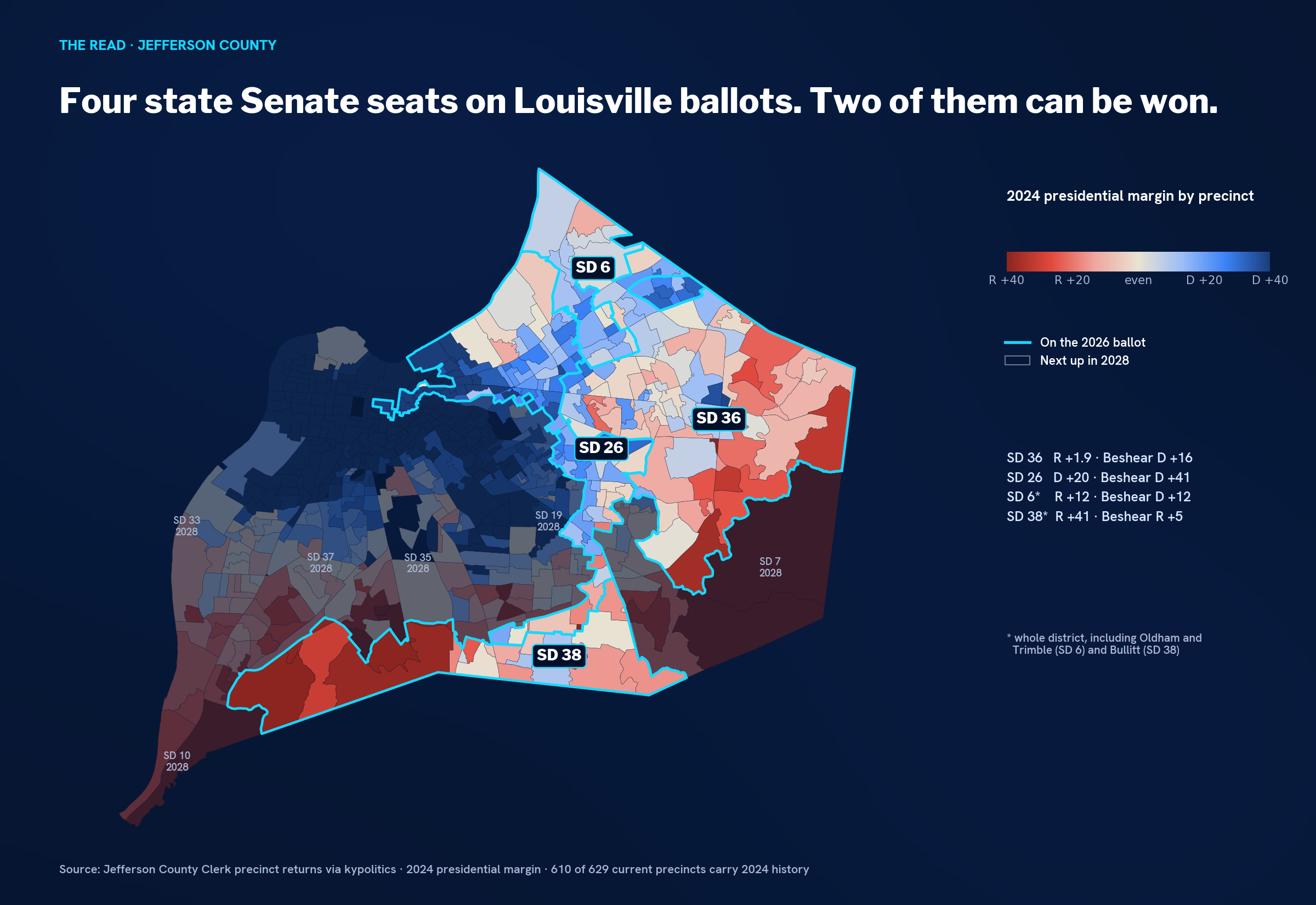
Four state Senate seats on Louisville ballots. Two of them can be won.
Jefferson County votes on four state Senate seats this fall. One is Karen Berg's, and she's earned it. One has no Democrat in it. The other two are live: a teacher from Middletown in a district that went Trump by two, and a physician from Oldham County in one that went Beshear by twelve. The precinct maps say where each of them wins it.
LOUISVILLE — Half the Kentucky Senate is up every two years, and this is the even-numbered half. In Jefferson County that means four districts on the ballot in November — 6, 26, 36 and 38 — plus two precincts of the 10th that I'm going to leave alone. I pulled every precinct in those four districts for the last three elections that had a real top of the ticket: Rand Paul against Charles Booker in 2022, Andy Beshear against Daniel Cameron in 2023, Trump against Harris in 2024. Same houses, same doors, three different reasons to vote. That's the cleanest test I know for what a district actually is, as opposed to what its registration says it is.
Here's what the four look like on that test.
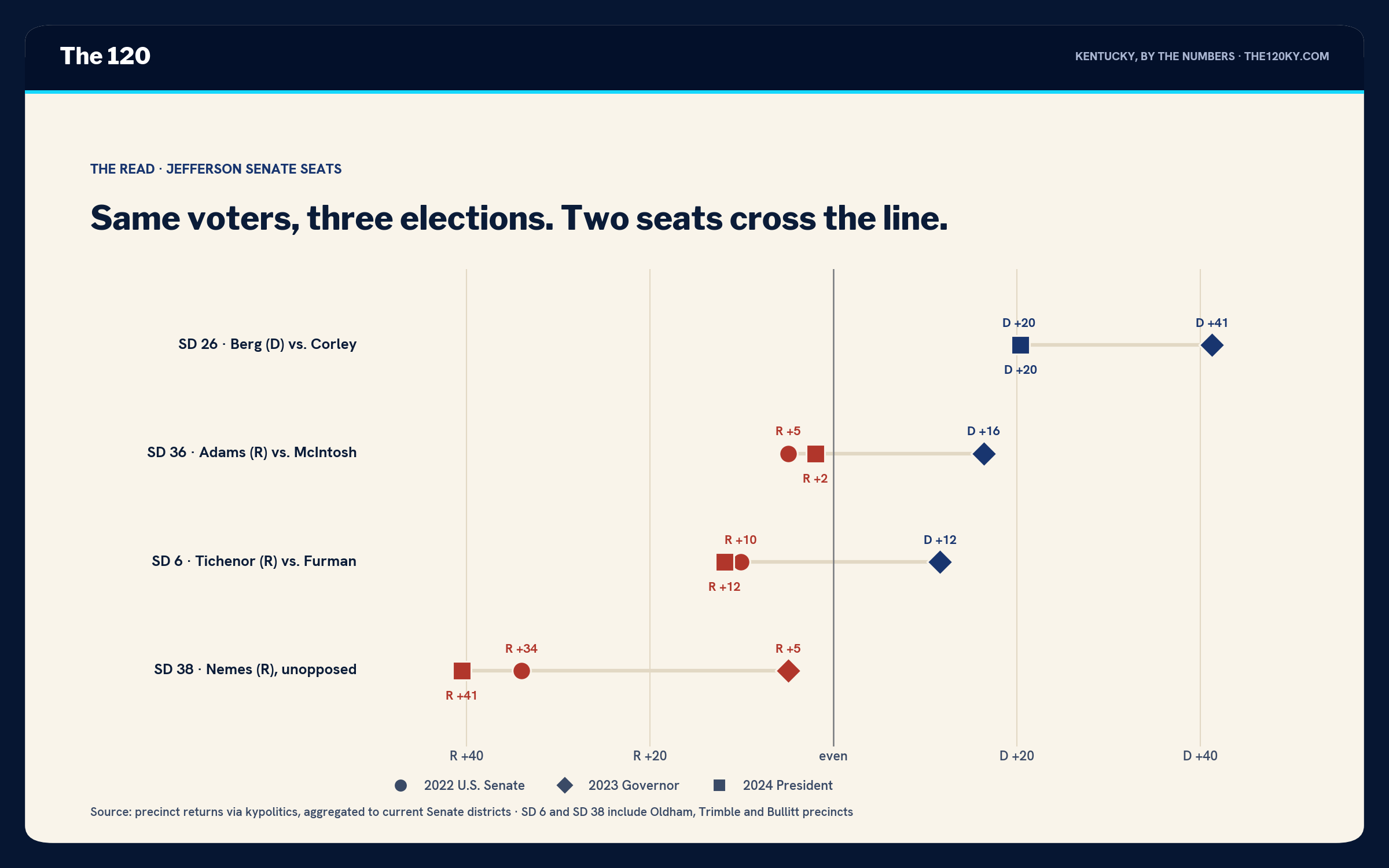
District 26 is Karen Berg's, and it's hers for a reason. The district — St. Matthews, the Highlands edge, out toward Lyndon — went Booker +20, Beshear +41, Harris +20, and Berg won it 60–40 in 2022. Everett Corley has filed against her. I want to be careful about the word "safe," because the numbers make it look automatic and it wasn't. Berg flipped this seat from Republican hands in 2020 and held it under new lines in 2022 by knocking doors in both races — not sending people, going — and she's one of the few members of that chamber who's respected on both sides of the aisle because she does the work and she's straight with people. A district doesn't stay D+20 in a federal year on its own. Somebody earns it. She did.
District 38 has no Democrat in it, and that's the last I'll say about it. Mike Nemes's seat is three-quarters Bullitt County; it went Trump +41 and Beshear lost it by five. Nobody filed.
That leaves two live races. They're different shapes, and I'm going to give them the same space, because both of them can be won and both of them are being worked.
District 36: Trump +1.9, Beshear +16, and no Democrat on the ballot last time. This is Julie Raque Adams's seat — the east end, Middletown and Jeffersontown out toward Fisherville, with pieces of six House districts in it. She's held it since 2015. In 2018, a good Democratic year with Sheri Donahue running, she won it 53–47, by 3,752 votes. In 2022, under the new lines, no Democrat filed and she took 36,851 votes unopposed. Read that again: the closest Senate district in Louisville went uncontested in the last midterm.
Here's what the same voters did with a real choice. In 2022 they gave Rand Paul a 4.9-point margin over Booker. In 2024 they gave Trump 34,049 votes to Harris's 32,726 — 1.9 points. In between, in 2023, they gave Beshear 28,780 to Cameron's 20,665, sixteen points. Registration is 38,675 Democrats, 41,709 Republicans, and 12,079 people in neither column, which is a district where the no-party voter is the margin twice over.
The Democrat is Sarah Cole McIntosh: a lifelong Louisvillian, a U.S. history teacher in the public schools for sixteen years, four years on the Jefferson County school board, and — this matters in a district that's about geography — a Middletown resident running in the district she lives in. She won a contested primary in May with 7,411 votes, 58%. And the primary produced a number I'd put on a mailer: in a district with 3,000 more registered Republicans than Democrats, the Democratic primary drew 12,802 ballots and the Republican primary drew 11,346. More Democrats than Republicans voted in Senate District 36 in May. That doesn't happen in a district that's asleep.
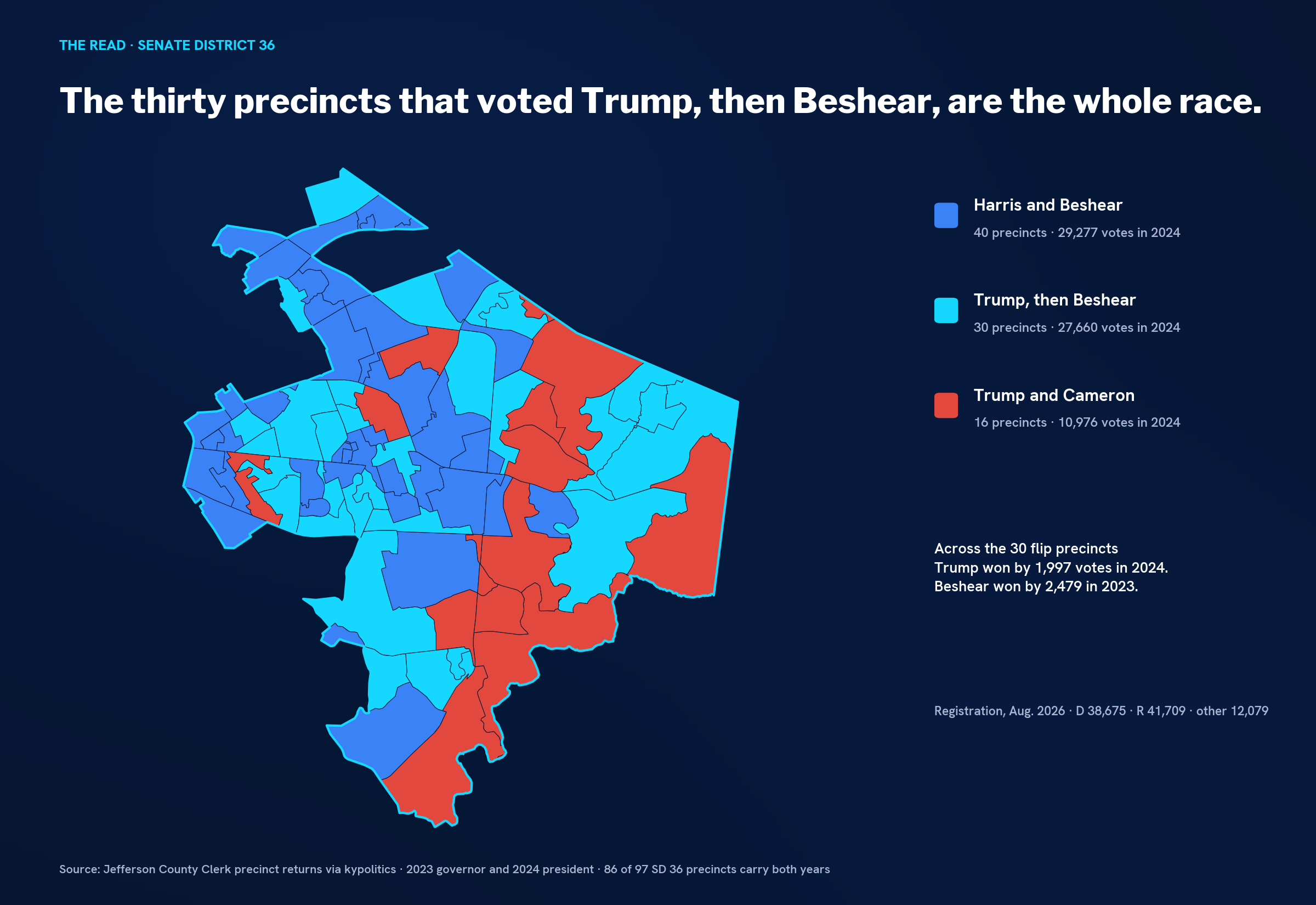
Eighty-six precincts have a result in both years. Forty of them voted for Harris and for Beshear — 29,277 votes in 2024, the Democratic floor. Sixteen voted for Trump and for Cameron — 10,976 votes, the Republican floor, along the eastern and southern edge. That leaves thirty precincts that voted for Trump in 2024 and for Beshear in 2023. They cast 27,660 votes. Trump carried them by a combined 1,997. Beshear carried the same thirty by 2,479.
That's McIntosh's race. Not the district — those thirty precincts. Hold the forty blue at their 2024 margin, split the thirty, and it's a Democratic seat by a few hundred votes. Hold the forty and lose the thirty the way Harris did, and it's Adams by about 1,300. The red sixteen don't matter to either side except as turnout. In a district this even, the 12,079 no-party voters are the whole margin, and they were the ones who couldn't vote in that May primary.
Thirty precincts, 27,660 votes, a Trump margin of 1,997 and a Beshear margin of 2,479 the year before. Everything else in Senate District 36 is already decided.
District 6: Trump +12, Beshear +12, and an incumbent who has never had a real race. Lindsey Tichenor's district is all of Oldham and Trimble counties plus twenty-five precincts of northeast Jefferson. On the three-election test it's Paul +10, Trump +12 — and Beshear +12. Nobody in Louisville looks at Oldham County and sees a pickup, which is exactly why the number surprised me when I ran it. The Democrat is Dr. Christian Furman: a geriatrician, UofL School of Medicine class of 1996, chief of the Division of Palliative Medicine at UofL and medical director of the Trager Institute's Optimal Aging Clinic, an Oldham County resident who has spent twenty-five years sitting at the bedsides of people's parents. She won her primary in May with 78% — 8,425 votes to 2,591 — in a district where Tichenor, who ran unopposed by a Democrat in 2022, didn't have a primary at all. She is knocking her own doors, and the Oldham County party is running canvasses for her on Saturdays — which, in a county where Democrats have historically been asked to show up for the top of the ticket and nothing else, is its own data point.
And Tichenor has a problem she made for herself. In February, when House Bill 1 — the bill opting Kentucky into the federal K-12 private-school scholarship tax credit — was moving through the Senate and Lt. Gov. Jacqueline Coleman was urging people to call their legislators, Tichenor answered on X. "Don't call us," she wrote. "It's going to pass and then we'll override the veto." The Senate passed it 33–5 that Friday with her vote, and the Kentucky Lantern printed the post. A senator who tells her own district to stop calling is a senator who has never had a hard race, and the numbers say she hasn't.
Here's the district, precinct by precinct.
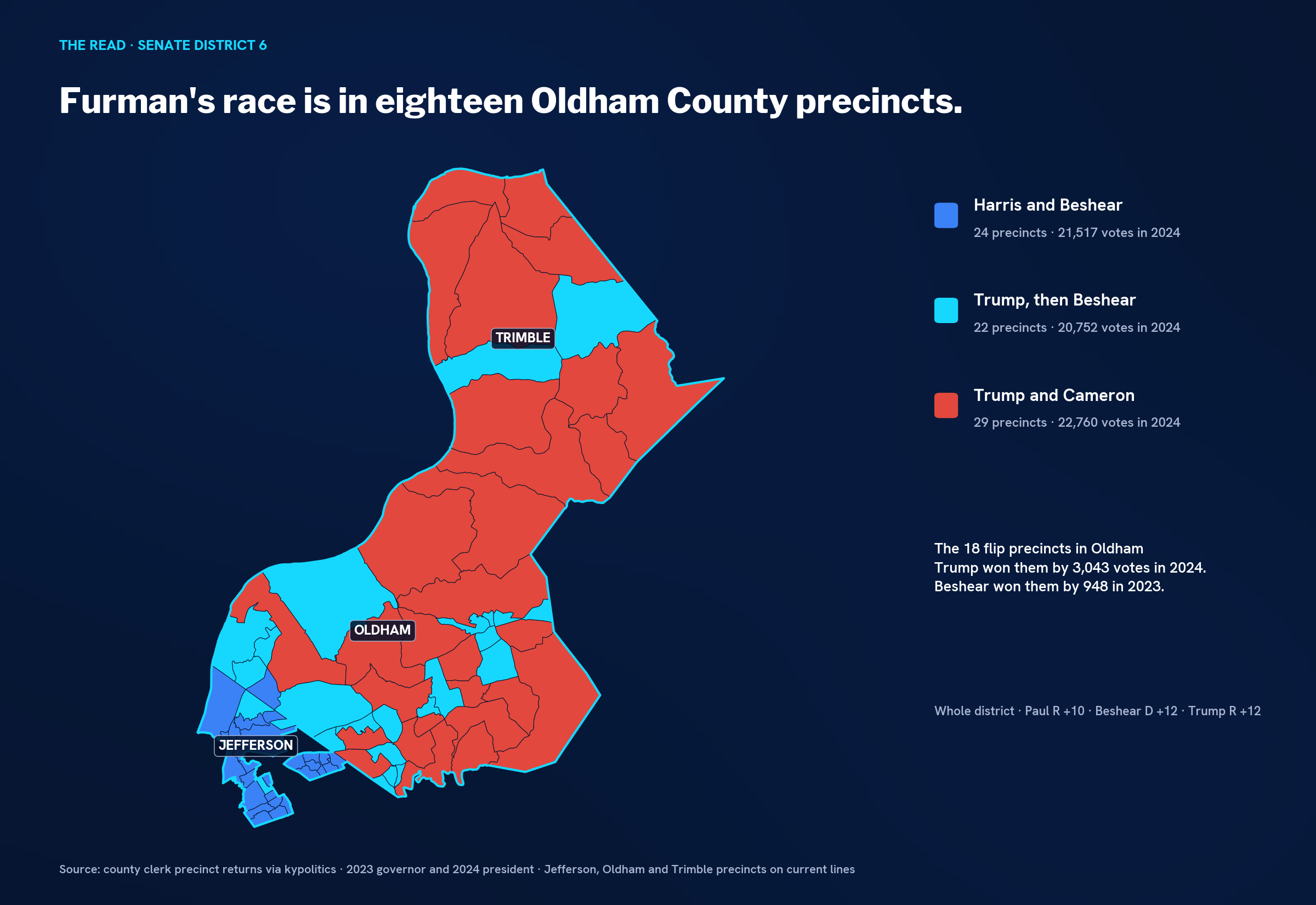
Three counties, three jobs.
The twenty-five Jefferson precincts are the floor. They went Harris +14 and Beshear +34 — 22,570 votes in 2024, a Democratic margin of 3,267 — and twenty-three of the twenty-five are blue in both years. A Democrat who doesn't max those out isn't running a campaign.
Trimble is the ceiling, and it's low: twelve precincts, 4,249 votes, Trump +55. It's a rounding error and I'd treat it as one.
Oldham is the race. Oldham casts six of every ten votes in this district, and it's two counties wearing one name. Nineteen precincts went Trump and Cameron — 19,040 votes, Trump by 5,611 — and those are gone. But eighteen precincts went Trump in 2024 and Beshear in 2023. They cast 18,580 votes. Trump carried them by 3,043. Beshear, a year earlier, carried the same eighteen by 948. The whole county went Beshear 12,952 to Cameron's 13,177 — a 225-vote loss in a county Trump would carry by 8,600 the following year. Oldham is a Beshear county that hasn't admitted it yet.
Eighteen Oldham County precincts, 18,580 votes. Trump won them by 3,043. Beshear won them by 948. The Democrat who wins Senate District 6 is the one who makes those eighteen vote like 2023.
So here's Furman's arithmetic. Her floor is the Jefferson margin, call it 3,300 in a federal-year turnout. Trimble costs her about 2,400 no matter what. Oldham's red nineteen cost her another 5,600 at 2024 rates. That's a hole of roughly 4,700 before the eighteen flip precincts vote at all, and at Trump rates they add 3,000 to it. Run the whole district at the 2023 pattern instead and every piece moves: the Jefferson slice goes to +5,661, Oldham's red nineteen shrink to a 1,251-vote Republican margin, the eighteen flip precincts go to +948, and the district is Democratic by 5,309 votes. The eighteen are where the swing is biggest and the doors are densest, and the distance between 2024 and 2023 in them is a distance a field program can walk.
Follow the money, because the 60-day reports landed this week. Every candidate in these four races filed a 60-day pre-general report with the Registry of Election Finance by the September 16 deadline, and the reports say something the maps don't.
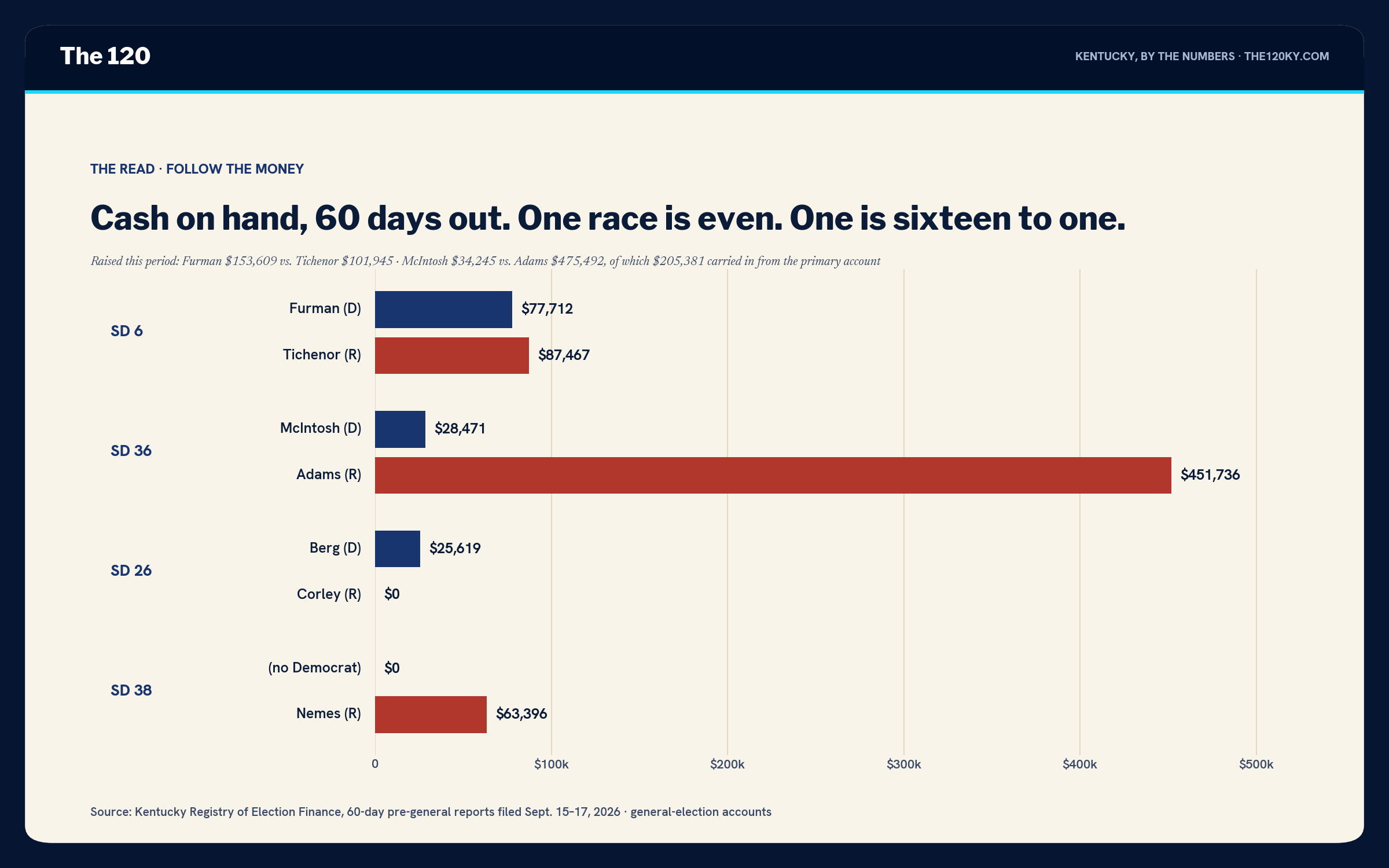
In the 6th, Furman has out-raised the incumbent. She reported $153,609 in general-election receipts to Tichenor's $101,945, and $38,506 of Tichenor's number is money carried over from the primary account, not new. Furman's report lists 104 unitemized small donors; Tichenor's lists none. Furman has also spent — $75,897 to Tichenor's $14,478 — which is what a campaign that's knocking doors in September looks like on paper. Cash on hand is $77,712 to $87,467. That's an even race financially, sixty days out, against a sitting senator. In Oldham County. Read that twice.
In the 36th, the money is the story running the other way. McIntosh reported $34,245 raised and $28,471 on hand. Adams reported $475,492 — $205,381 of it carried in from her primary account, $210,380 itemized, $59,730 from PACs, and not one unitemized small contribution — and she has spent almost none of it: $451,736 in the bank. That's sixteen to one. It doesn't change the precinct map. It changes what the last six weeks look like in the mailbox, and it means McIntosh's race is a field race or it isn't a race. A district where the swing is thirty precincts and 27,660 votes is a district a volunteer operation can cover; it is not a district where you win the air war against half a million dollars.
Berg has $25,619 to Corley's zero, which tells you everything about the 26th. Nemes has $63,396 and no opponent.
Now the honest version, and it goes against my own side. A Beshear number is the most seductive number in Kentucky politics and it gets people beat. Beshear +16 in the 36th and Beshear +12 in the 6th are what those districts do when the choice is Andy Beshear against Daniel Cameron. They are not what those districts do in a federal midterm with a Republican president and Barr against Booker at the top of the ballot; in that kind of year their own history says R+5 and R+10, and the 2022 electorates were 54,000 and 48,000 ballots, not the 68,000 and 65,000 that turned out for Trump and Harris. The flip precincts on both maps don't turn blue because the Democrat is nice. They turned blue once, for one name, and turned back the next year.
What makes me think both of these are real anyway is the part that isn't on the maps. Two candidates the districts already know — a teacher from Middletown, a doctor from Goshen — both working their own doors. Two primaries that showed Democratic energy where there wasn't supposed to be any. Two incumbents who have never had to run a contested general under these lines. And on the other side, the thing I wrote about last week: in sixteen years of clerks' reports the gap has never closed because Republicans quit, it closes when Democrats show up — but a Republican electorate that turns out at 2023 rates instead of 2024 rates, apathy rather than conversion, is worth about two points in the 36th and three in the 6th, and neither of these margins can spare two points. One of them can't spare a dollar, either.
What I'm watching in November is one figure from each clerk: the Democratic turnout rate against the Republican one in the thirty flip precincts of the 36th and the eighteen in Oldham. If they look like 2023, Louisville sends two new Democrats to Frankfort. If they look like 2022, the maps above are nice pictures and both districts vote the way they voted for Rand Paul.
The clerk publishes it by precinct either way. I'll have it the week after.
Disclosure: I work in Kentucky Democratic politics and consult campaigns in this state, and Jefferson County is where I live and work. I have no client relationship with any candidate in the four races above. I read them the same way whether or not it's good news for my side — that's the job. Precinct returns are the county clerks' certified results via kypolitics, assigned to the current Senate lines; 610 of Jefferson's 629 current precincts carry 2024 history, and the 19 precincts created for 2026 are drawn from parents that do. Senate Districts 6 and 38 include their Oldham, Trimble and Bullitt precincts. The two Jefferson precincts in Senate District 10 are omitted.