
The read · Fall 2026
The best case, the worst case, and the 115,000 voters in between.
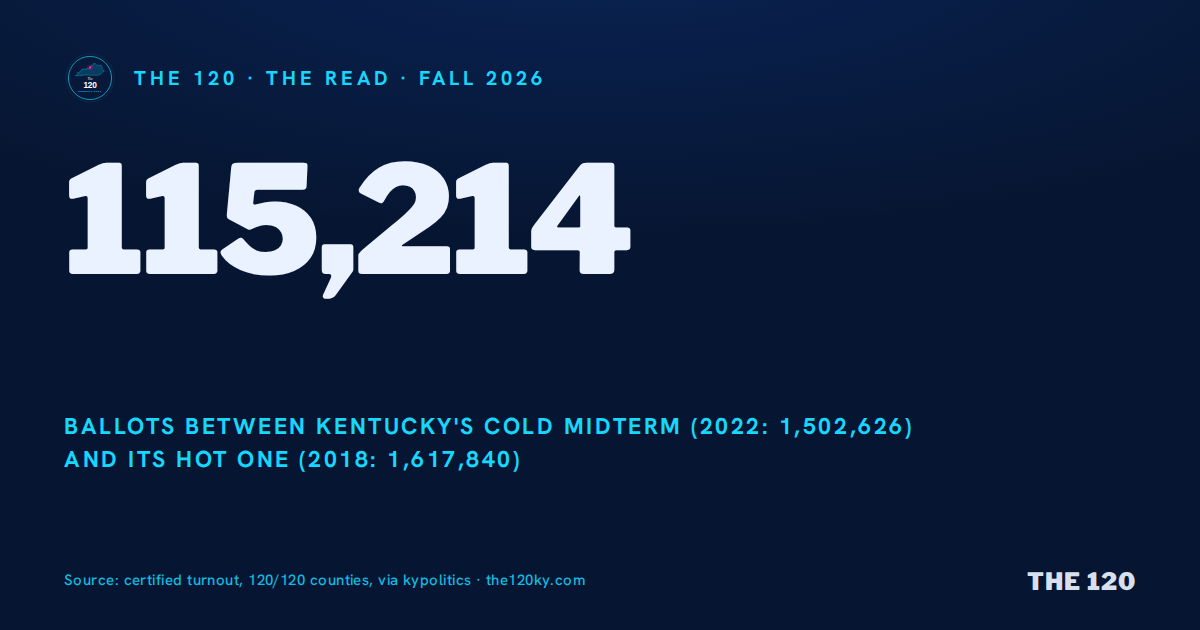
Kentucky's last two midterms were 115,214 ballots apart. Which one 2026 resembles decides the Senate margin, five House tossups, and every close race in this state. Here are both scenarios, read straight.
LOUISVILLE — Every argument about Kentucky's fall — every one — is secretly an argument about two numbers: how many people vote, and where they live. So instead of a prediction, I'm going to give you the honest ceiling and the honest floor, built from the state's own midterm record, and tell you which way I lean and why. Cheerleading and doom are both reading the wrong year. The right years are 2018 and 2022.
The midterm record, 120 of 120 counties, certified: 2014 drew 1,451,311 ballots (45.9% of registered voters). 2018 — the high-attention midterm — drew 1,617,840 (47.5%). 2022 — the flat one — drew 1,502,626 (41.9%). The distance between Kentucky's hot midterm and its cold one is 115,214 voters, and that gap is not evenly spread: attention-driven turnout concentrates in the urban and suburban counties where Democratic votes live. That is the whole ballgame, and it's why the two scenarios below diverge as far as they do.
1,502,626 · 1,617,840 · 115,214
2022 midterm ballots · 2018 midterm ballots · the gap between Kentucky''s cold midterm and its hot one
Certified statewide totals, 120/120 counties, via kypolitics county turnout records.
The pessimistic case — a 2022 rerun. Turnout lands near 42%, composition tilts older and more rural. The Senate race replays Booker's own midterm floor — he took 38.2% in 2022, and floors exist because electorates repeat them. The five House tossups I flagged two weeks ago break mostly Republican, the caucus stays parked at 20 of 100, and the close Jefferson seats stay a few hundred votes out of reach. The 6th District reverts toward its +20s midterm baseline. Nothing about this case is exotic; it is what happens when nothing happens.
The optimistic case — a 2018-shaped year. Turnout pushes toward 47%, and the extra 115,000 voters skew toward Jefferson, Fayette, and the suburban collars — the places attention-driven voters actually live. In the primary, Jefferson alone was 17.6% of the electorate; in a hot fall its weight grows. Booker consolidates the 346,400 ballots cast in the Democratic primary and climbs out of the floor toward the low 40s — Jim Gray's 42.7% in 2016 remains the modern ceiling, and it was set with a presidential electorate, so matching it in a midterm would be a genuinely historic result, which is exactly why I name it as the ceiling and not the target. The five tossups break Democratic and the caucus grows to 25. The 6th — open seat, both parties spending — lands in single digits. The 340-vote and 249-vote Jefferson margins from last Friday's piece become coin flips decided by whoever ran the better doors program.
Now the knife, turned on the optimistic case, because that's the job: high turnout is not a side in Kentucky. 2024 was the highest-turnout election this state has run in a decade — 2,086,320 ballots, 58.8% — and it delivered Trump +30. More voters means more of everybody's voters. The optimistic case doesn't rest on turnout being high; it rests on turnout being high in the right fifteen counties. Composition beats size, every cycle, no exceptions. Anyone selling you raw turnout as salvation is selling.
High turnout isn''t a side in Kentucky. It''s a question — whose? The answer lives in about fifteen counties, and it gets decided by October, not in November.
My lean, stated plainly so you can hold me to it: I think 2026 runs a little hot — closer to the 2018 shape than the 2022 one. An open U.S. Senate seat with national money, a congressional map with every line contested for the first time in two cycles, and the most expensive House primary in American history still echoing in the 4th — that is not a nothing-happens year. Attention is turnout's leading indicator, and attention is already here in August.
But the structural cap holds regardless of scenario, and honesty means ending on it: Democrats left 44 state House seats uncontested this cycle. In the hottest turnout year imaginable, the caucus ceiling is set by the races you're actually in. The 115,000 extra voters can only move contests that exist. That decision was made at filing, and no scenario un-makes it.
What I'm watching, in order: September registration deadlines in Jefferson and Fayette, the early-vote composition when it starts posting in late October, and whether the tossup-district campaigns are visibly on doors by Labor Day. Turnout is read before totals exist — and I'll be reading it every week, straight, until the only numbers left are real ones.