
County Read No. 16 · Scott County
The 125-vote House seat in Scott County has no Democrat on the ballot
Georgetown's county has grown by half since 2010 and swings 37 points between a Trump ballot and a Beshear ballot, tied for the widest in the series. Twenty-nine of its 45 precincts voted for Rand Paul and then for Andy Beshear. Its Democrats out-vote its Republicans in off-years. And the House seat that sits on all of that — lost by 125 votes in 2024 — has a Republican, an independent, and no Democrat on the ballot.
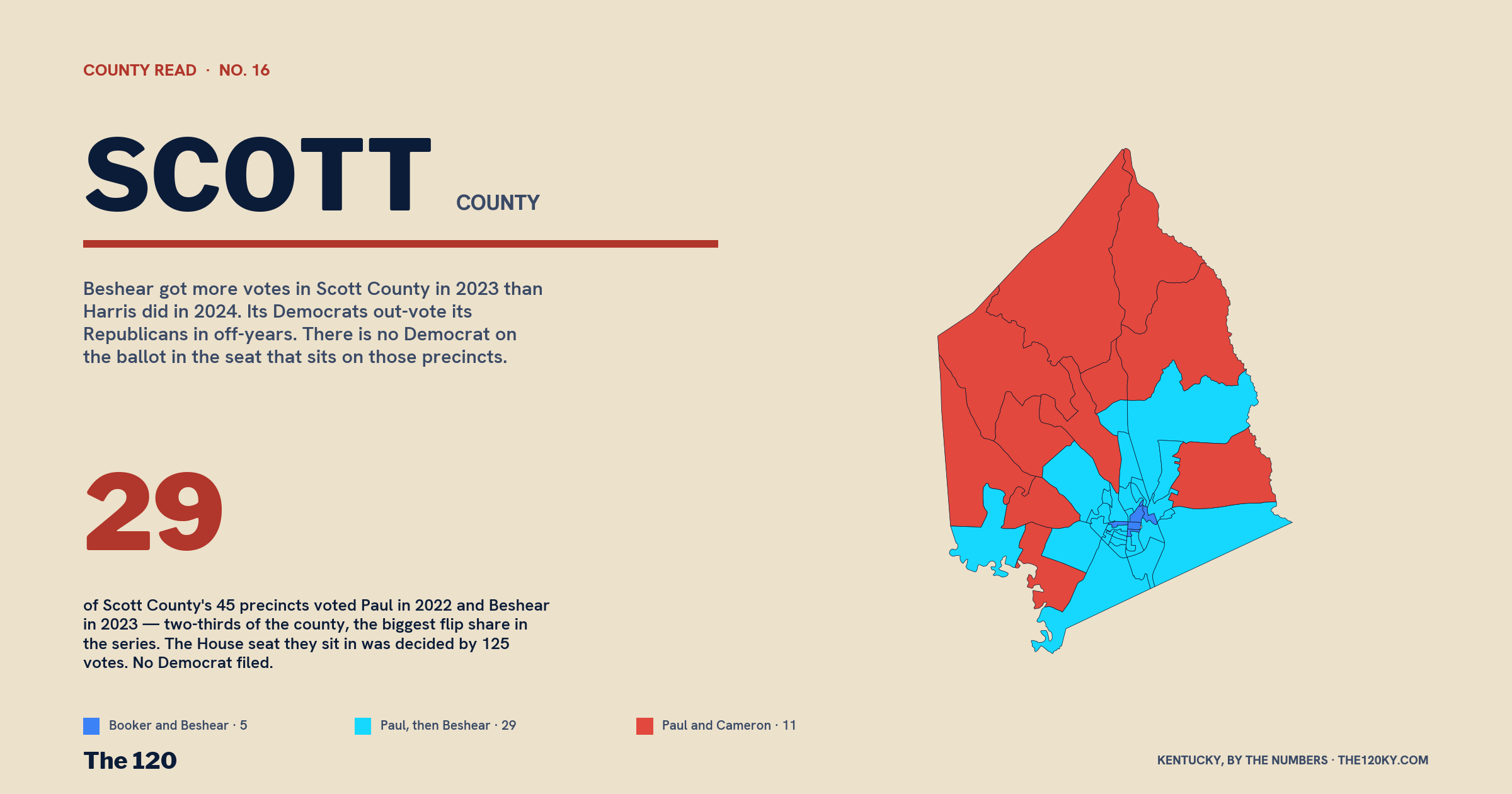
LOUISVILLE — Sixteenth of twenty, and the one I've been waiting to write. Same five questions: the paper, the ballots, the turnout, the map, the money. Scott County answers the first four better than any county outside Louisville and Lexington and the fifth worse than almost any of them.
What the paper says. Scott County has 45,303 registered voters on the August file: 17,118 Democrats, 22,907 Republicans, 5,278 in neither column. That's 37.8% Democratic, 50.6% Republican, 11.7% no-party. In 2010 it had 30,124 voters and was 56.0% Democratic, 37.9% Republican. It's grown by half — 15,200 voters in sixteen years, the fastest growth of any county in the series so far — and the Republican column got 11,500 of them, the no-party column 3,500, and the Democratic column 260. That's Toyota and the Lexington overflow: a county that doubled its Republicans and held its Democrats flat, and went from a Democratic majority on paper to a Republican one without anybody switching. The purge took 1,554 names net since Election Day 2024, two-thirds of them Democrats.
What the ballots say. Here's the chart, and here's why I've been waiting.
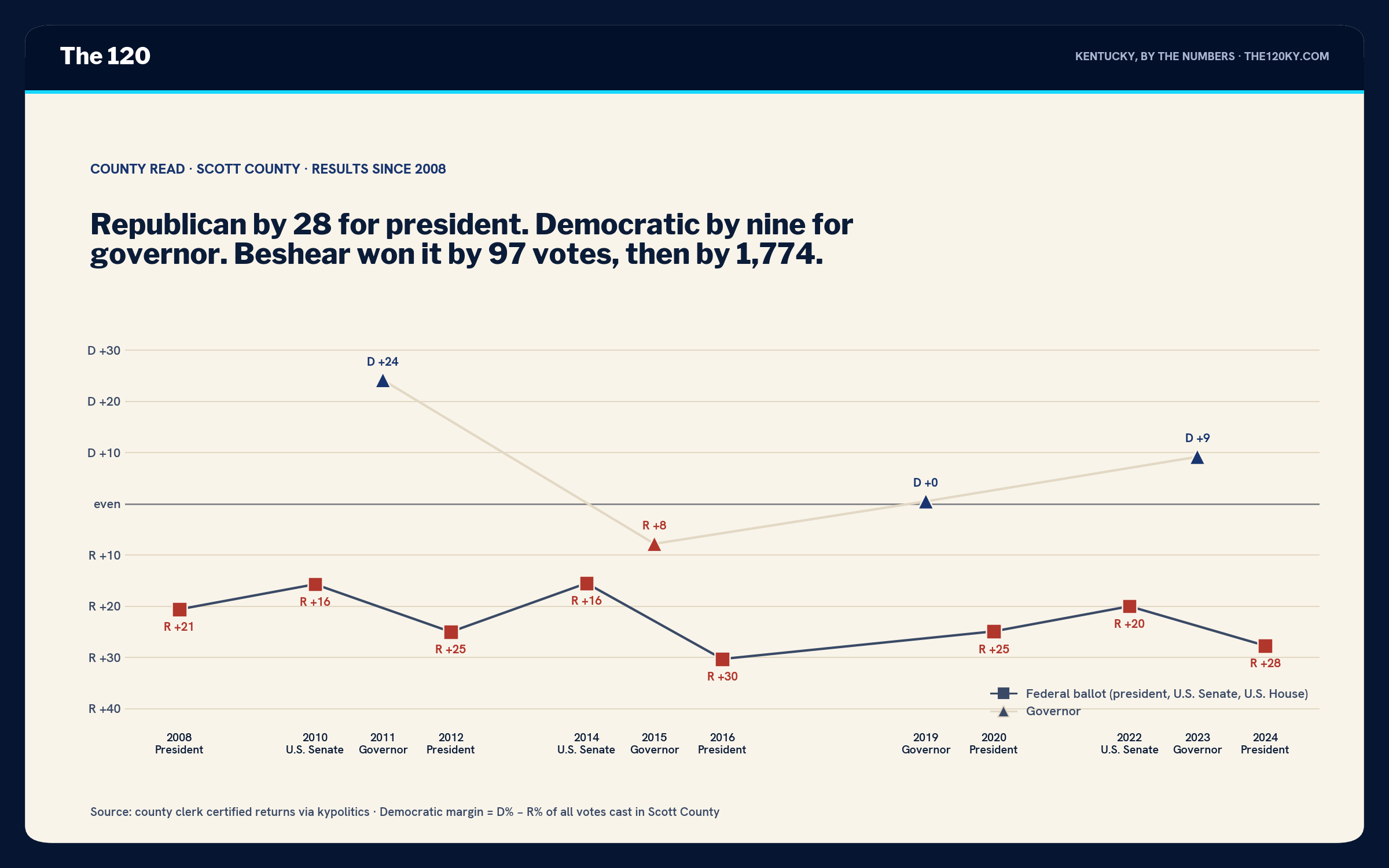
Trump carried Scott County by 28 in 2024, 18,747 to 10,501. Beshear carried it by nine in 2023, 10,575 to 8,801 — a 1,774-vote margin, after carrying it by 97 votes in 2019, 9,827 to 9,730. That's a 36.9-point swing between consecutive Novembers, tied with Bullitt for the widest in the series, and it's the opposite kind of swing from Bullitt's. In Bullitt the Democratic vote sat at 10,000 and the Republican vote did the moving. Here Beshear got 10,575 votes in an off-year — more than Harris got in a presidential one, more than Biden's 10,564 — and got them by winning people who'd voted for Rand Paul twelve months earlier. His gain from 2019 to 2023, 8.7 points, is the third-biggest of the twenty, behind Fayette and McCracken. Scott County is where the Beshear coalition is most visible, most measurable, and most completely wasted.
Who's turning out. The best Democratic turnout numbers outside the two cities.
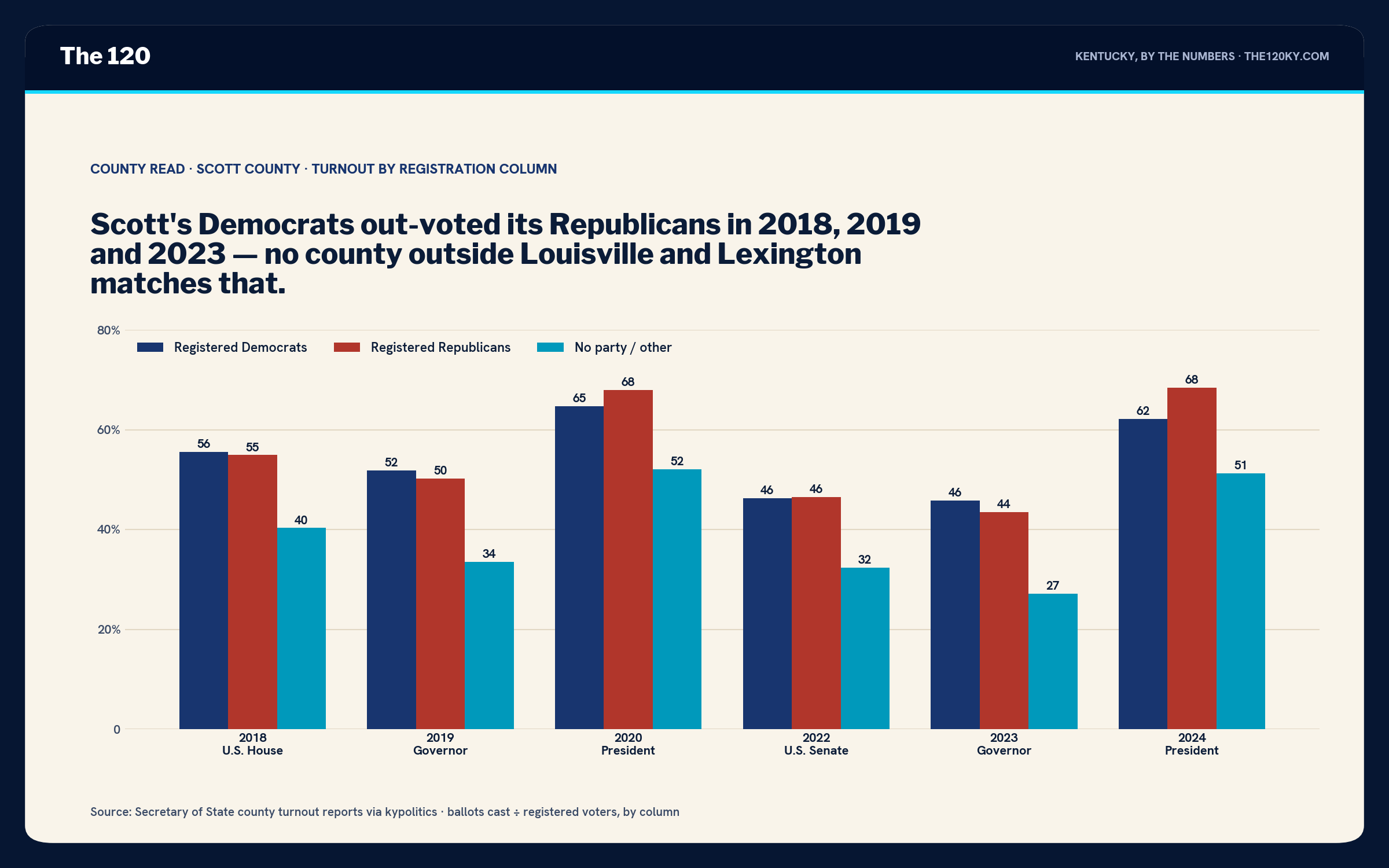
In 2018, Scott's registered Democrats out-voted its Republicans, 55.5 to 54.9. In 2019, 51.8 to 50.2. In 2023, 45.8 to 43.5 — a 2.3-point Democratic edge, the widest in a governor's year anywhere in the series outside Louisville and Lexington, and the year Beshear won the county by nine. In 2022 they were two-tenths apart. The Republican column only pulls away in presidential years: three points in 2020, six in 2024. That's a Democratic column that shows up on its own, in a county where it's 38% of the file. And the whole county votes: 55% turnout in 2018, 68% for Republicans in 2024, and a no-party column that turned out at 32.4% in 2022 and 27.1% in 2023 — among the highest off-year no-party rates in the series.
Beshear got more votes in Scott County in 2023 than Harris did in 2024. Its Democrats out-vote its Republicans in off-years. Twenty-nine of 45 precincts flipped to him. There is no Democrat on the ballot in the seat that sits on those precincts.
Where it happens. Scott reported its 2024 presidential vote by eleven vote centers, so the map is the 2022 Senate race against the 2023 governor's race, on 45 of 46 precincts — the same test as Campbell, McCracken and Pulaski. And it lights up.
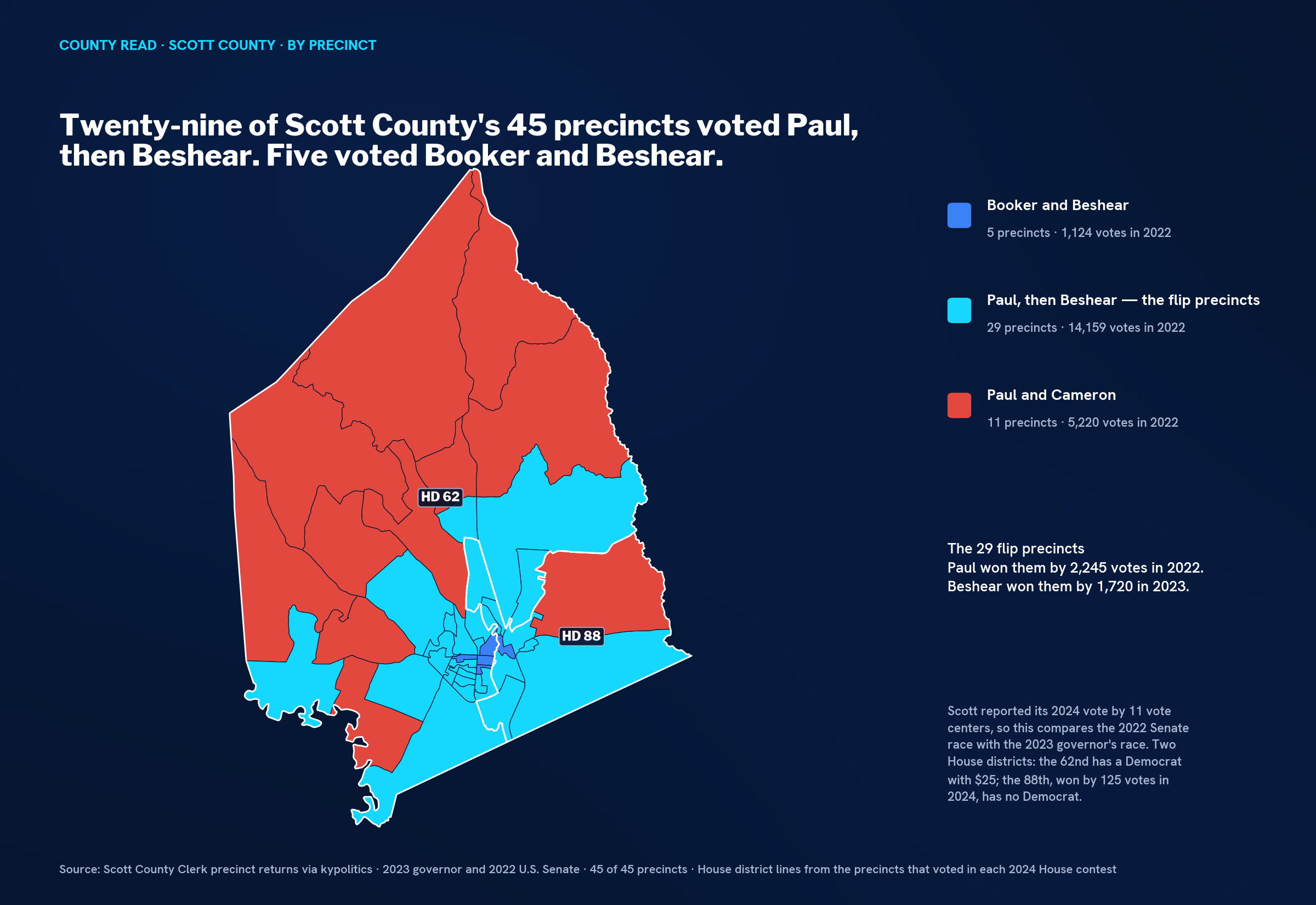
Five precincts voted for Booker and for Beshear — 1,124 votes in 2022, Booker by 131, Beshear by 399. Eleven voted for Paul and for Cameron: 5,220 votes, Paul by 1,990, Cameron by 344. And twenty-nine voted for Paul and then for Beshear: 14,159 votes, Paul by 2,245, Beshear by 1,720. That's 64% of the county's precincts and 69% of its 2022 vote — the biggest flip share of any county in the series, ahead of Hardin's 45%. In most of these counties the flip precincts are a ring around a city. In Scott they are the county: Georgetown, its suburbs, the new subdivisions, everything but the rural edges.
The 88th — the Georgetown seat — has ten Scott precincts: eight of them flip precincts, one blue, one red. Paul carried them by 495. Beshear carried them by 642. The 62nd has the other 35: 21 flip, four blue, ten red. Paul carried them by 3,609, Beshear by 1,133.
What's on the ballot, and who's paying. Two House districts cover Scott County; its Senate seat isn't up this year. Both are contested. Neither has a Democrat who's raised more than $25.
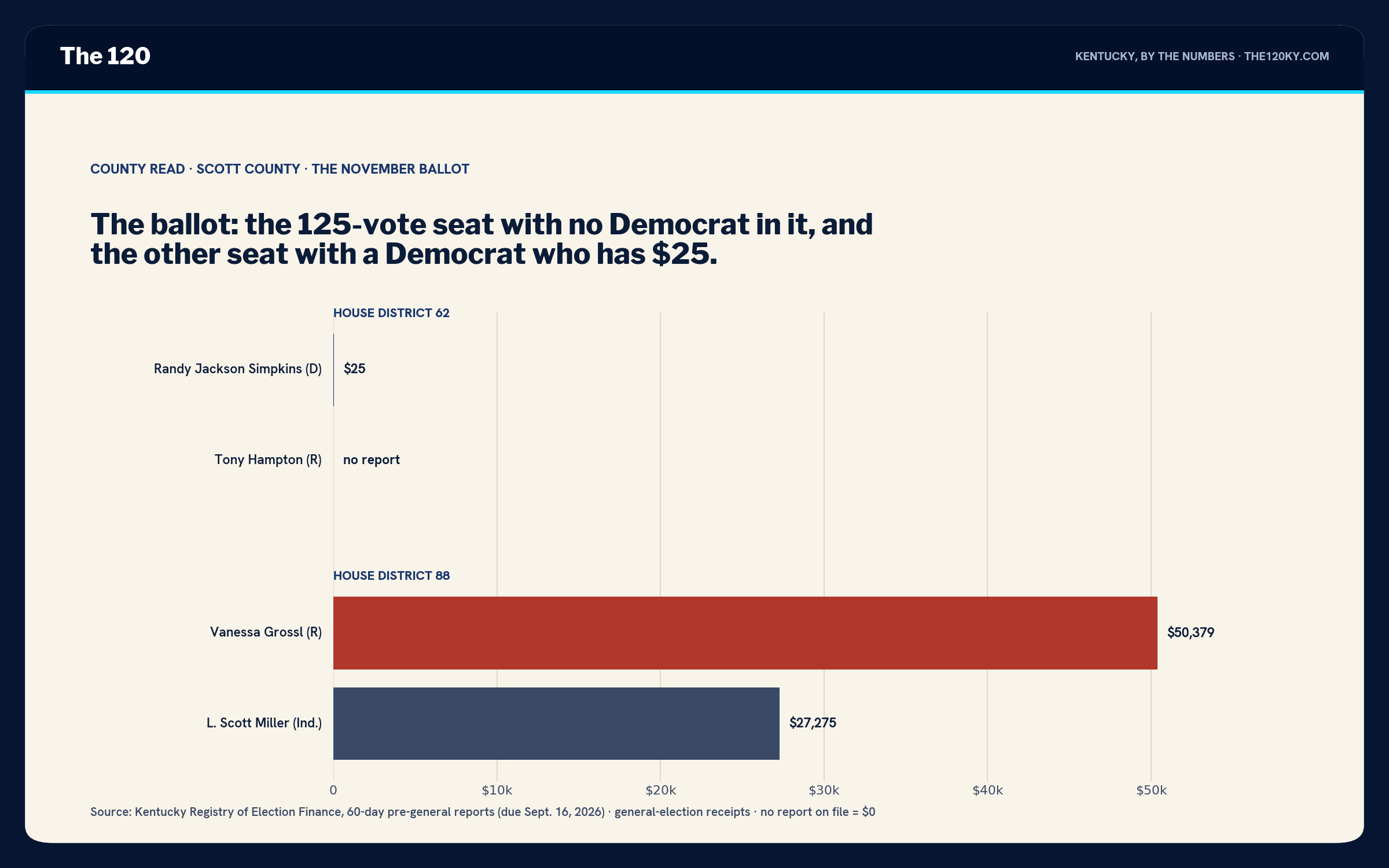
The 88th. Vanessa Grossl won this seat in 2024 by 125 votes, 11,722 to 11,597, over the Democratic incumbent — the second-closest House race in the state. Its Scott precincts went for Beshear by 642 and for Paul by 495. Eight of its ten Scott precincts are flip precincts. This is, by every number in this series, the most winnable Republican-held seat in Kentucky outside Louisville. And there is no Democrat on the ballot: the Democrat who filed was disqualified in May, and as of the September filing list there's no replacement on the line. L. Scott Miller is running as an independent with $27,275 against Grossl's $50,379. I don't know what an independent does in a 125-vote seat with a Beshear majority in it. Nobody does. That's the point.
The 62nd is Tony Hampton's — 35 Scott precincts, the rest of the county, Trump by 33 in 2024 — and Randy Jackson Simpkins is the Democrat with $25. Twenty-five dollars. Hampton has no 60-day report on file. Beshear carried the 62nd's Scott precincts by 1,133; Paul carried them by 3,609. It's a real Republican seat, but it's a seat where the county's 29 flip precincts mostly live, and the Democratic line has a name and no campaign.
The read. Scott County is the Beshear coalition on a map. It's a county that grew by half, went Republican on paper without anyone switching, votes Republican by 28 for president — and where the same voters, twelve months later, gave the Democratic governor a nine-point win by flipping two-thirds of the county's precincts. Its Democrats out-vote its Republicans in off-years. Its no-party column shows up. Beshear got more votes here in 2023 than Harris got in 2024. Every number in this series that's supposed to point toward a winnable legislative seat points here, at the 88th, which was lost by 125 votes in 2024 and has no Democrat in it. Not because the seat isn't winnable. Because the filing got disqualified in May and nobody fixed it. This is the one county in the twenty where I can tell you exactly what the ceiling is, and exactly who isn't reaching for it.
What I'm watching in November: the 88th's Scott precincts, and what Miller pulls in the eight flip precincts against Beshear's 642. If an independent with $27,000 comes within five points of Grossl in a seat with no Democrat, the 2028 filing in this seat writes itself. And the 62nd's flip precincts against 2022 — if Scott County's off-year Democratic turnout edge holds in a year with nothing on the ballot, that's the most portable Beshear number in the state.
Tomorrow: Pike.
Disclosure: I work in Kentucky Democratic politics. I'm not paid by, and don't advise, any candidate named above. I read this county the same way whether or not it's good news for my side — that's the job.