
County Read No. 17 · Pike County
Pike County: a 56-point swing, and the voter file just went Republican
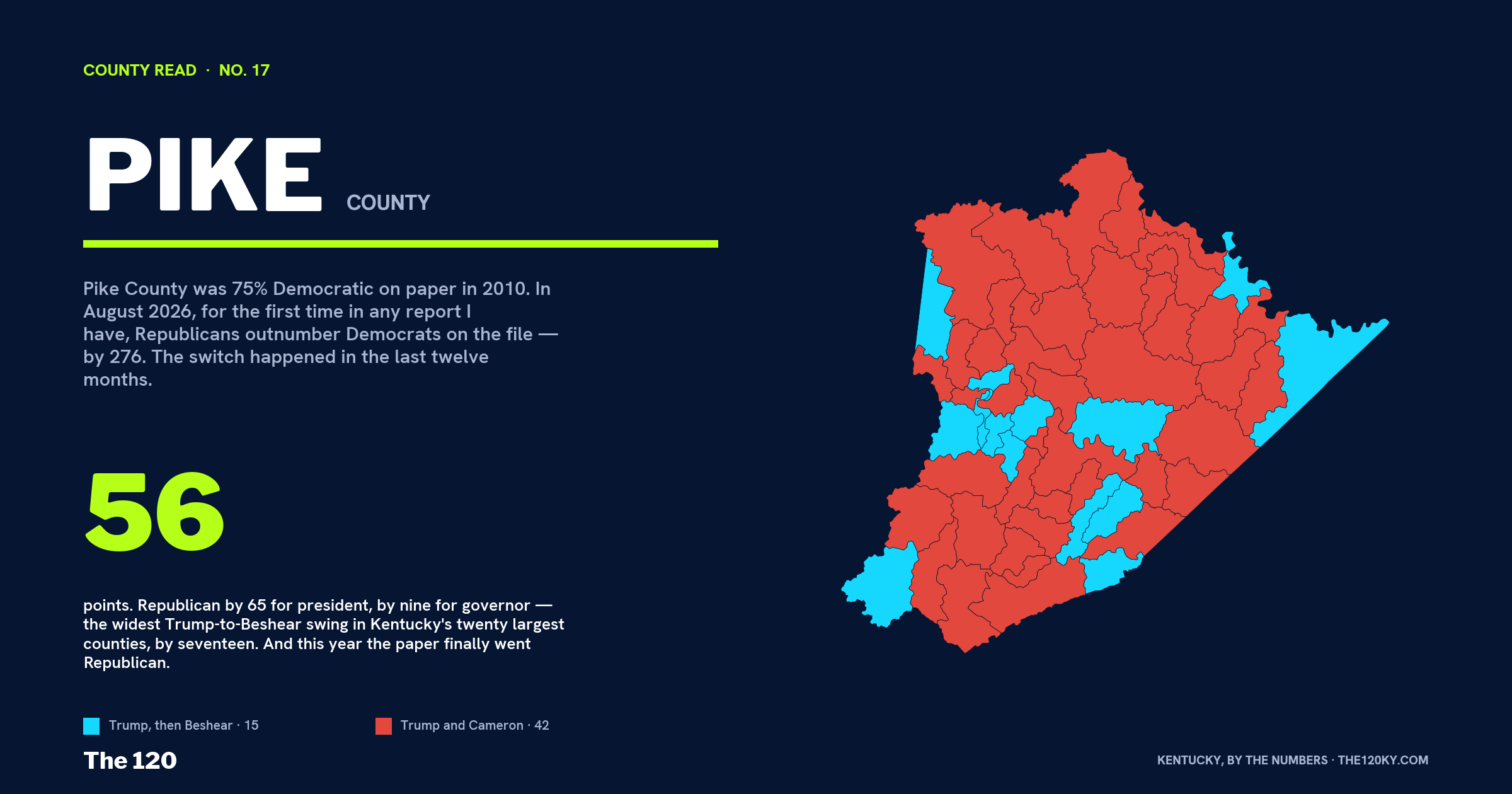
Pikeville's county was 75% Democratic on paper in 2010 and had a Republican majority on the file for the first time this August. It voted for Rand Paul's opponent within a point in 2010, for Trump by 65 in 2024, and for Cameron by nine in between. That's a 56-point swing, seventeen wider than any other county in Kentucky's top twenty. It's also the only county in this series east of Lexington with a Democratic incumbent on the ballot — and he's being out-raised.
LOUISVILLE — Seventeenth of twenty, and the first county east of I-75. Same five questions: the paper, the ballots, the turnout, the map, the money. Every one of them has a number on it that you won't see anywhere else.
What the paper says. Pike County has 42,075 registered voters on the August file: 19,238 Democrats, 19,514 Republicans, 3,323 in neither column. That's 45.7% Democratic, 46.4% Republican, 7.9% no-party. Read the first two again. In 2010 Pike County was 75.1% Democratic and 21.6% Republican — 33,821 Democrats to 9,738 Republicans, a 24,000-name edge, the most Democratic paper of any county in the twenty by a mile. Sixteen years later the Democratic column has lost 14,600 people and the Republican column has doubled, in a county that shrank by 3,000 voters. And the crossover happened in the last twelve months: on Election Day 2024 there were 22,987 Democrats and 18,691 Republicans on the Pike County file. Since then the Democratic column lost 3,749 and the Republican column gained 823 — through a purge. That's not the cleanup removing dead Democrats; the Republican column grew. That's people walking into the clerk's office and switching. As of August, for the first time in any registration report I have, there are more registered Republicans than Democrats in Pike County, by 276.
What the ballots say. The chart with the biggest number in the series.
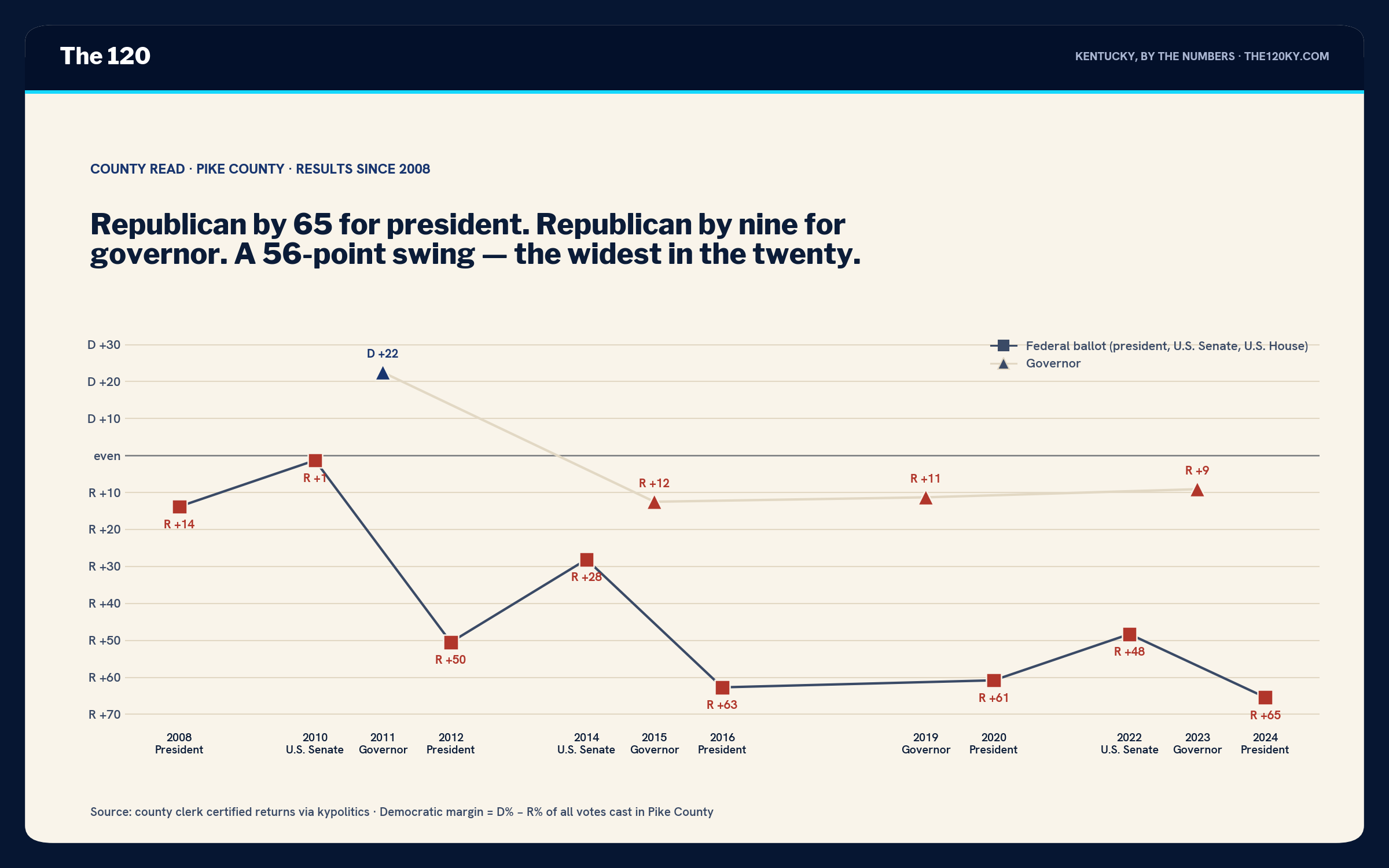
In 2010, Jack Conway lost Pike County to Rand Paul by 193 votes — 7,470 to 7,663, a point. In 2024, Trump carried it by 65: 19,684 to 4,025, a 15,659-vote margin, 82% of the vote. That's a 52-point move on the federal ballot since McCain carried it by fourteen in 2008 — the biggest of any county in the state's top twenty — and it's the whole eastern Kentucky story in one line: a coal county with a Democratic paper majority that voted Democratic for federal office until about 2012 and then didn't, all at once.
And on the governor's line, it barely moved. Bevin by twelve in 2015. Bevin by eleven in 2019. Cameron by nine in 2023, 6,954 to 5,797. Beshear got 45.5% of Pike County twelve months before Harris got 16.8%. That's a 56.3-point swing between consecutive Novembers — seventeen points wider than Bullitt's and Scott's 36.9, which are next. No other county in the twenty is close. Pike County votes for a Democratic governor at nearly the rate it did in 2011 and for a Democratic president at a third of that rate, and the same 42,000 people are doing both.
Who's turning out. The gap is smallest in the year that matters least.
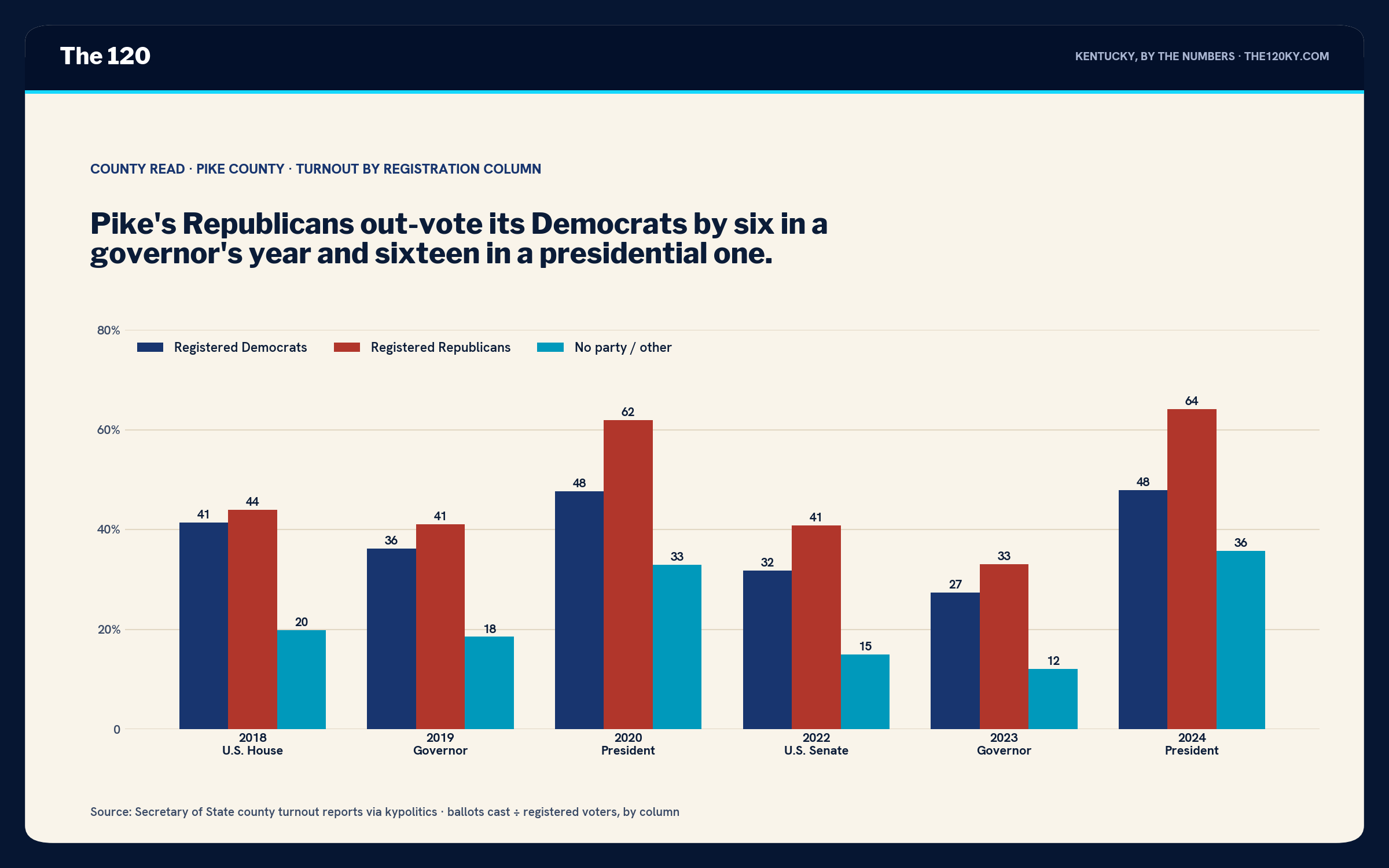
In 2023, 33.1% of Pike's registered Republicans voted and 27.4% of its Democrats did — a six-point gap. In 2024, 64.1% and 47.9% — sixteen points, behind only Laurel and Pulaski in the series. The pattern is the same as every paper-Democratic county, exaggerated: the Democratic column here is 19,000 people, most of whom registered that way when it was the only way to vote in a primary that mattered, and in a presidential year half of them stay home and the other half vote for Trump. The no-party column, 3,323 voters, turned out at 15.0% in 2022 and 12.1% in 2023 — the second-lowest in the series after Christian.
Pike County was 75% Democratic on paper in 2010. In August 2026, for the first time in any report I have, Republicans outnumber Democrats on the file — by 276. The switch happened in the last twelve months, through the purge, with the Republican column growing.
Where it happens. All 57 precincts with both years — the first county since Daviess with 2023 and 2024 on every precinct — and no blue on the map.
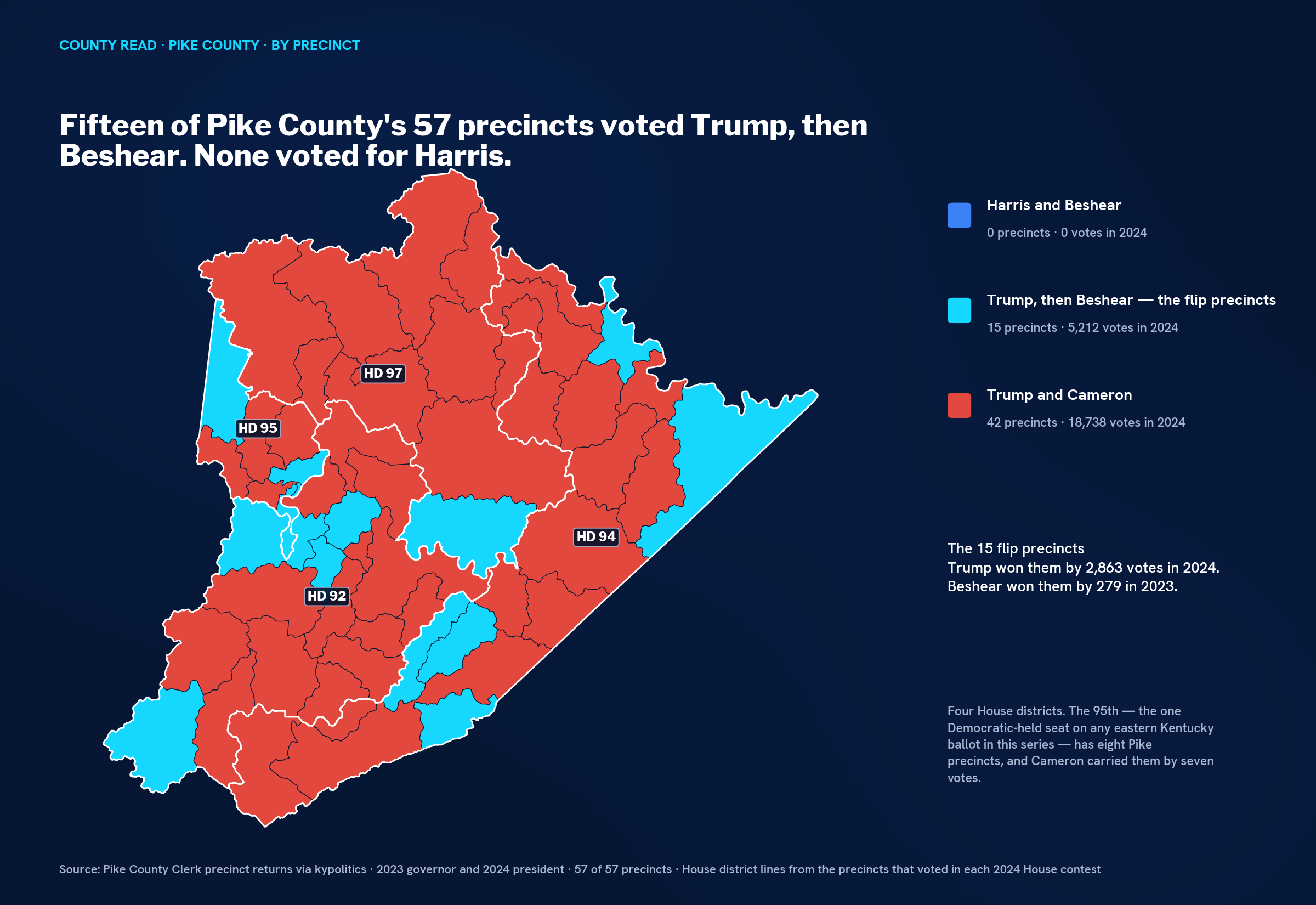
No precinct in Pike County voted for Harris. Fifteen voted for Trump and then for Beshear — 5,212 votes, Trump by 2,863, Beshear by 279. Forty-two voted for Trump and for Cameron: 18,738 votes, Trump by 12,796, Cameron by 1,436. Beshear lost the county by 1,157 votes; he lost the 42 red precincts by 1,436 and won the fifteen cyan ones by 279. That's Pikeville, the county seat, and the river towns, against the hollows. It's a narrower Democratic core than Paducah's or Owensboro's — there is no blue here at all — but it's the same shape: a Democratic governor wins the town and loses the county by a little, and a Democratic president loses everything by a lot.
The flip precincts split across all four House districts: five in the 92nd, five in the 94th, four in the 95th, one in the 97th. The 95th's eight Pike precincts went for Trump by 2,128 and for Cameron by seven votes. Seven.
What's on the ballot, and who's paying. Four House districts touch Pike County; its Senate seat isn't up this year. Two are contested. One of the two has a Democratic incumbent — the only one on any ballot east of Lexington in this series.
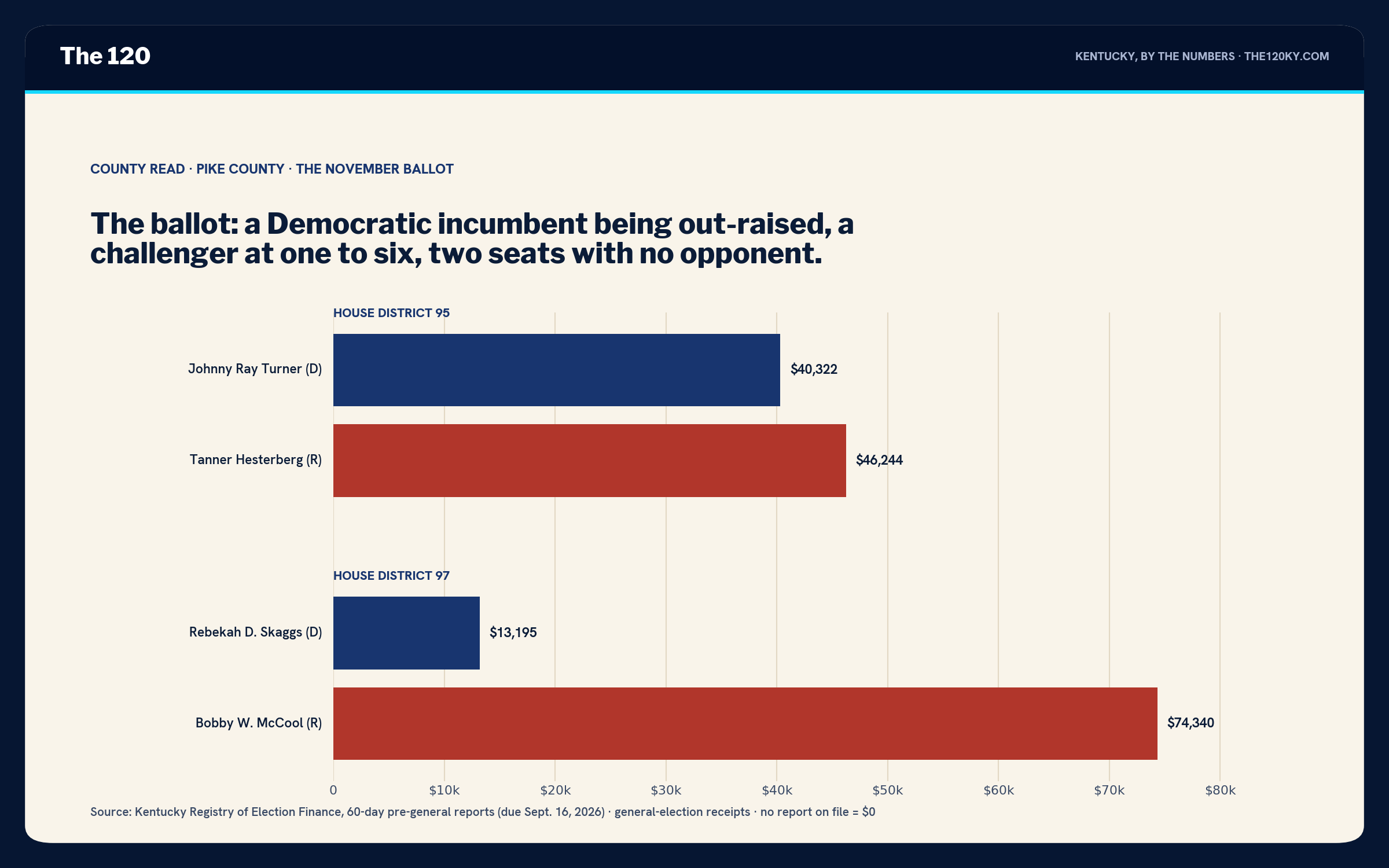
The 95th is Johnny Ray Turner's — Floyd County and eight Pike precincts — and he's a Democrat who won it in 2024 by 12.6 points, 10,721 to 8,330, on a day Trump carried every precinct in the county. Tanner Hesterberg is the Republican and has $46,244 to Turner's $40,322. That's a Republican challenger out-raising a Democratic incumbent, and it's the only House race in Kentucky this cycle where that's true. The 95th's Pike precincts were Cameron by seven; the seat is Floyd's mostly, and Floyd isn't in this series, but this is the last Democratic-held House seat in the coalfield and the Republicans have money on it.
The 97th is Bobby McCool's — ten Pike precincts — $74,340 against Rebekah Skaggs's $13,195, in a seat McCool held without a Democrat in 2024. The 92nd is John Blanton's, nineteen precincts, $46,974, no opponent. The 94th is Mitch Whitaker's, twenty precincts, $24,169, no opponent.
The read. Pike County is what the 2010s did to Democratic Kentucky, in one county, with the receipts. A paper majority of three to one that voted for Conway within a point, then for Romney by 50, then for Trump by 65, and finally — this year — stopped being a Democratic majority on paper at all. What survived is the governor's line: Beshear at 45% in a county Harris lost by 65 is the widest gap between the two ballots anywhere in the state, and it's the same gap Bevin faced in 2015 and 2019. That's not persuasion; that's a county that has simply never connected the two offices. And the one place it still reaches a legislative seat — the 95th, with a Democratic incumbent — is the one place in the twenty where a Republican challenger is out-raising a Democrat who holds the seat. If Turner holds, eastern Kentucky still has a Democratic House seat. If he doesn't, the last Beshear-to-legislature bridge east of Lexington is gone.
What I'm watching in November: the 95th, and the fifteen cyan precincts against Beshear's 279. And the registration file in December — whether the Republican column keeps growing through a purge, which would mean the switching hasn't stopped.
Monday: Jessamine.
Disclosure: I work in Kentucky Democratic politics. I'm not paid by, and don't advise, any candidate named above. I read this county the same way whether or not it's good news for my side — that's the job.