2026 · U.S. Senate
Booker vs. Barr: the floor is 38, and this time the seat is open.
Three Kentucky Democrats have run for Senate in the last decade and lost. All three ran at an incumbent. This one doesn't — and that, plus a midterm with Trump off the ballot, is the whole case for paying attention.
LOUISVILLE — The primaries are settled: Charles Booker is the Democratic nominee, Andy Barr the Republican. Before anyone tells you it's hopeless or tells you it's winnable, here's the band a Kentucky Democrat actually operates in — and the two things about 2026 that make it different from the last three tries.
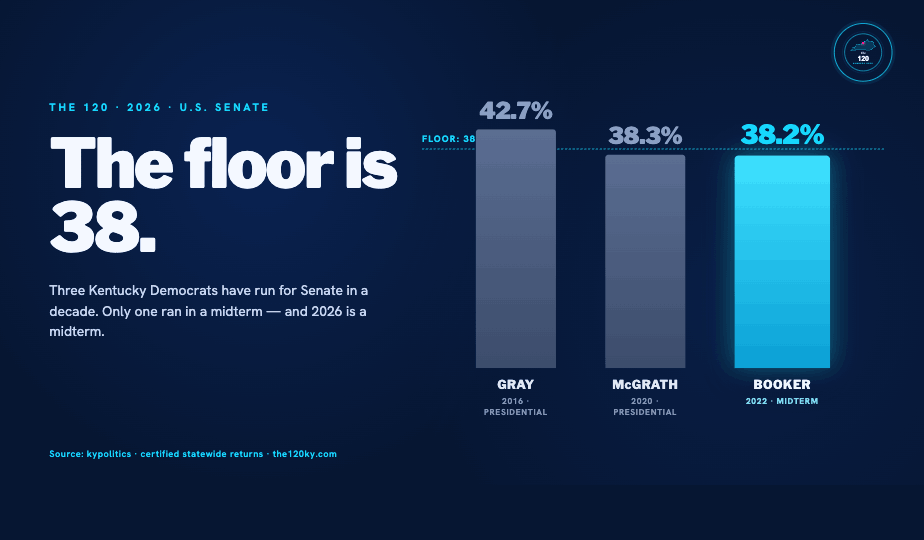
42.7% · 38.3% · 38.2%
Gray 2016 · McGrath 2020 · Booker 2022 — the last three Democratic Senate runs
A Kentucky Democrat for Senate has finished between 38 and 43 percent every modern try. But those three numbers aren't the same kind of number — and reading them as one band is the mistake.
Here's the distinction the cable hit will skip. Gray's 42.7% and McGrath's 38.3% came in presidential years — Trump on the ballot, a 2-million-plus electorate. Booker's 38.2% came in 2022, a midterm, with about 1.48 million voters. 2026 is a midterm. So the honest benchmark for Booker isn't Gray's presidential ceiling — it's Booker's own midterm floor: 38, a 23-point loss. Start there and be straight about it.
But now look harder at Gray's number, because it carries the most important lesson in Kentucky politics. In 2016 Trump won Kentucky with 63%. Gray still got 42.7% — running nearly ten points ahead of Hillary Clinton on the very same ballot. Roughly 184,000 Kentuckians voted Trump for president and Gray for Senate. That is the split-ticket capacity of this state, documented in a landslide year: even when the top of the ticket goes 63-33, a Democrat with the right profile can pull a tenth of the electorate back across the line.
The ceiling on a Kentucky Democrat isn't 38 because Kentuckians won't split a ticket. They will — 184,000 did it for Jim Gray while voting for Trump. The ceiling is about who the Democrat is and how the money's spent.
There's a fresher signal than 2016, from exactly the kind of election 2026 will be. The last time a Democrat ran for Senate in a midterm — Booker, 2022 — he lost with 38%. But 38% in that midterm beat the 34.5% the presidential nominee managed two years later. A Senate race in a lower-turnout midterm is friendlier ground for a Kentucky Democrat than the top of a presidential ticket — and 2026 is a midterm. Down at the district level Booker even cleared 50% in suburban Louisville and Northern Kentucky seats — House Districts 57, 67, and 38 — that the presidential nominee lost. None of it won. All of it points the same way: in the kind of year 2026 is, the Democratic floor ticks up, not down.
So the two things that make 2026 its own animal, not a rerun:
It's an open seat. Gray ran at Rand Paul. McGrath ran at Mitch McConnell. Booker ran at Rand Paul. All three were beating their heads against an incumbent — the single hardest thing to overcome in American politics. Mitch McConnell is retiring, and for the first time in a generation there is no incumbent on this ballot. Open seats are exactly where the out party makes its midterm gains. Barr starts as the favorite, but he starts as a candidate, not a 40-year institution.
Trump isn't on the ballot. That cuts both ways, and honesty means naming both. It costs Democrats the presidential-year electorate — a midterm sheds roughly a half-million voters off the 2024 turnout, and a lot of them are the irregular voters Booker needs. But it also means Barr doesn't inherit Trump's 64% ceiling — that number is Trump's, not the Republican Party's (the whole argument of our swing-map dispatch), and the first midterm of a Republican presidency historically punishes the president's party. The 184,000 split-ticket voters Gray found don't have a Trump at the top pulling them home this time.
Now bring in what's actually happening to the voters this race is fought over, because a Senate read that stops at vote totals is half a read.
35 hospitals · +29.8% · $89/acre
The squeeze on rural Kentucky, right now
35 Kentucky rural hospitals are flagged at risk of closure under the 2025 Medicaid cuts — the most of any state in the country (Sheps Center, UNC). ACA premiums rose a weighted 29.8% for 2026 before subsidies — roughly $181 a month more for the average Kentucky family — now that the enhanced subsidies have expired. And soybean farmers are staring at about an $89-per-acre market loss, a third straight losing year, after China stopped buying; the December federal aid of $30.88 an acre was called, by the soybean growers' own former president, "a Band-Aid on a deep wound."
Those numbers belong in a Senate analysis, not just a stump speech, because of where they land: the rural counties posting them are the same counties that gave Trump 70 and 80 percent — and gave Andy Beshear majorities the year before. That's the split-ticket seam. The question a midterm puts on the table is whether a hospital that just closed, a premium that just doubled, and a crop with no buyer are the kind of kitchen-table pain that peels a Trump voter onto a Democratic Senate line — the way 184,000 of them peeled to Jim Gray.
And that's where Barr's own campaign becomes the variable. Since his first ad, Barr has run as one thing: the Trump candidate. He and his allied PACs poured roughly $27 million into the primary, and in the closing two weeks spent $5 million on television whose message was the endorsement itself — not hospitals, not premiums, not farm prices, not a Kentucky agenda of his own. He built his brand on a name at the top of the ticket, and that name isn't on the 2026 ballot. A candidate who is only "the Trump guy" is strongest when Trump is popular and on the ballot — and most exposed in a midterm, when Trump is neither.
Then the discipline, because the same honesty has to cut the other way: Kentucky has absorbed staggering rural pain before and voted Republican anyway. Hospitals were closing and farms were hurting in 2024, and Trump still carried the state by thirty. Issue pain alone has not moved Kentucky's federal results — the brand has beaten the checkbook every time. So the honest read isn't that these numbers flip the seat. It's that 2026 stacks the three things that could finally make them bite at once: a midterm, an opponent with no identity but Trump, and a fresh, nameable squeeze in the exact counties where the split ticket already lives. Whether that's enough is the race.
Jefferson County · 2026 U.S. Senate primary
Put it together and the read is specific, not mushy. Booker's floor is his own 2022 number — 38, a 23-point loss, and Cook still rates this Solid R. The open seat and the anti-incumbent midterm are the variables that could lift him toward Gray's 42–43 — but in a smaller midterm electorate, and 43% still loses. To actually win, the bubble — open-seat softness, a sour national climate, Barr underperforming Trump's borrowed ceiling, and Gray-level ticket-splitting — has to clear a 20-plus-point gap all at once. That's a wave, not a normal cycle. The straight verdict: more genuinely competitive than any Kentucky Senate race since Gray, and still an underdog's race that needs the climate to break.
The number that should scare a Kentucky Democratic Senate campaign isn't the polling. It's the spending. McGrath raised about $90 million and finished four points below Jim Gray, who ran on a shoestring at $2.95 a vote.
Which is the part I'd fight about in the room. If the ceiling is really about candidate and money, then Booker tests it the way Gray did — efficient, on the ground, in the counties and the Louisville/Lexington precincts where Democratic votes actually exist and the split-ticket voters live — not the way McGrath did, lighting $90 million on television that bleeds across five state lines to people who will never vote for him. The open seat gives him the opening. The midterm climate gives him the wind. Whether he has Gray's discipline with a dollar is the variable he actually controls.
What I can't size yet is the climate itself — "midterms punish the president's party" is a direction, not a number, and Kentucky's lean can swallow a normal wave. The tell to watch isn't the topline poll. It's whether Barr is spending time and money defending Republican counties he should own outright. The day he plays defense in his own base is the day this stops being Solid R on paper and starts being a race. I'll be reading the precincts for it.
Disclosure: I work in Kentucky Democratic politics and consult campaigns in this state. I read this race the same way whether or not it's good news for my side — that's the job.