The take
AI won't win your race. It will give you back the hours you were losing.
Every campaign in Kentucky is being sold AI this year, and most of the pitches are for the one thing it does worst. Here's where it actually earns its keep — and the three places I'd keep it out.
LOUISVILLE — I build with these tools every day. I also run field programs, which means I spend a lot of time around people who have been told AI is going to write their persuasion mail, target their voters, and generate their volunteers. It will not do any of those things well, and the vendors selling it know that. What it will do is something less glamorous and more valuable: give a two-person campaign back the twenty hours a week it was spending on work a machine should have been doing since 2019.
So here is the honest version, from somebody who has no product to sell you.
AI is not a strategist. It's the best junior staffer you've ever had — fast, tireless, and wrong in ways you have to check. Hire it for that job and it will change your campaign. Hire it for the top job and it will lose it.
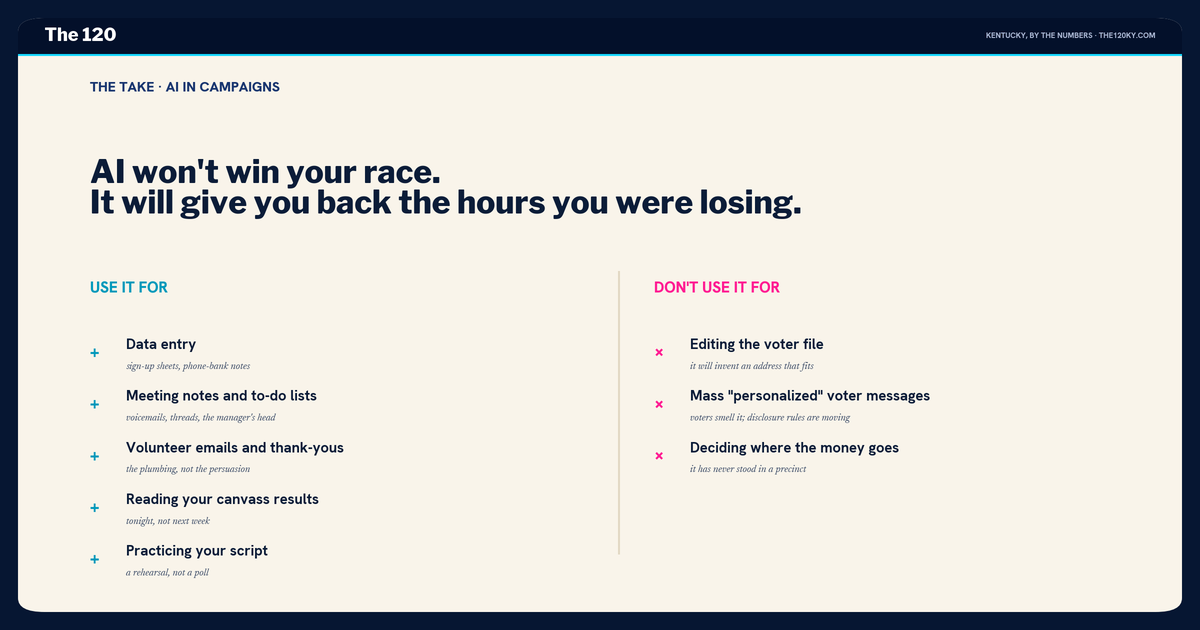
Where it earns its keep — the layers nobody wants to do.
The data that isn't on a phone yet. MiniVAN put the doors into the database for you; what's still on paper is everything else — the sign-up sheet from the house party, the phone-bank notes, the shoebox of cards from the county fair, the volunteer who "definitely" said yes on a text thread. A photo of each and a model that reads handwriting turns a volunteer's Tuesday night into twenty minutes and a review pass. That's the data the postcard ladder runs on, and it was never getting entered.
Turning notes into a record. Every campaign has a manager who knows everything and writes down nothing. Point the tool at the voicemail transcripts, the Slack threads, and the meeting notes, and ask it for the list of commitments, the list of open questions, and the people it heard mentioned. It will not be perfect. It will be more than the campaign had, which was nothing.
First drafts of the routine. The volunteer thank-you, the event confirmation, the "here's what happened at the doors this week" update to the county committee. These are not persuasion. They are the plumbing of a campaign, and they were not getting written because the one person who could write them was cutting turf. Draft them in seconds, fix them in a minute, send them. The volunteer who gets told what her turf came back with is the volunteer who shows up next Saturday.
Reading your own numbers. Export the canvass results, hand it the spreadsheet, and ask it which precincts came back above the average and which volunteers' packets came back empty. It will not tell you why. It will tell you where to look, in the time it takes to make coffee, and that is the whole point — the data was always there and nobody had an hour to read it.
Testing a script before a human hears it. Give it the persuasion script and ask it to argue back as a fifty-eight-year-old Democrat in Madison County who voted for Beshear and Trump in consecutive years. It's a rehearsal, not a poll. But it is a cheap rehearsal, and most campaigns walk into a real door with none.
Where I'd keep it out — three places.
The voter file. Never let a model touch the data of record. It does not know which Robert Smith on Bardstown Road is yours, it will confidently invent an address that fits the pattern, and one hallucinated record in a walk list is a volunteer standing in front of a house that does not exist. The file is a legal document. Models are for reading it, never for writing it.
Persuasion at scale. The pitch you will hear is a thousand personalized messages, each one tuned to the voter. Two problems. The first is that it does not work the way they say — a voter can smell generated copy faster than any of us can, and the thing that persuades in Kentucky is a neighbor at the door, not a paragraph tuned to her Zip code. The second is that disclosure rules on synthetic content are moving through statehouses across the country, and the campaign that gets caught using generated voices or images in October is the campaign whose last two weeks are about the tool instead of the candidate. Nobody wants to be the Kentucky test case. Not worth it. Not close.
The decision. Where to spend, whom to target, which precincts get the field program and which get the mail. The tool can lay out the trade-offs faster than your consultant can. It cannot own the call, because it has never stood in a precinct, and it does not know that the county chair's cousin runs the Baptist church that anchors that turf. Twenty years of this taught me that the relationship outlasts the org chart. The model has no relationships.
20 hours
A rough weekly figure for what a small campaign loses to work a machine should be doing
My own estimate from campaigns I've walked into, not a survey: data entry, note-taking, routine correspondence, and reading results the campaign already collected. Your number is different. Count it.
The honest test for any AI pitch is one question: does this replace the work I was avoiding, or the judgment I was paying for? The first is a gift. The second is a mistake dressed as efficiency, and this year it's an expensive one.
Here is what I am watching. Not which campaigns use AI — most will, quietly, and the ones who say they don't are usually the ones with an intern doing it on a personal account. I'm watching which campaigns get the paper — the sign-up sheets, the phone notes, the house-party lists — into the database the same night for the first time in their history, because that is the tell that the tool got used for the right job. The rest is a vendor's slide deck.
I read the numbers straight. The machine helps me read them faster. It has never once told me what they mean.
Disclosure: I co-founded a company that builds custom AI tools. Nothing in this piece recommends a product — mine or anyone's.