
County Reads Nos. 13–15 · Pulaski, Laurel, Christian
Where nobody's running: Pulaski, Laurel and Christian counties
Twelve House districts touch these three counties. One has a race, and it's $208,445 to $930. Pulaski and Laurel are the floor of the series — Trump by 65 and by 70 — and Beshear still set the Democratic record in both. Christian is the exception: a Democratic column that actually votes, and a Hopkinsville seat Cameron carried by 329 votes where nobody has filed against the incumbent in two cycles.
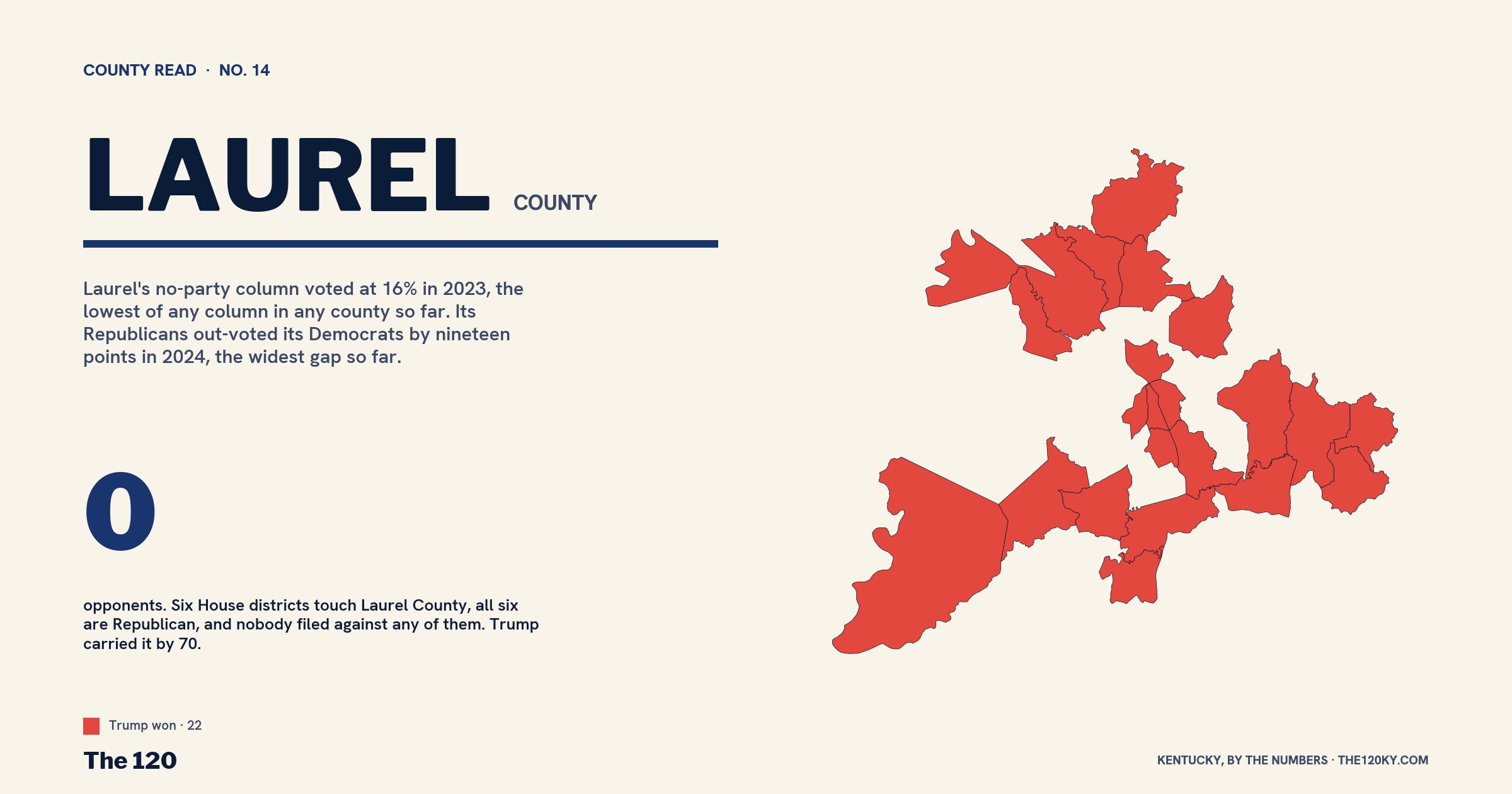
LOUISVILLE — Thirteenth, fourteenth and fifteenth of twenty, in one piece, because the November answer in all three is the same: there's almost nothing on the legislative ballot. Twelve House districts touch Pulaski, Laurel and Christian counties. Eleven have one name on them. The twelfth is a race in the sense that two names are on the ballot.
But the three get there by different roads, and the difference is the most useful thing in this series. Two of these counties are the floor. The third is an open door nobody's walked through.
The floor: Pulaski and Laurel.
Start with the paper. Pulaski County has 50,990 registered voters on the August file, 71.5% Republican and 18.6% Democratic. Laurel has 47,265, 74.6% Republican and 17.9% Democratic — the smallest Democratic column, the biggest Republican one and the smallest no-party column of any county in the twenty. Neither has a correction story. In 2010 Pulaski was already 67.9% Republican and Laurel 71.8%. The paper was right before anyone was looking.
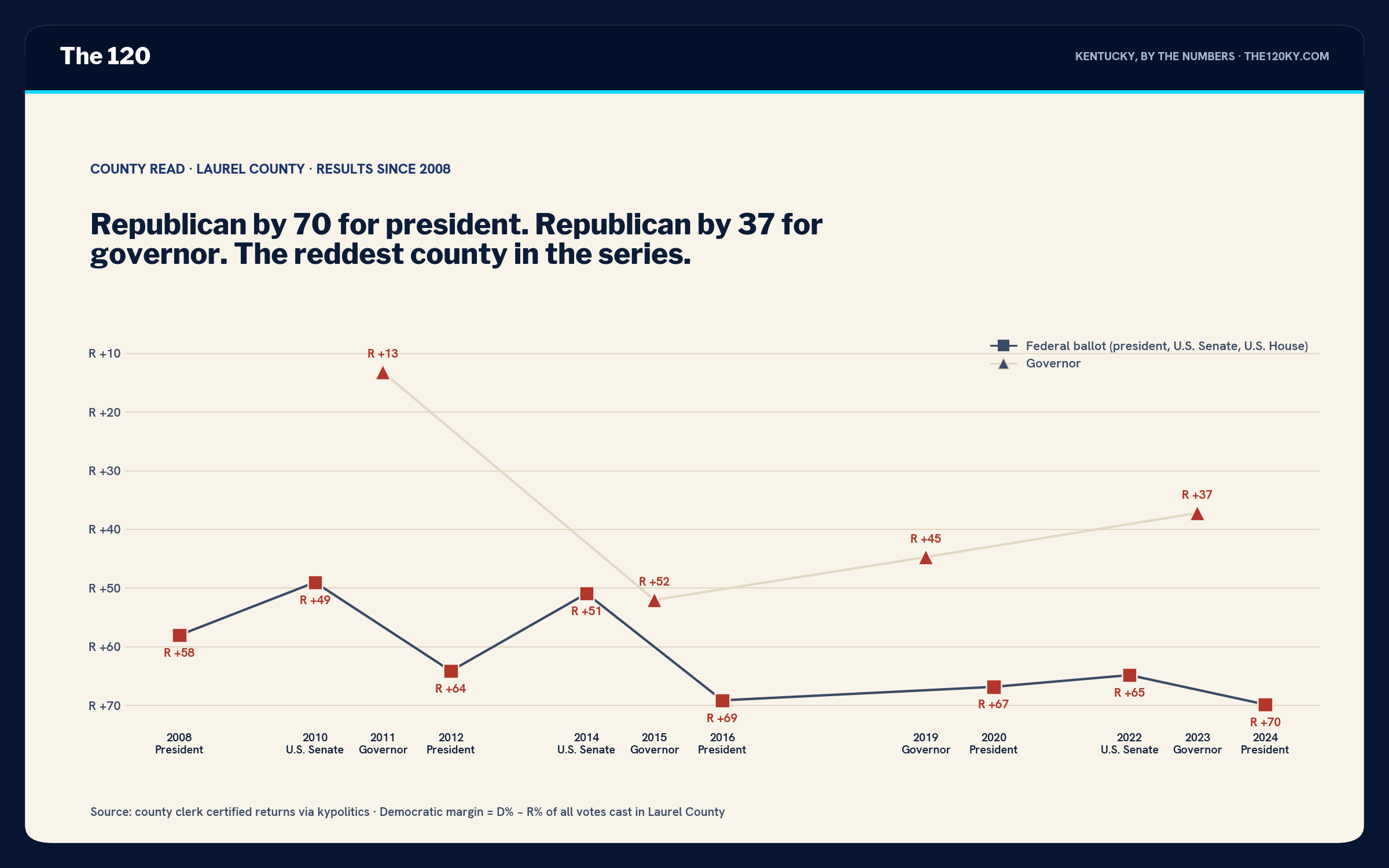
Trump carried Laurel by 70 points in 2024, 23,516 to 4,037 — 84% of the vote, the widest presidential margin in the twenty. He carried Pulaski by 65, 26,051 to 5,351. On a governor's ballot the year before, Cameron carried Pulaski by 36 and Laurel by 37. That's a 29.5-point swing in one and a 32.6-point swing in the other, the same size as Hardin's and McCracken's — except here it runs from a place no Democrat can reach to another place no Democrat can reach.
Now the honest version, because this is the number most people would skip. Beshear's 6,139 votes in Pulaski in 2023 are more than any Democrat has gotten there for president or governor since at least 2008. His 4,974 in Laurel are the record there too — more than Obama, more than Biden, more than Harris. He lost Pulaski by 36 and Laurel by 37 and set the Democratic high-water mark in both, on an off-year ballot. Both things are true. The second one is the one people miss.
In the reddest counties in Kentucky, the ceiling for a Democrat is a third of the vote, once, for one man — and nobody is on the ballot to test whether it holds.
The turnout gap is where the floor really shows.
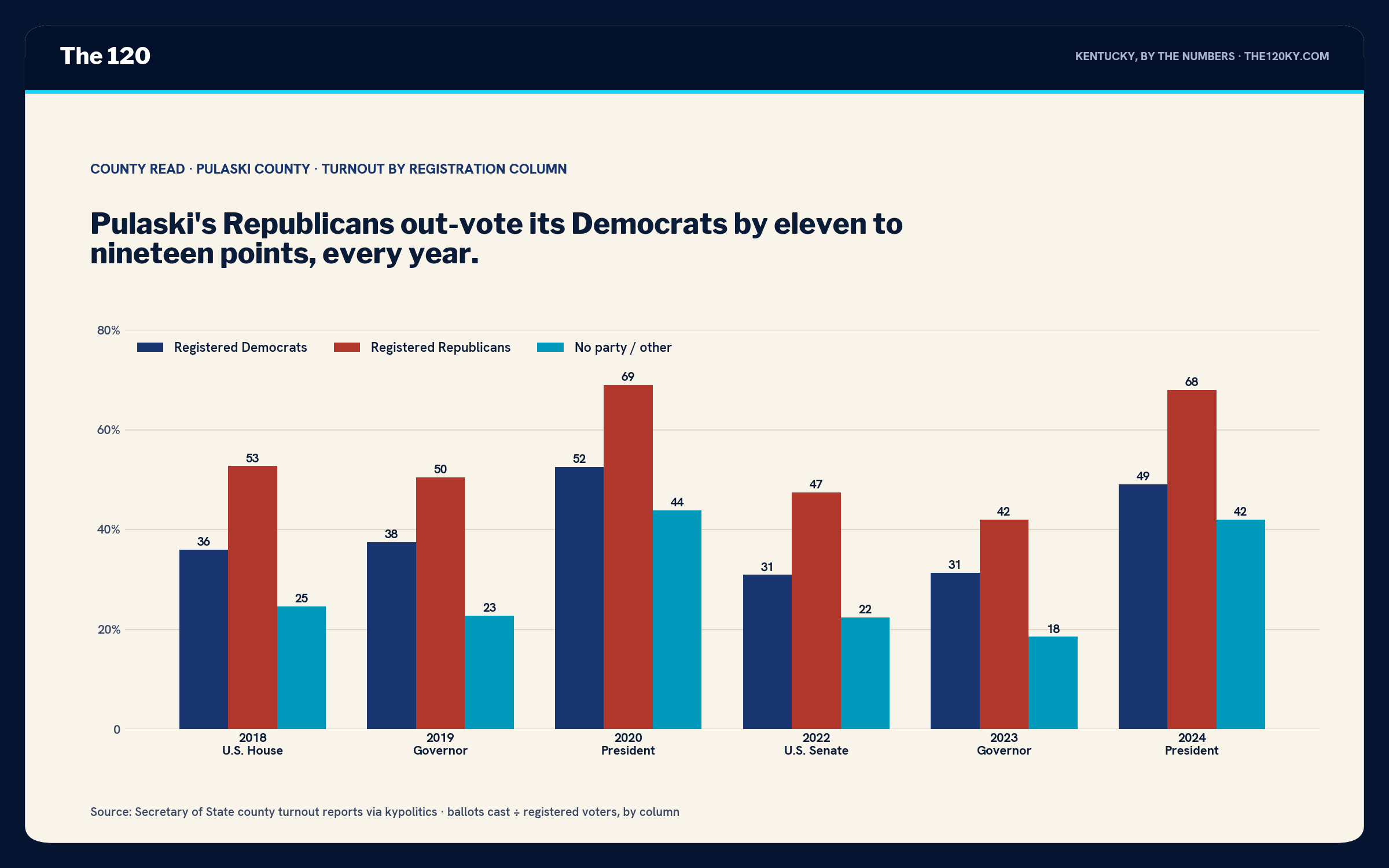
In 2024, 62.5% of Laurel's registered Republicans voted and 43.5% of its Democrats did — a 19.0-point gap, the widest in the series. Pulaski's was 18.8. Nothing else in the twenty is above twelve. A Democratic column that's under a fifth of the file in counties this Republican is heavy with people who registered that way a long time ago and either don't vote or vote the other way when they do.
And the ballot. Five House districts touch Pulaski; four have no opponent. Six touch Laurel; all six are Republican and all six are unopposed — Derek Lewis, Shane Baker, Tom O'Dell Smith, Timmy Truett, Josh Bray and Nick Wilson, $199,393 between them and nobody to spend it against. The one race in either county is the 80th, two Pulaski precincts on the edge of a district that's mostly Lincoln and Rockcastle. David Meade, the Speaker Pro Tem, has $208,445, the third-largest general-election account in the House. Mary Russell, the Democrat, has $930. Two hundred twenty-four to one.
The open door: Christian.
Christian County is the reason this piece isn't just a list of blank lines.
On paper it's even: 46,147 voters, 42.5% Democratic, 43.3% Republican. In 2010 it was 62.2% Democratic. That much looks like the rest of the series. What doesn't is who the Democrats are.
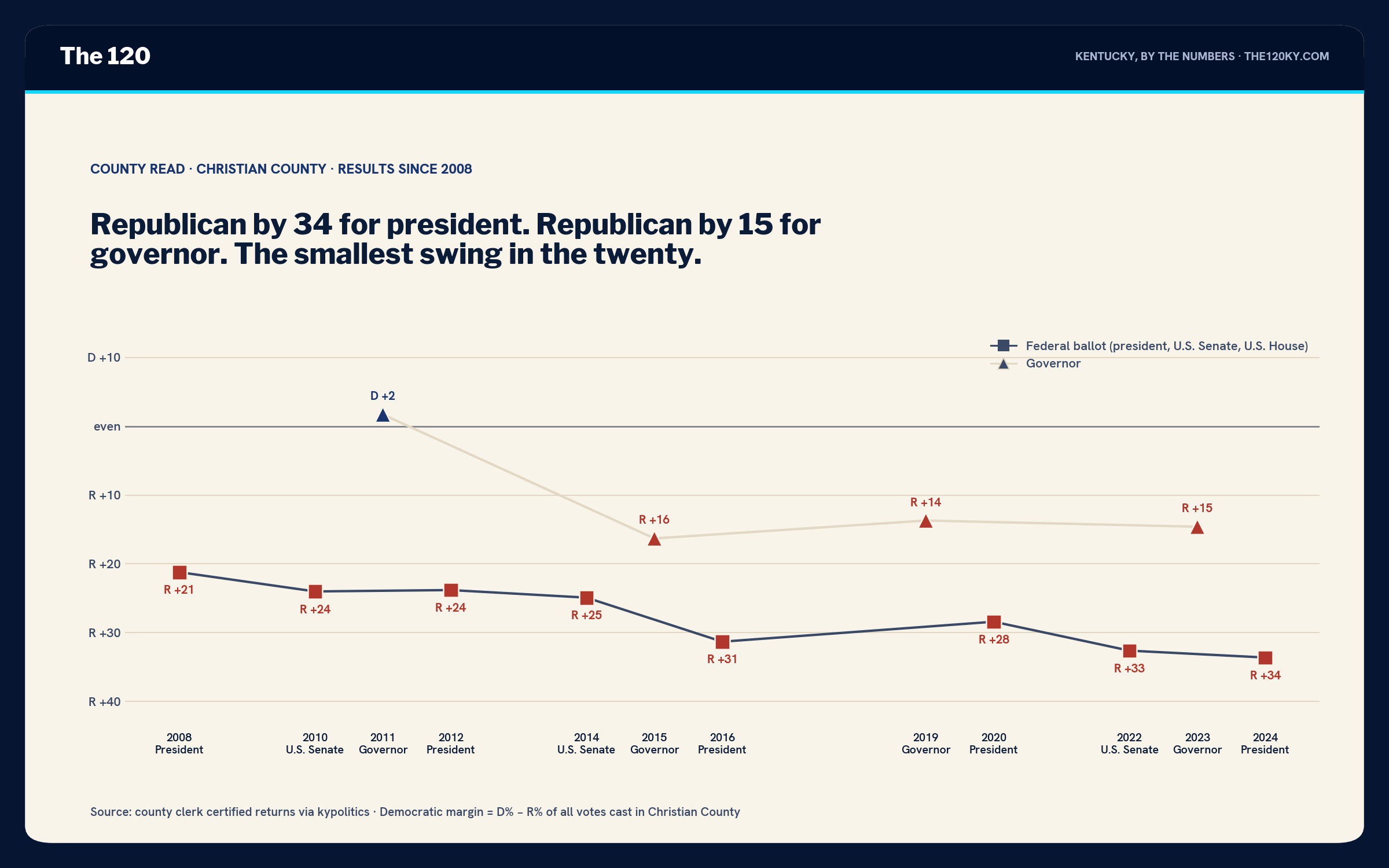
Trump carried Christian by 34. Cameron carried it by fifteen. That's a 19.0-point swing, the smallest in the top twenty. In Daviess or Madison or McCracken, the Democratic column is paper: people who registered decades ago, vote Republican for president and come home for Beshear. That's what makes a 34-point swing. In Christian the Democratic column is Hopkinsville and Fort Campbell's families, and they vote Democratic when they vote. There's nothing for Beshear to win back because they were never gone.
The proof is turnout. In 2018 Christian County's registered Democrats out-voted its Republicans, 37.0% to 33.6% — the widest Democratic turnout edge in any county in this series outside Louisville and Lexington. They were within a point in 2019 and 2020. This is a Democratic column that shows up.
Here's where it lives.
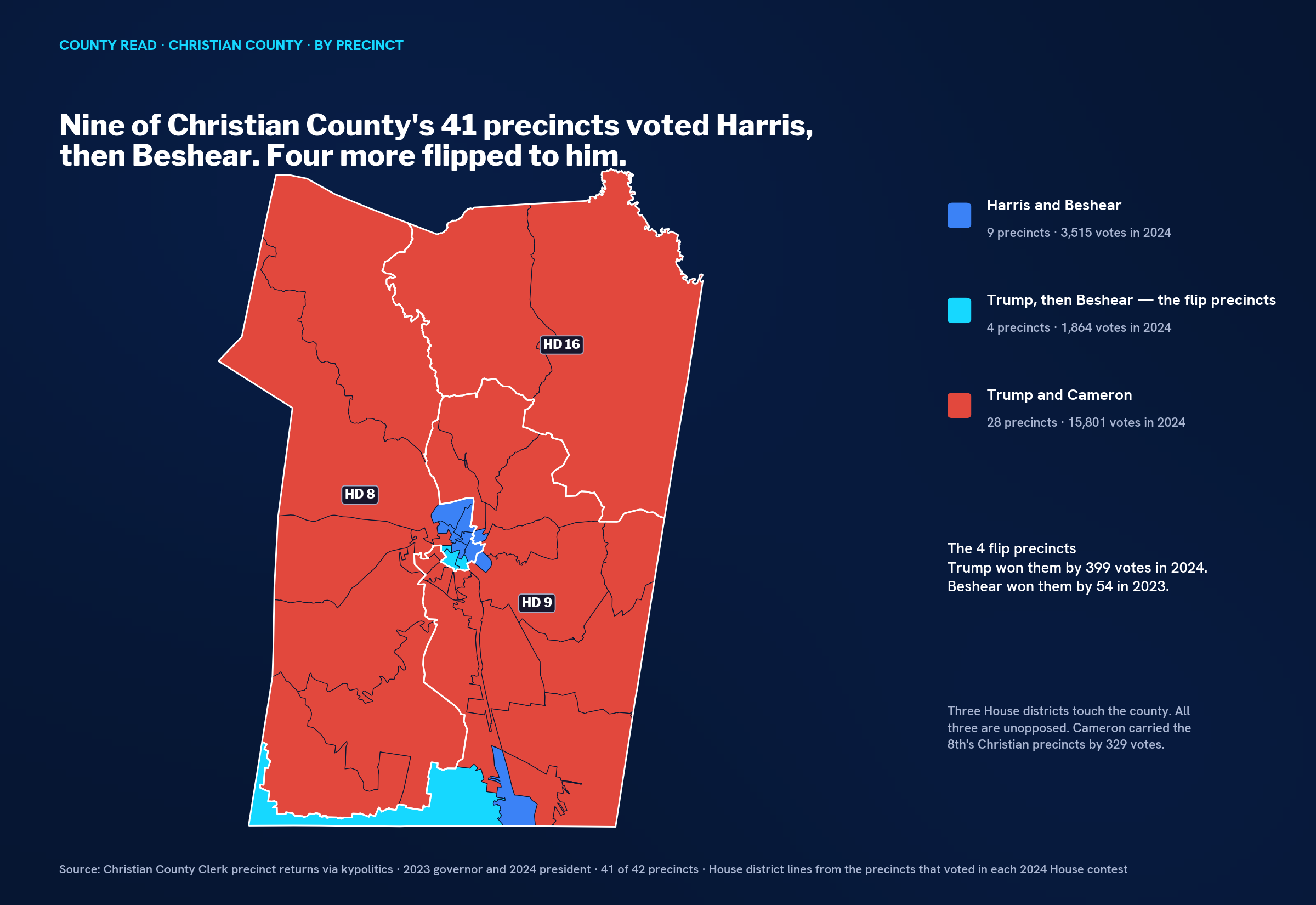
The 8th is Walker Thomas's seat — Hopkinsville, eighteen Christian precincts, six of the nine blue ones and three of the four cyan. Across those eighteen precincts, Trump won by 2,395 and Cameron by 329 votes. Thomas has no opponent this year and no 60-day report on file. He had no Democrat in 2024 either and won 14,661 to nothing. The 9th (Myron Dossett, $10,317) and the 16th (Jason Petrie, $11,900) are unopposed too. Twenty-two thousand dollars across three seats. Nobody's spending here because nobody has to.
Now the honest version of Christian. The Democratic column is real and it's shrinking. Since Election Day 2024 the county lost 5,974 registered voters net — one in nine, the heaviest cut in the series — and 3,784 of them were Democrats. Fort Campbell is most of that: soldiers and families who register, rotate out and get cleaned off the file. No campaign fixes that. And 329 is Cameron's margin in the seat's Christian County precincts, a governor's race, not a House race. It's still the best Democratic House opportunity in western Kentucky that nobody has taken. Twice.
The read.
Pulaski and Laurel are what Kentucky looks like when the paper and the vote agree. A Democrat at the top of his form got a third, set a record doing it, and the party filed a name in one of the nine House districts that touch them — the one at 224 to one. That's not a November story. It's the floor, and every other county in the series should be measured against it.
Christian is the opposite problem. The votes are there and nobody's asking for them. A seat Cameron carried by 329 votes in its Christian precincts, in a county whose Democrats out-voted its Republicans eight years ago, has gone two cycles with no Democrat filed.
You can't lose a race you don't contest. You also can't win one.
What I'm watching in November: the Republican turnout rate in Pulaski and Laurel against 2022 — 47.4% and 41.4%. Together they're 98,000 registered voters, almost three-quarters of them Republican. If that column comes in near 50 in a midterm with nothing on the ballot, it's a statewide number. In Christian, I'm watching 2028, and whether anyone files in the 8th.
Friday: Scott.
Disclosure: I work in Kentucky Democratic politics. I'm not paid by, and don't advise, any candidate named above. I read this county the same way whether or not it's good news for my side — that's the job.