
The read · The books close today
The books close tonight. Five dates left, and one is the whole ballgame.
Today is the last day to register to vote in Kentucky's November election. From here the voter file is fixed, the calendar is short, and the only thing left to decide is who actually shows up. Here's every date that matters between now and the third of November, what each one is worth in votes, and the arithmetic of what a campaign can still do with the time it has.
LOUISVILLE — Ten days ago I wrote about what moved in the registration file before the books closed. Tonight they close. Whatever the Secretary of State's next county report says — and I'll have it the day it posts — that's the electorate. Nobody else gets in. From here on, every number in Kentucky politics is a turnout number.
So this is the short version of the next four weeks: what's on the calendar, what each date is actually worth, and what the arithmetic says a campaign can still do with twenty-nine days.
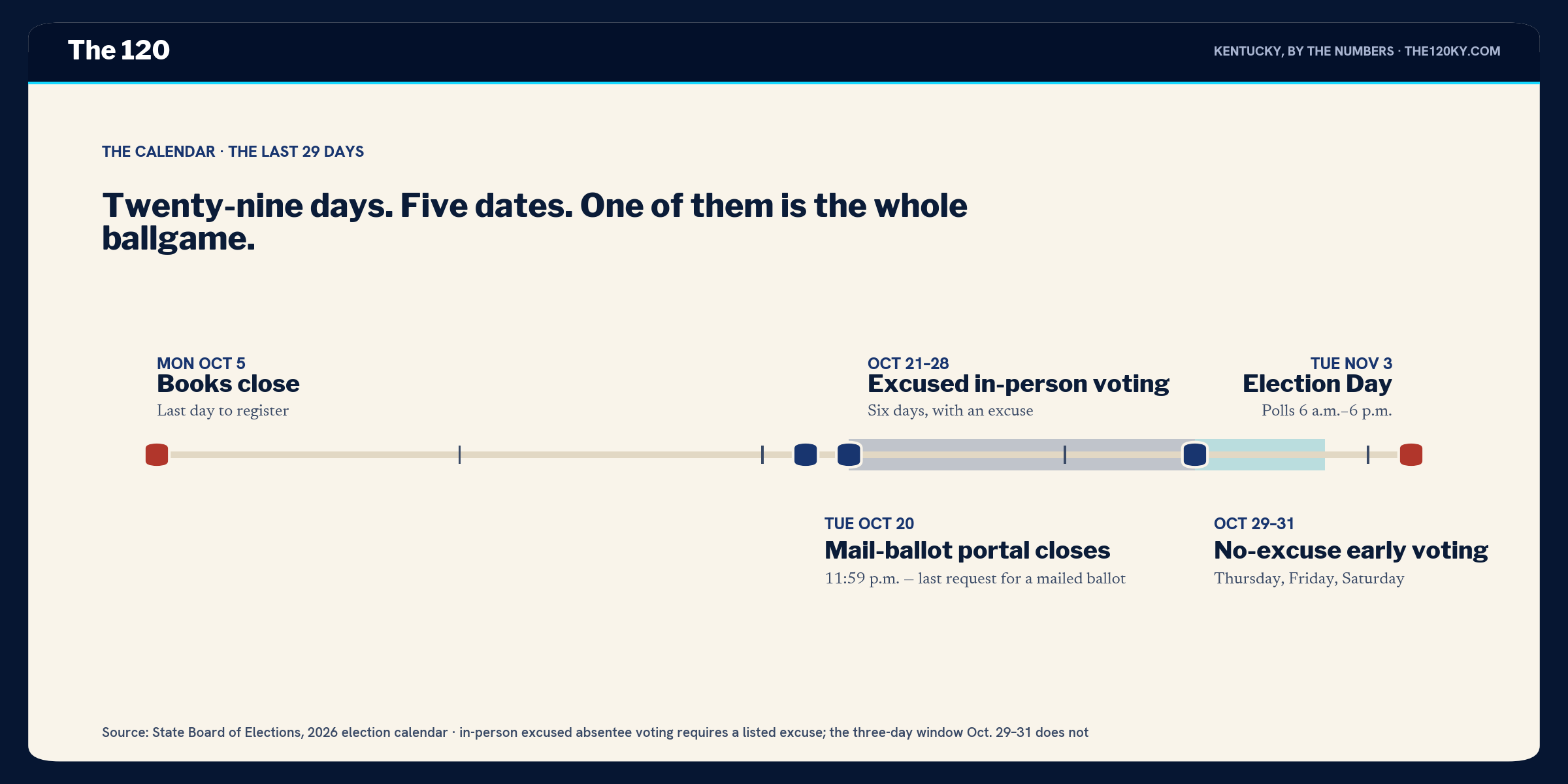
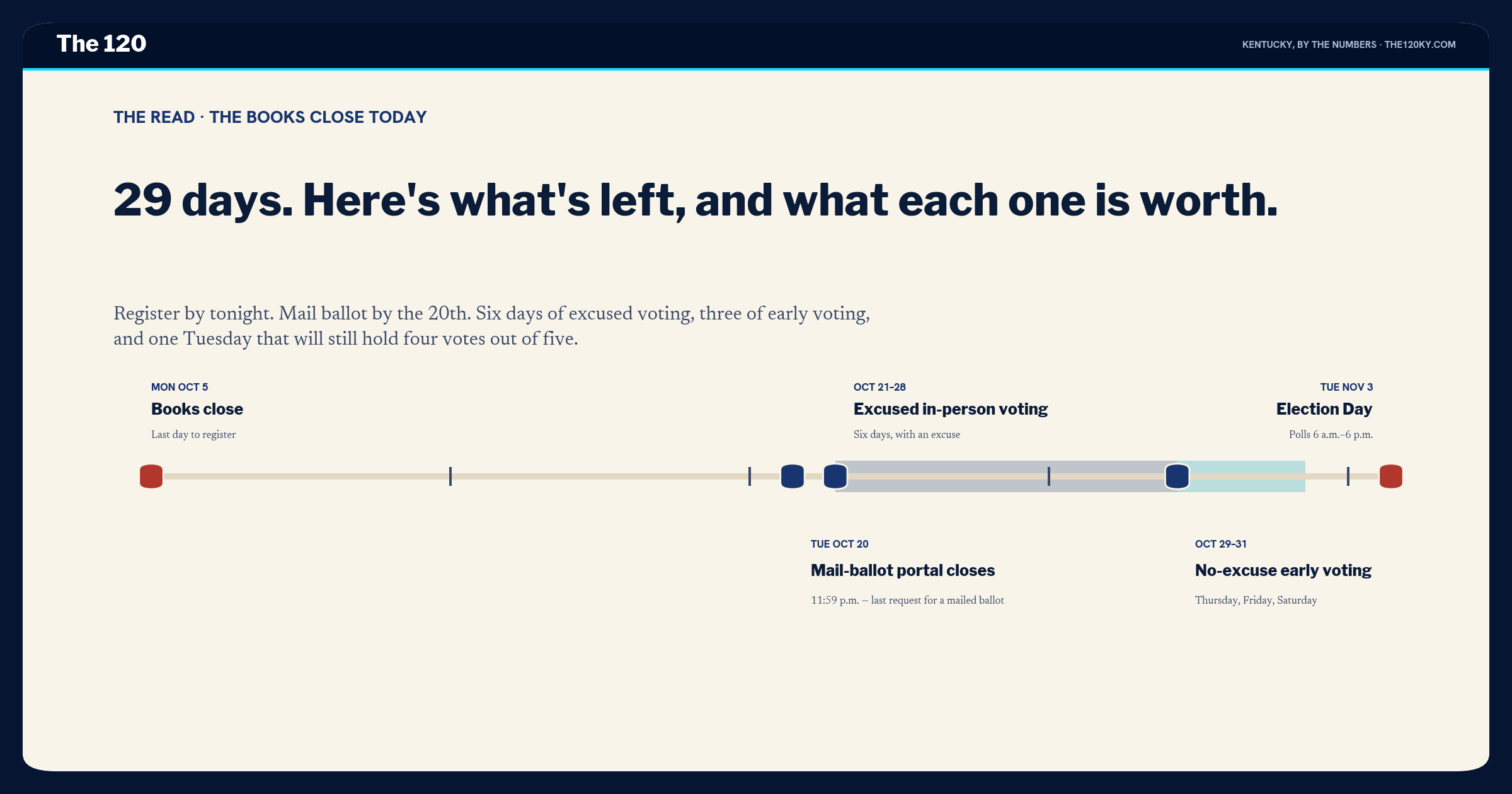
Monday, October 5 — the books close. Registration deadline, 29 days out. If you're not on the rolls by tonight, you're not voting in November, and if you are on the rolls, you are now part of a denominator that isn't going to change. The 386,382 no-party voters I wrote about last week are in it. So are the 3.4 million names that were on the file in August, minus whatever the clerks removed in September, plus whoever registered this fall. When the state posts the pre-election county totals I'll run the same comparison I ran on the August file, and the one column I'll watch is the third one.
Tuesday, October 20 — the mail-ballot portal closes at 11:59 p.m. That's the last day to ask for a ballot in the mail. Kentucky mail voting is excuse-based — age, illness, disability, being out of the county, the listed reasons — and in the May primary it carried 2.2% of Jefferson County's ballots. Two point two. A mailed ballot is the surest vote a campaign can bank, and in this state it's a rounding error. If you're running a program that identifies people who qualify and gets them a ballot, the 20th is your deadline; after that there's a paper application for medical emergencies and nothing else.
October 21–28 — six days of excused in-person voting. Wednesday through Friday, then Monday through Wednesday, at the clerk's office, with a listed excuse. This is the window most people have never heard of and most campaigns skip. It's small. It's also six more days of the polls being open for anyone who can honestly check a box, and a field program that sends its 80-year-olds and its shift workers to the clerk's office that week is a program that's not depending on Tuesday for votes it doesn't have to.
October 29–31 — three days of no-excuse early voting. Thursday, Friday, Saturday. Anybody. This is the window that was supposed to change how Kentucky votes, and in May it didn't: 15.1% of Jefferson's primary ballots came in over those three days and 82.2% waited for the one day. Statewide, 78.6% voted on Election Day. I wrote in July that this hands the field program back its oldest shape — the weekend is the program — and nothing since has changed my mind. What I'm watching is whether a general election electorate, which carries deeper early-voting habits than a primary one, moves that 15 back up toward what a general election usually draws. If it doesn't, Kentucky votes on the day now, and a campaign that spent its money on a three-week early-vote chase spent it on the smallest door in the room.
Tuesday, November 3 — the day. Polls open six to six. Mail ballots have to be in the clerk's hands by six. And on the May evidence, four out of five votes in this election will be cast between those hours. That's the ballgame.
Five dates. Two of them — the 20th and the 29th — are where a campaign banks the votes it already has. The 3rd is where it finds out whether it had them.
Two more dates that aren't on the voter's calendar. The 30-day pre-General campaign finance reports are due to the Registry October 13, and the 15-day reports are due October 28. Those two filings are the last honest look anyone gets at who has money before the vote. I'll run the House map again when the October 13 numbers are up. And for the U.S. Senate race, the federal third-quarter reports land October 15 — the last full quarter before the vote, and the first time we see what September's fundraising looked like on both sides.
The arithmetic of twenty-nine days. Here's the part I'd actually put in front of a campaign this morning, because it's the part that's still in their hands.
Back in August I wrote that a ground game is a math problem you solve in February: a lean 6,000-door universe, 18 doors an hour blended, 330 volunteer-hours for one pass, 900 or more for two passes and a GOTV sweep, which at a dozen people doing one shift a week takes 28 weeks. Nobody has 28 weeks. What's left is four.
Four weeks at that same crew — twelve people, three hours each, once a week — is 144 volunteer-hours. At 18 doors an hour, that's about 2,600 doors. So the honest read for a campaign that's starting now, or starting over now, is that you get one clean pass at 2,500 doors, and then the weekend. Not two passes. Not 6,000 doors. One pass on the doors that decide it, and a closing weekend built to get the people behind those doors to a booth. If the district was decided by 340 votes last time, 2,500 doors is enough. If it was decided by 3,000, it isn't, and no amount of October enthusiasm changes that arithmetic; the only thing that could have was February.
29 · 144 · ~2,600
Days left · volunteer-hours from a dozen people doing one three-hour shift a week · doors that buys at a blended 18 an hour
Illustrative arithmetic with the assumptions stated in August's ground-game piece. Swap in your own crew and turf speeds; the shape of the answer survives.
Two things make the 2,600 count. The first is the list. A pass at the right 2,500 doors — the identified supporters who skip midterms, the no-party voters in the flip precincts, the people your own data says are yours — is worth ten thousand knocks on a walk list somebody pulled by precinct number. The second is the sequence: who gets a knock the week of the 19th, who gets sent to the clerk's office the week of the 21st, who gets a ride on the 31st, who gets the Tuesday-morning call. That sequencing is the part of this I don't publish, and if you've run a program with me you already have it.
What the numbers say to watch. Four things, in order. The pre-election registration file, when it posts: how big the third column got. The 30-day money, due October 13: whether anything moved in the close House seats. The three-day early vote, October 29–31: whether Kentucky is a vote-on-the-day state now or whether May was a primary artifact. And Tuesday.
Twenty-nine days. The file's closed. Everything else is turnout.
Disclosure: I work in Kentucky Democratic politics and consult campaigns in this state. I have no client relationship with any candidate named above.