County Read No. 12 · McCracken County
McCracken County: $163,000 against nothing in Paducah's House seat
Paducah's county was 63% Democratic on paper in 2010 and is 42% now, and it's one of two counties in the series that grew through the purge. Beshear lost it by fifteen in 2019 and by six in 2023 — the biggest four-year gain of any county in the twenty outside Lexington. Four of its five legislative seats have no opponent. The fifth has a Democrat who hasn't reported a dollar against a Republican with $163,416.
LOUISVILLE — Twelfth of twenty, and the first county west of the Tennessee River. Same five questions: the paper, the ballots, the turnout, the map, the money.
What the paper says. McCracken County has 59,969 registered voters on the August file: 25,103 Democrats, 27,561 Republicans, 7,305 in neither column. That's 41.9% Democratic, 46.0% Republican, 12.2% no-party. In 2010 it was 63.5% Democratic and 29.2% Republican — a 34-point Democratic county on paper, wider even than Daviess. The Republican column has doubled, 13,728 to 27,561; the Democratic column lost 4,700 in a county that grew by 13,000. And it kept growing: since Election Day 2024, through the purge, McCracken added 875 voters net — Democrats down 677, Republicans up 921, no-party up 631. Kenton is the only other county in the series that did that. The paper here is being corrected the same way as everywhere in western Kentucky, but the county underneath it is still adding people.
What the ballots say. Two lines, and the gap between them is closing from the bottom.
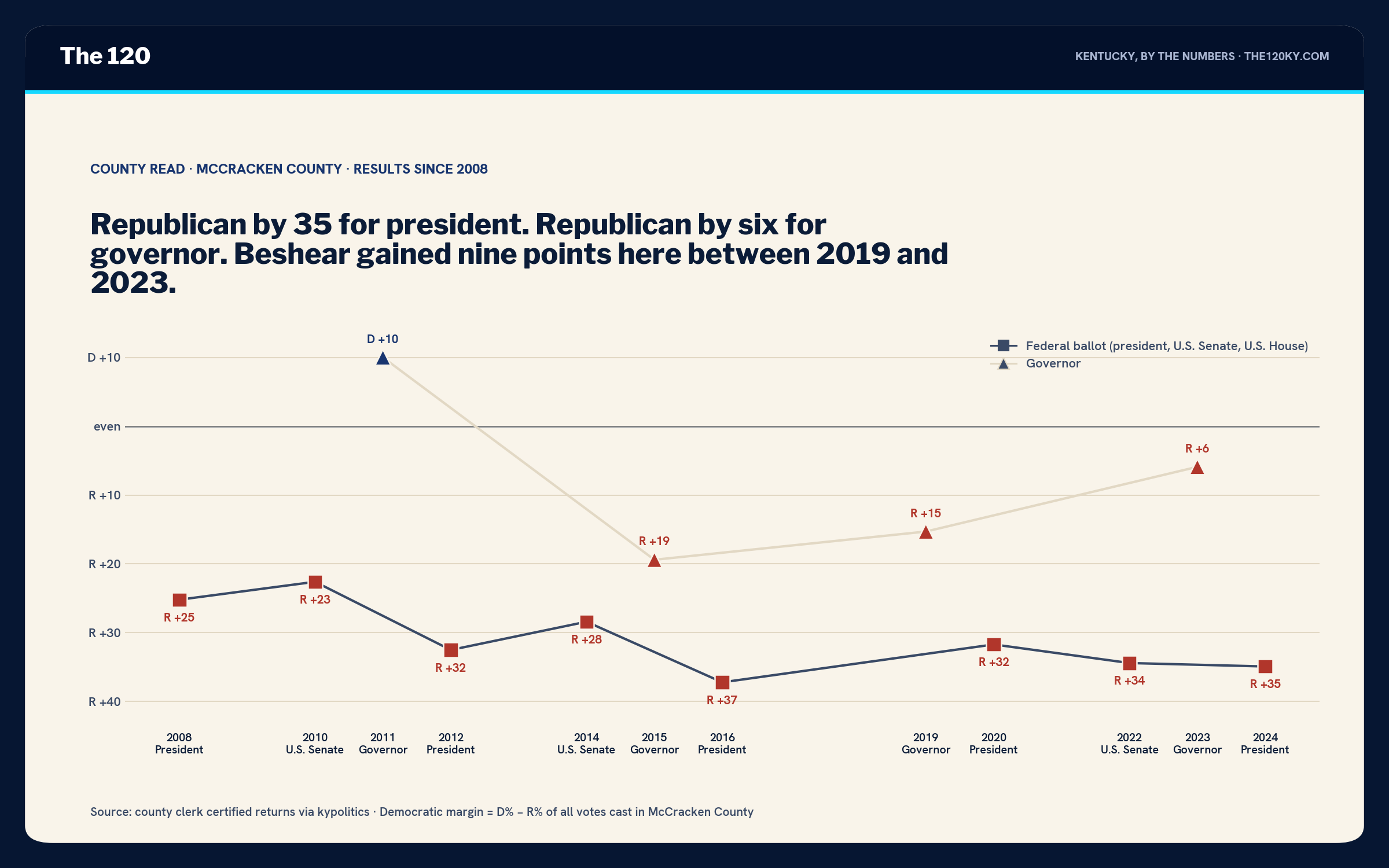
On a federal ballot McCracken has been Republican by about a third since 2012: Romney by 33, Trump by 37, then 32, then 35 — 21,349 to 10,191 in 2024, an 11,158-vote margin. On a governor's ballot, watch the direction. Bevin by nineteen in 2015. Bevin by fifteen in 2019. Cameron by six in 2023 — 11,099 to 9,867, a 1,232-vote margin. That's a 9.4-point gain for Beshear between his two races, the second-biggest of the twenty counties and the biggest outside Fayette; the state as a whole moved about five. And it's a 29-point swing between November 2023 and November 2024, on the same registration, same as Hardin's, Warren's, Kenton's. McCracken is the western Kentucky county where the Beshear number is still moving.
Who's turning out. The Republican column votes harder, and the gap has doubled.
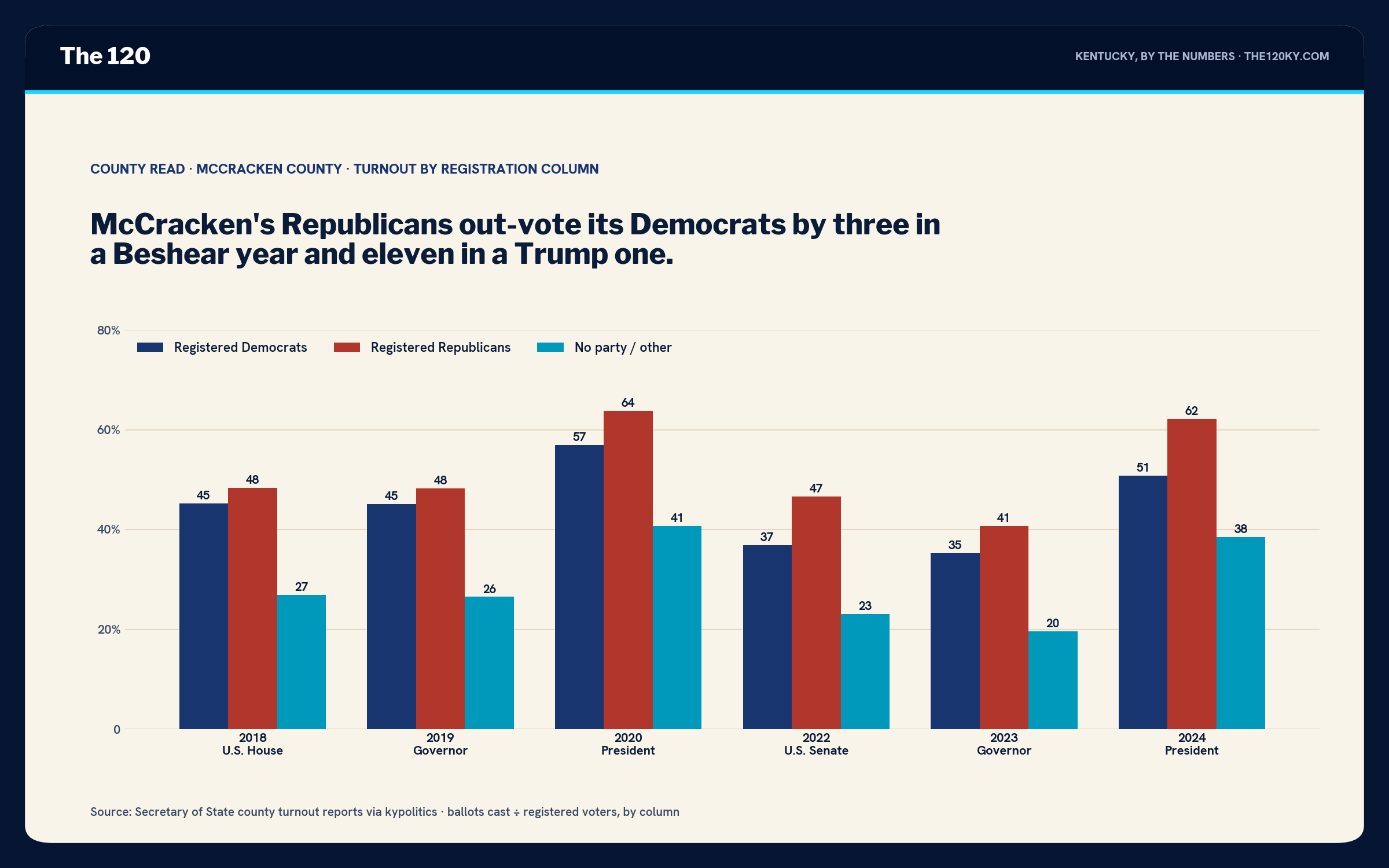
In 2018 and 2019 the gap was three points: 48.4 to 45.2, 48.2 to 45.1. Then it opened. Ten points in 2022, 46.6 to 36.9. Five in 2023, 40.7 to 35.3. Eleven in 2024, 62.1 to 50.8 — among the widest presidential-year gaps in the series, with Kenton and Bullitt. That's the same thing I've seen in every paper-Democratic county: the Democratic column is losing its voters to the other column and keeping its non-voters, so the rate falls even as the count does. What's different here is that Beshear's number rose nine points while the Democratic turnout rate fell five. That's not the Democratic column showing up. That's Republicans who voted, and voted for him. The no-party column, 7,305 voters, turned out at 23.1% in 2022 and 19.6% in 2023.
Beshear gained nine points in McCracken between 2019 and 2023 while the county's registered Democrats turned out five points worse. The gain came from the other column.
Where it happens. McCracken counted its 2024 vote on consolidated precincts — 41 lines where the 2022 and 2023 returns have 54 — and the two don't map onto each other cleanly. So the test here is the 2022 Senate race against the 2023 governor's race, on all 54 precincts, the way I ran Campbell.
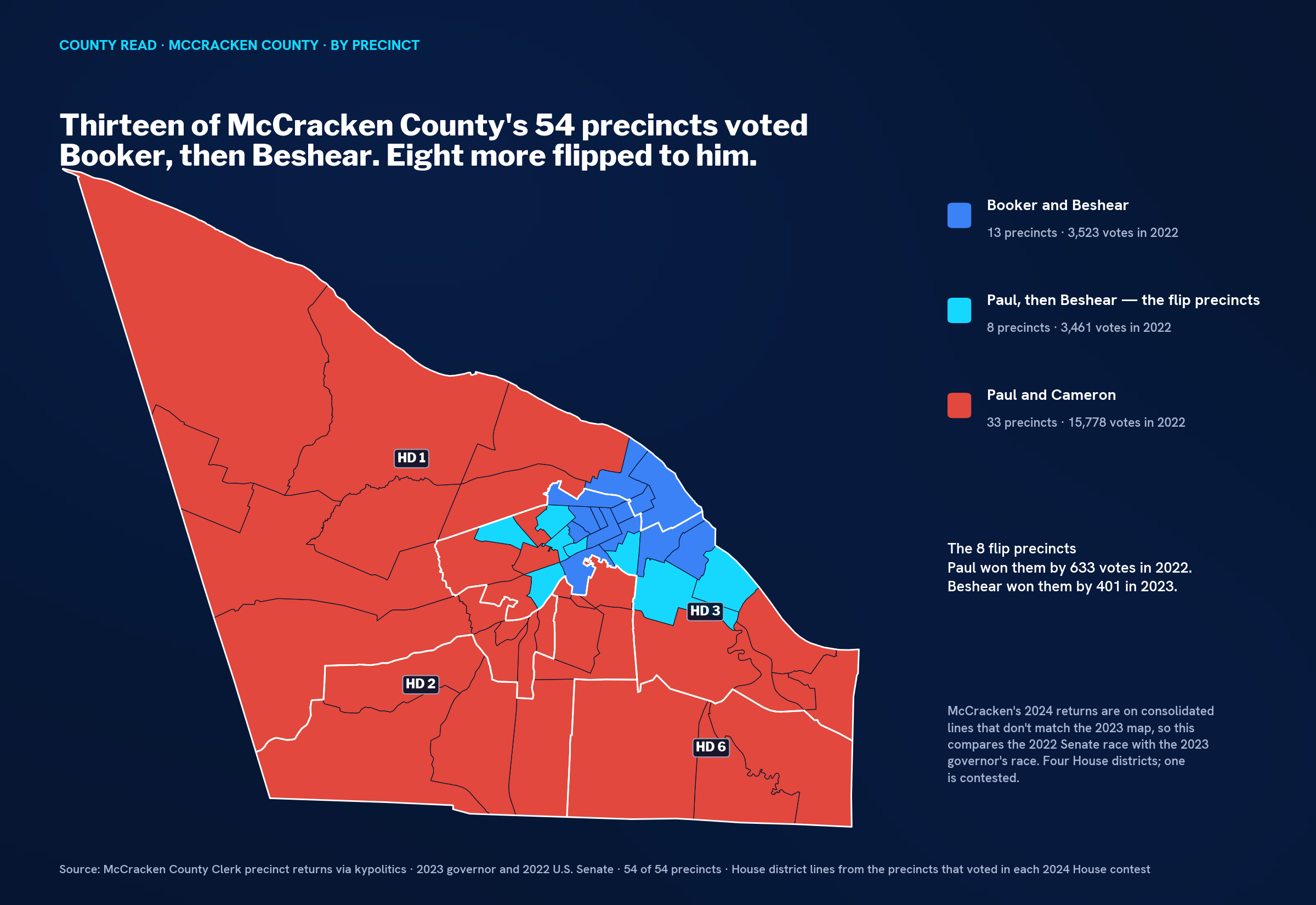
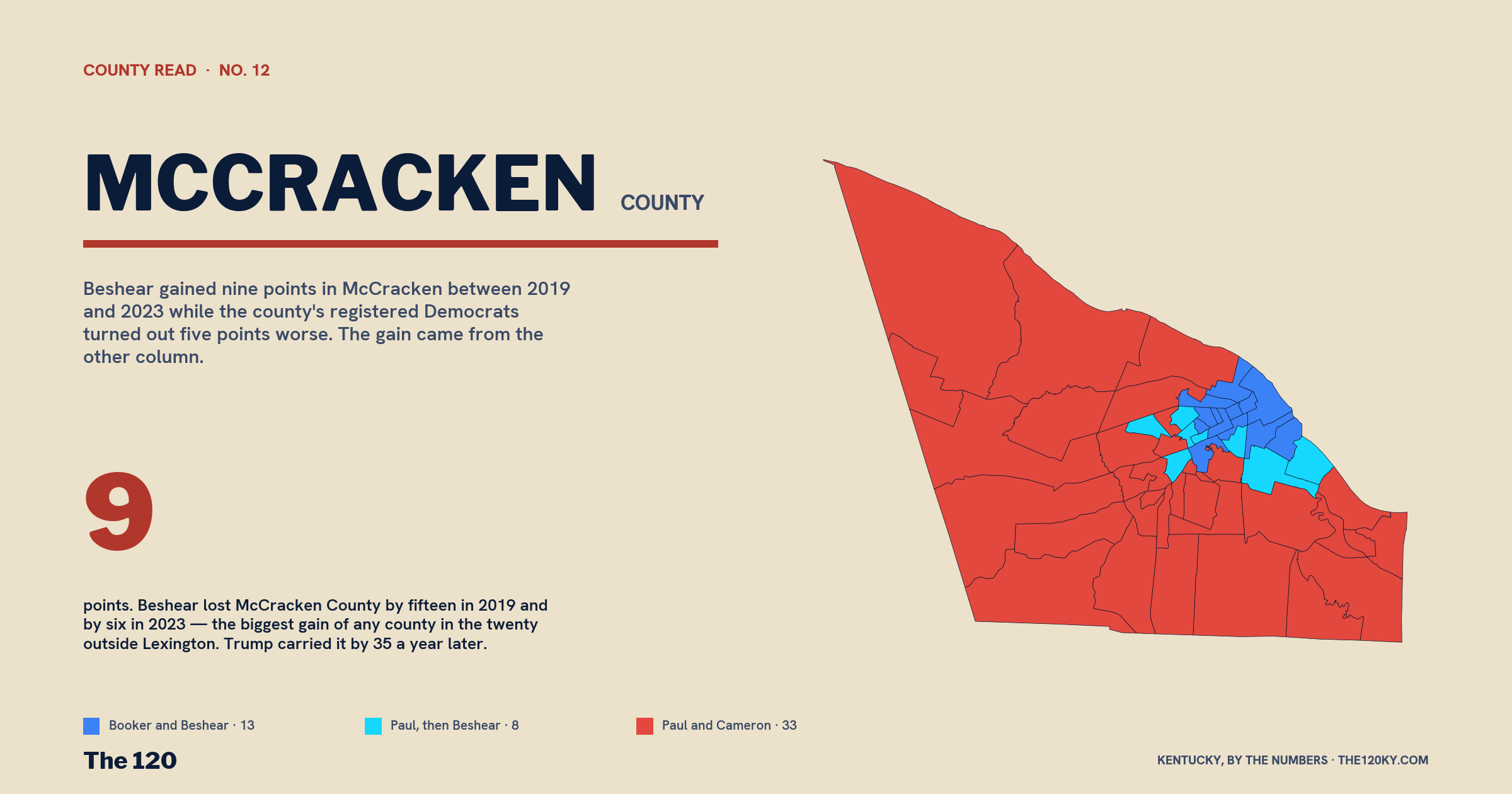
Thirteen precincts voted for Booker and for Beshear — 3,523 votes in 2022, Booker by 888, Beshear by 1,543. That's downtown Paducah and the neighborhoods around it. Thirty-three voted for Paul and for Cameron: 15,778 votes, Paul by 8,083, Cameron by 3,176 — everything outside the city. And eight voted for Paul and then for Beshear: 3,461 votes, Paul by 633, Beshear by 401. The flip precincts are the ring around the blue ones — Paducah's edge — and they're small. The city is a sixth of the county's vote here, smaller than Bowling Green's share of Warren or Owensboro's of Daviess, and the county outside it is 33 precincts and a 3,000-vote Republican floor even in Beshear's best year.
Eighteen of the 21 blue and cyan precincts are in the 3rd. Across the 3rd's 27 McCracken precincts, Paul won by 2,407 and Beshear by 706. The 1st's sixteen precincts — the west and north of the county — went Paul +3,012, Cameron +879. The 2nd's eight, Paul +1,705, Cameron +775.
What's on the ballot, and who's paying. Three House districts, a piece of a fourth, and one Senate district touch McCracken County. Four of the five are unopposed. One has a Democrat.
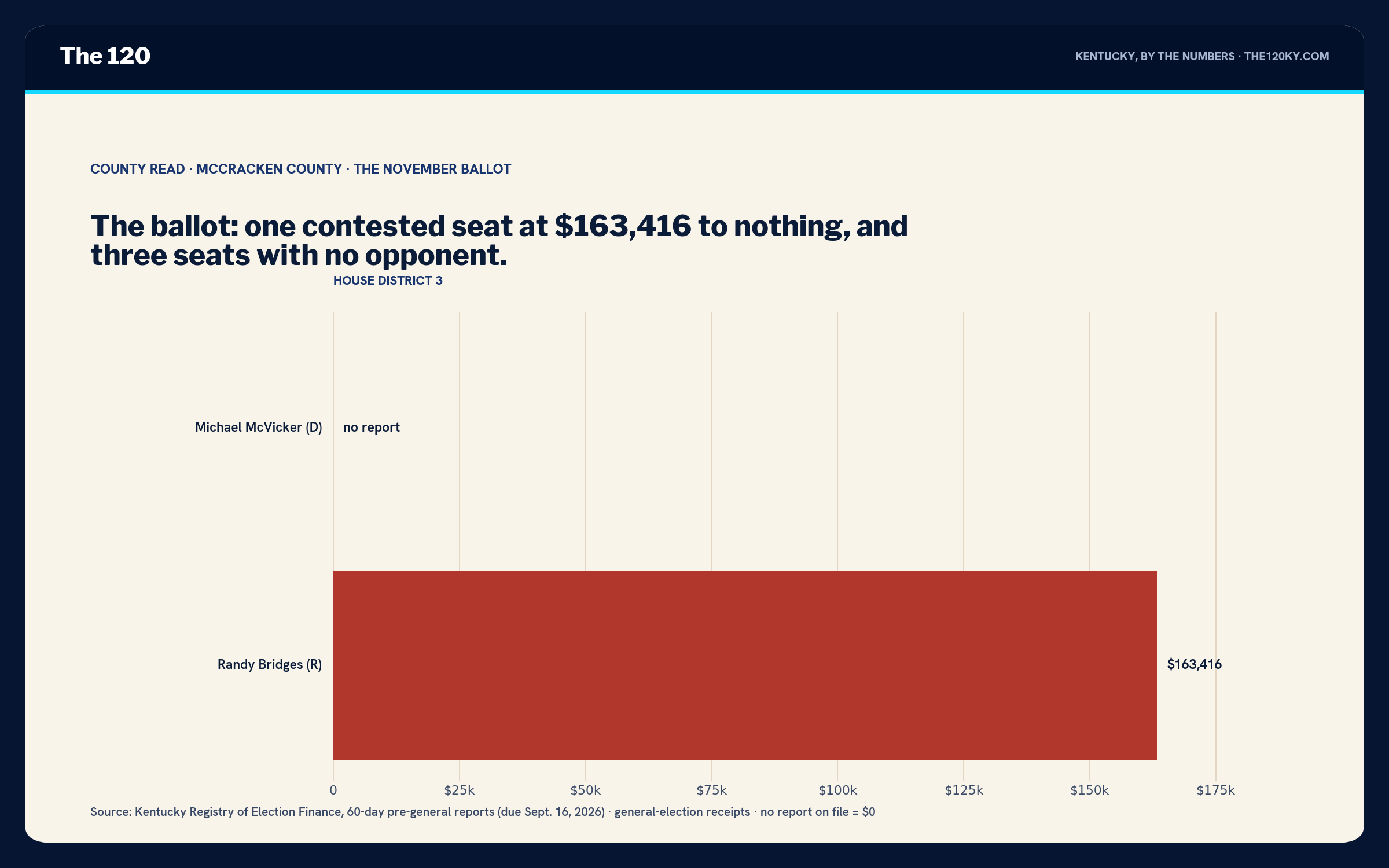
The 3rd is Paducah — 27 of the county's 54 precincts, eighteen of the 21 that voted for Beshear — and it's Randy Bridges's, who won it 13,455 to 6,632 in 2024, by 34. Michael McVicker is the Democrat and has no 60-day report on file. Bridges has $163,416, the fifth-largest general-election account in the House; Rudy's, next door in the 1st, is sixth. Beshear carried this seat's McCracken precincts by 706 in 2023. That's the whole case for a race here, and nobody's funded it.
The 1st is Steven Rudy's — the House majority floor leader, $161,499, no opponent. The 2nd is Kim Holloway's, no opponent, no report. The 6th is Chris Freeland's, three precincts here, $64,758, no opponent. Senate District 2 is Danny Carroll's, $22,886, no opponent. A quarter of a million dollars across those four accounts with no one to spend it against, in a county the governor lost by six.
The read. McCracken is the county that's moving toward Beshear the fastest in western Kentucky and has the least to show for it. A 34-point paper Democratic county in 2010 that's four points Republican now, still growing, still losing its Democratic column at 700 names a year; a governor's number that went from minus fifteen to minus six in one term, on the strength of Republicans crossing over rather than Democrats turning out; and a city of thirteen blue precincts and eight cyan ones that's a sixth of the county and sits almost entirely inside one House seat. That seat has a Democrat, and the Democrat has nothing. If you wanted to know what a Beshear-plus-nine county does for a funded down-ballot Democrat, this is where you'd have found out, and this year you won't.
What I'm watching in November: the 3rd's Paducah precincts against Beshear's 706, and the Republican turnout rate against the Democratic one. If the gap comes in near 2023's five instead of 2022's ten, McCracken is a different county for whoever runs here next.
Tomorrow: Pulaski, Laurel and Christian.
Disclosure: I work in Kentucky Democratic politics. I'm not paid by, and don't advise, any candidate named above. I read this county the same way whether or not it's good news for my side — that's the job.