County Read No. 8 · Daviess County
A Democrat is out-raising the incumbent nine to one in Daviess County
Owensboro's county was Democratic by 32 points on paper in 2010 and is Republican by four now. It swings 34 points between a Trump ballot and a Beshear ballot, more than any county in this series so far. Every legislative seat on its ballot has a Democrat, and in the one that had none two years ago, the Democrat has $36,381 to the incumbent's $4,000.
LOUISVILLE — Eighth of twenty. Same five questions: the paper, the ballots, the turnout, the map, the money.
What the paper says. Daviess County has 75,646 registered voters on the August file: 32,127 Democrats, 35,439 Republicans, 8,080 in neither column. That's 42.5% Democratic, 46.8% Republican, 10.7% no-party — the lowest no-party share of the eight counties so far, a third under Northern Kentucky. In 2010 Daviess was 62.8% Democratic and 30.9% Republican. Read that again: a 32-point Democratic registration edge, sixteen years ago, in a county that voted for McCain by ten. It's a four-point Republican edge now. The Republican column added 15,400 voters; the Democratic column lost 8,500 — the biggest Democratic loss, in raw numbers, of any county in the series so far, in a county that grew by 11,000. The purge took 3,448 names since Election Day 2024, and 2,986 of them, 87%, were Democrats. This is the eastern Kentucky story on the Ohio River: a column that was inherited from grandparents being corrected one obituary and one party switch at a time.
What the ballots say. The widest swing in the series so far.
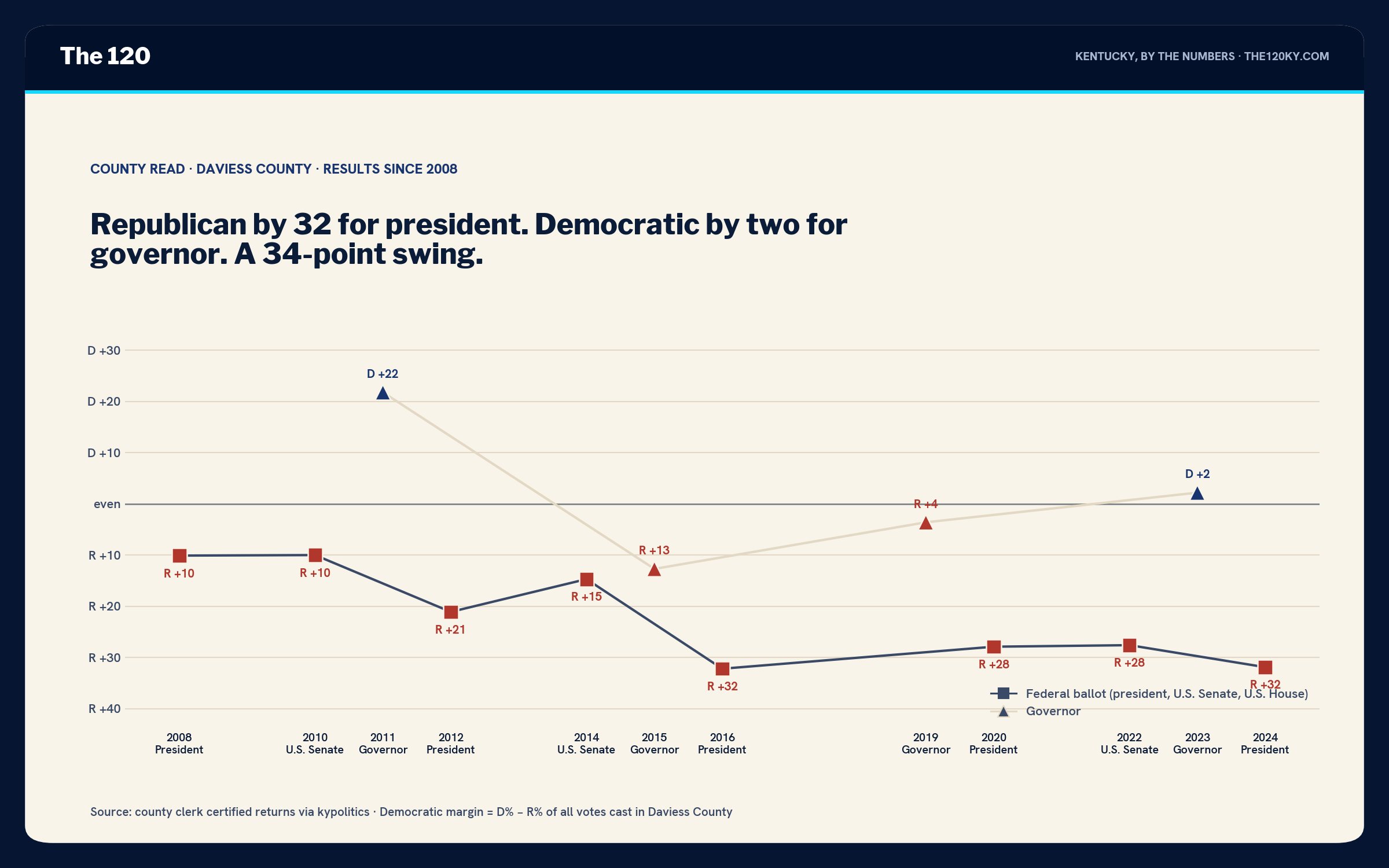
McCain carried Daviess by ten. Romney by 21. Trump by 32, then 28, then 32 again — 30,705 to 15,673 in 2024, a 15,032-vote margin. That's a 22-point move toward the Republicans on the federal ballot in sixteen years, the biggest of the eight counties, and it tracks the registration almost exactly: the county's federal vote went where its paper is going, just faster.
And then 2023. Andy Beshear carried Daviess County by 677 votes — 15,572 to 14,895, a 2.2-point win — twelve months before Trump carried it by 32. That's a 34.1-point swing between consecutive Novembers, the widest of the eight counties so far by a wide margin. Hardin's was 28.7, Warren's 28.5, Kenton's 27. Beshear had lost the county by 3.6 in 2019 and came back and won it. Daviess is the clearest case in Kentucky of a county that will vote for a Democrat it likes by two and against one it doesn't by 32, on the same registration, in the same year.
Who's turning out. Here's the piece of Daviess that doesn't fit the pattern.
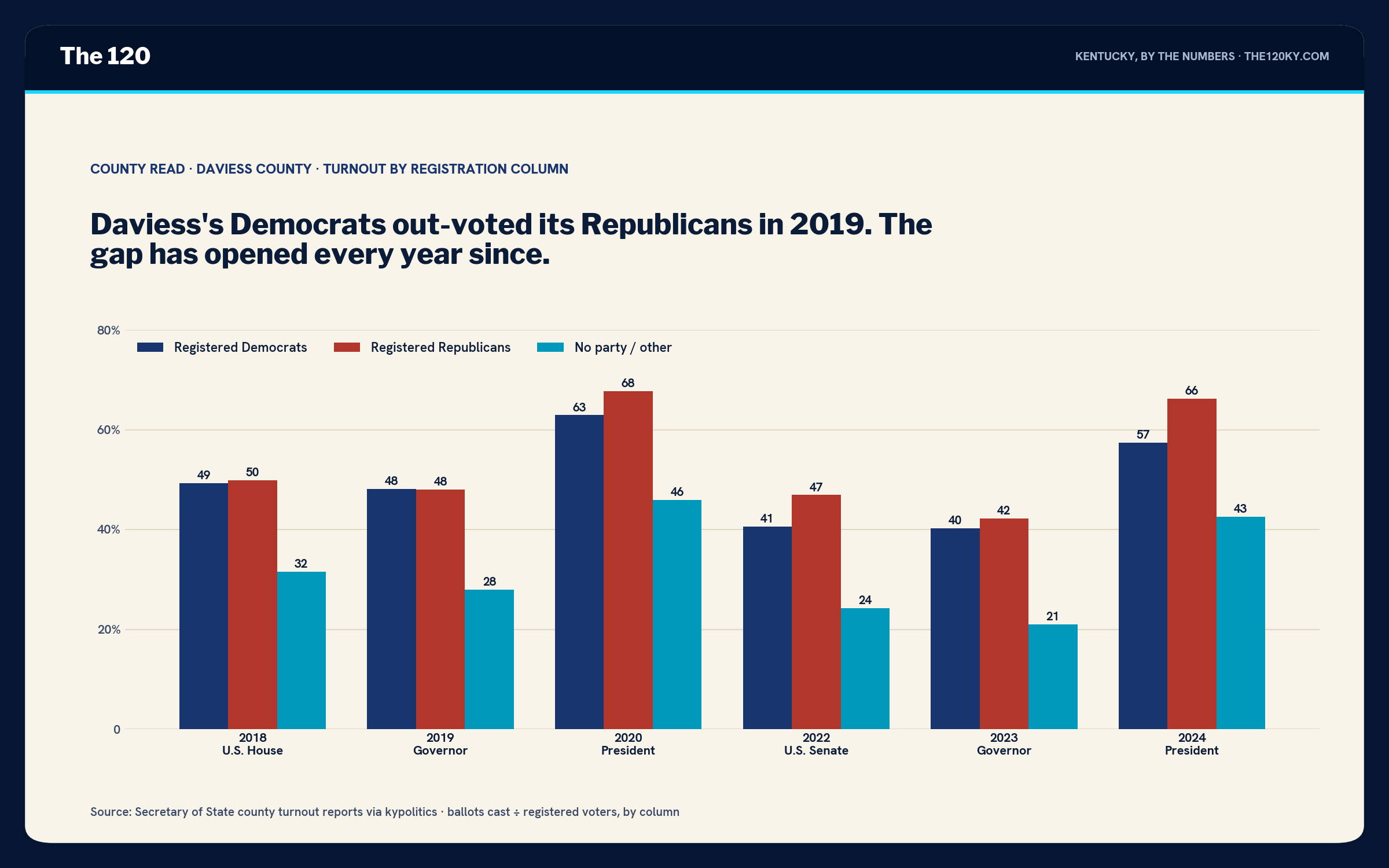
In 2018, Daviess's registered Democrats and Republicans turned out within six-tenths of a point of each other. In 2019 the Democrats were ahead, 48.1 to 48.0 — one of two counties in the series where that's happened outside Louisville and Lexington. Then the gap opened: five points in 2020, six in 2022, two in 2023, nine in 2024. That's the correction happening in the turnout numbers before it happens in the registration: the Democratic column is losing its non-voters to the purge and its voters to the other column, and the people left are more Democratic and fewer. The no-party column, 8,080 voters, turned out at 24.2% in 2022 and 21.0% in 2023 — second-lowest in the series after Hardin.
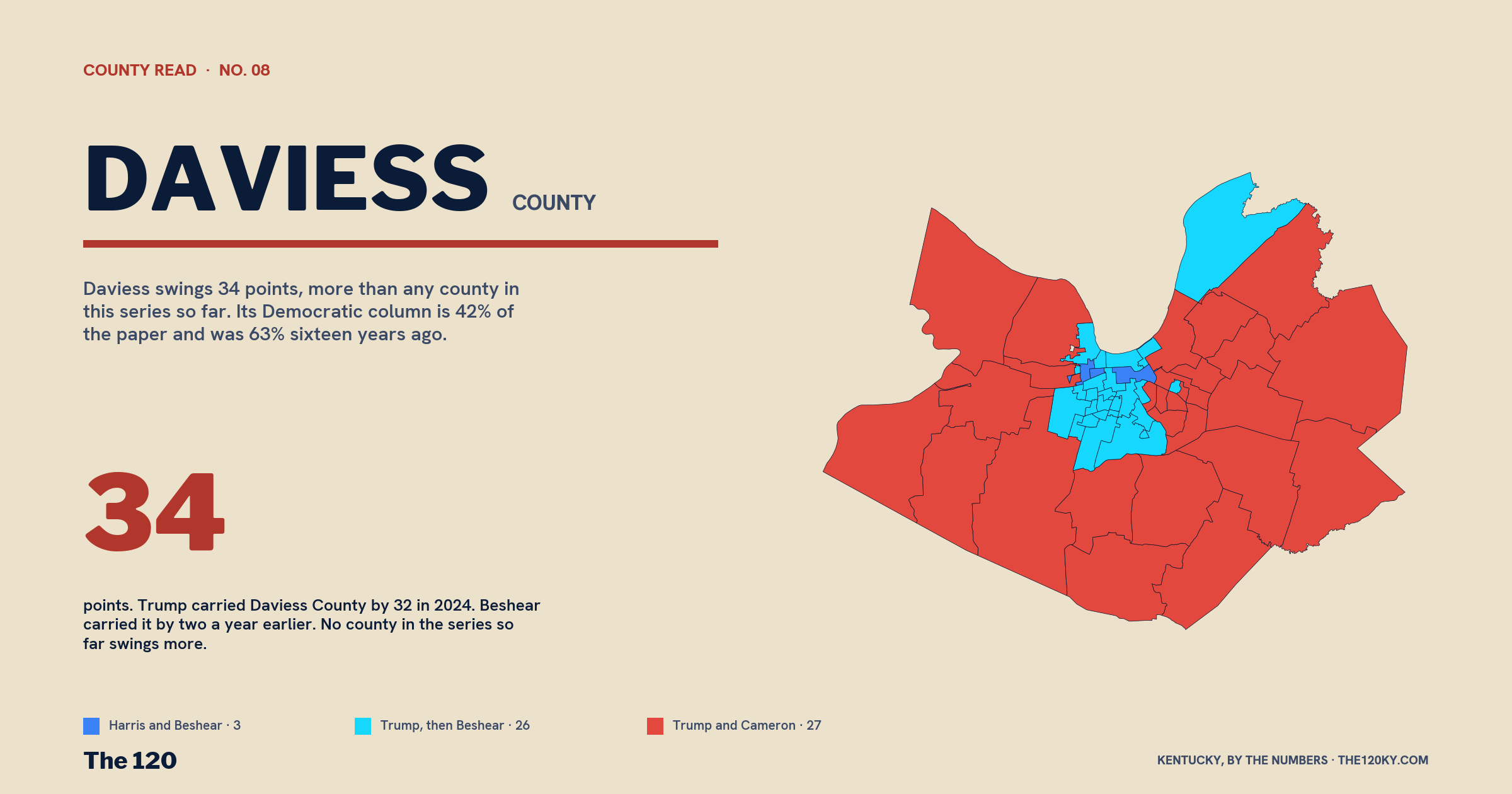
Daviess swings 34 points, more than any county in this series so far. Its Democratic column is 42% of the paper and was 63% sixteen years ago. Both numbers are true, and the second one is why the first one doesn't win anything.
Where it happens. All 56 precincts with both years, and the three-election test cuts the county down the middle.
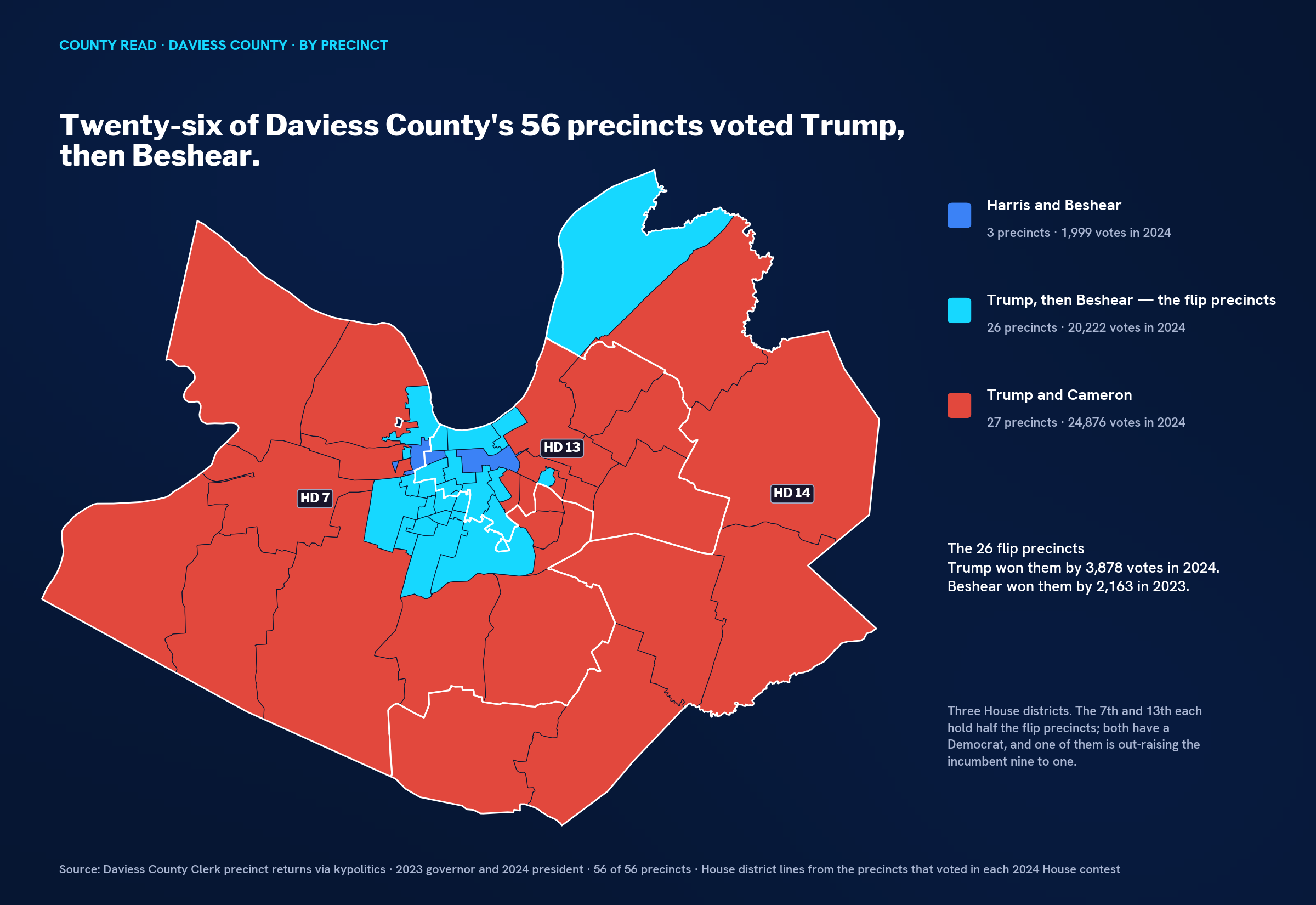
Three precincts voted for Harris and for Beshear — 1,999 votes, Harris by 143. Twenty-seven voted for Trump and for Cameron: 24,876 votes, Trump by 11,297, Cameron by 2,032. And 26 voted for Trump and then for Beshear: 20,222 votes, Trump by 3,878, Beshear by 2,163. That's Owensboro. The flip precincts are the city and the river side, 43% of the county's vote, and the Republican floor is everything outside the city limits. The city split almost exactly in half between the 7th and the 13th: fourteen flip precincts and one blue one in the 7th, eleven and two in the 13th. Across the 7th's 27 Daviess precincts Beshear won by 754; across the 13th's 22, by 699.
What's on the ballot, and who's paying. Three House districts and one Senate district touch Daviess. All four have a Democrat — the first county in the series where that's true.
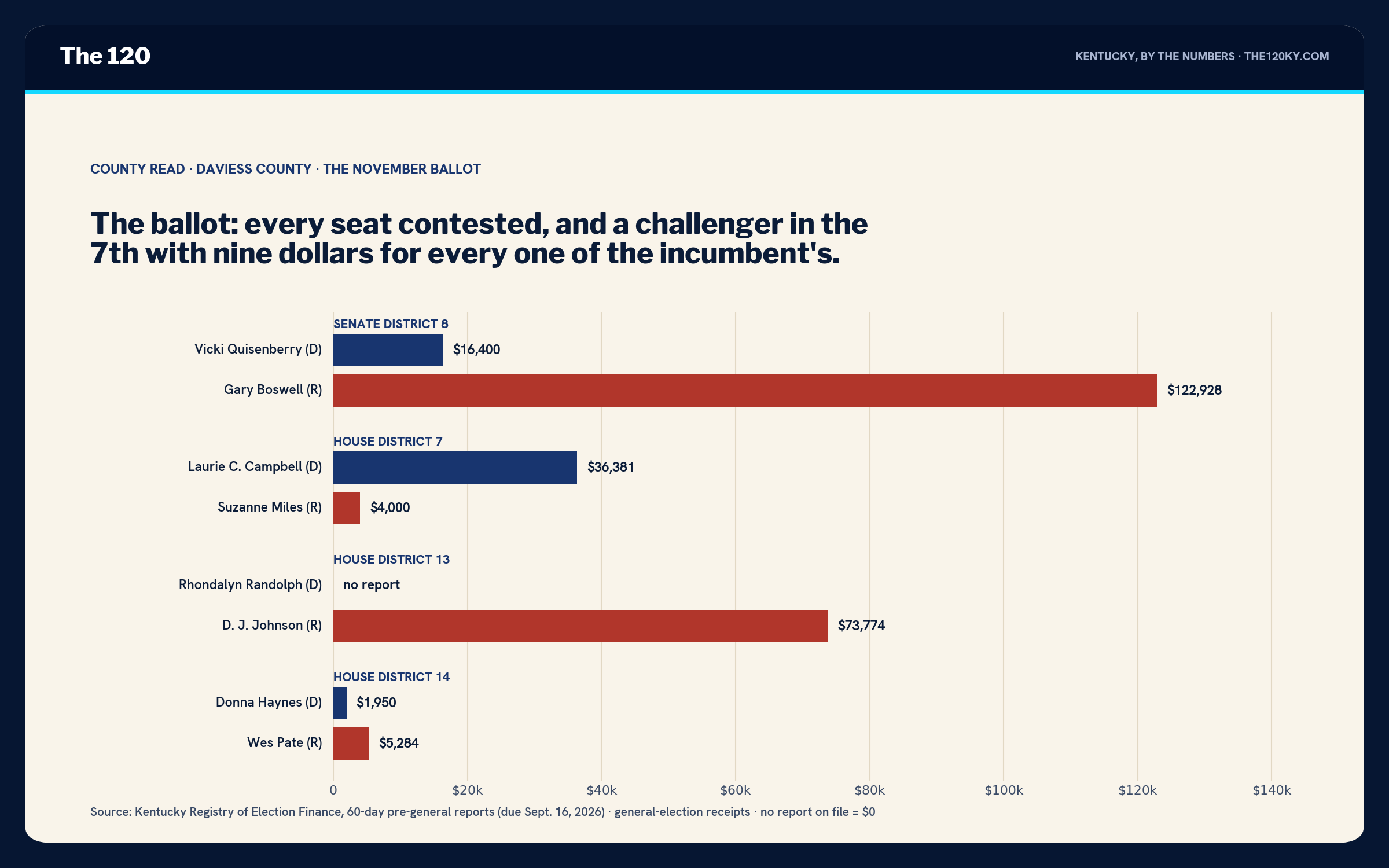
The 7th is the line. Suzanne Miles has held it since 2014 and had no Democrat against her in 2024. This year Laurie Campbell filed, and at the 60-day deadline she has $36,381 to Miles's $4,000 — nine to one, the widest money advantage any challenger in Kentucky holds over an incumbent who has filed a report. The district's Daviess precincts went Beshear +754 and hold fourteen of the county's 26 flip precincts. I want to be careful about what that means: the 7th was unopposed in 2024, so there is no recent number for what a Democrat does here, and a Trump +32 county doesn't become a House race because of one filing report. But it's the only seat in Kentucky where the challenger has out-raised a sitting member nine to one, and it sits on the most persuadable half of the most swingable county in the state. If the 7th isn't a race, somebody should explain why.
The 13th is the other half of the city: D.J. Johnson, $73,774, no Democrat in 2024, and Rhondalyn Randolph this year with no report on file. Eleven flip precincts and two blue ones, Beshear +699. The map says it's the 7th's twin; the money says it isn't.
The 14th is the rural east of the county, which Wes Pate won by 61 points in 2024: Pate $5,284, Donna Haynes $1,950. Senate District 8 is Gary Boswell's, $122,928 against Vicki Quisenberry's $16,400 — the seat that covers the whole county.
The read. Daviess is a county that swings 34 points and has every reason to: a paper Democratic majority that was 63% in 2010 and is 42% now, still shedding 3,000 names a year, and a city that votes for Beshear by two and Trump by 32 without seeing any contradiction. The Republican floor is the county outside Owensboro and it's 27 precincts and 11,000 votes deep, which is why the swing never reaches a legislative seat. What's different this year is the 7th: a Democrat with real money in a seat nobody contested last time, on the half of the city that voted for Beshear. It won't flip a Trump +32 county. It will tell you, for the first time since redistricting, what a funded Democrat can do in Owensboro — and that number is worth more to the next four cycles than anything else on this ballot.
What I'm watching in November: the 7th, precinct by precinct, against Beshear's 2023 numbers in the same precincts. That's the benchmark.
Tomorrow: Campbell.
Disclosure: I work in Kentucky Democratic politics and consult campaigns in this state. I have no client relationship with any candidate named above. I read this county the same way whether or not it's good news for my side — that's the job.