
Primary recap
What the primary told us — and the three things it didn't.
The headline was the Senate race. The lesson was the turnout gap. And the most important numbers are the ones that weren't on the ballot in May.
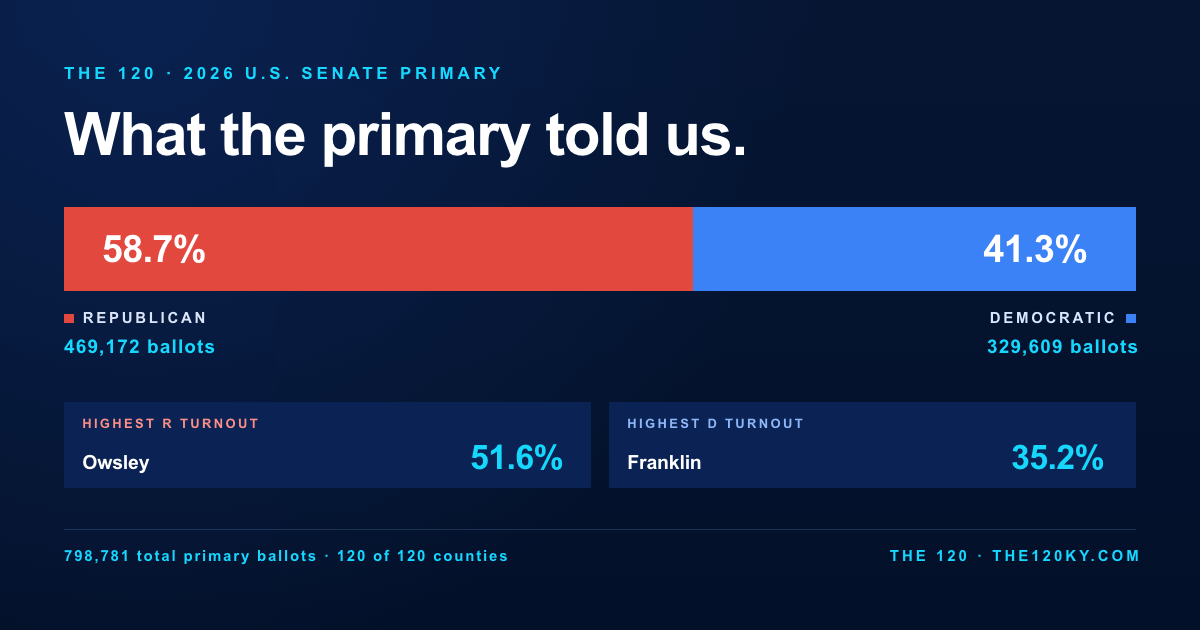
LOUISVILLE — Everybody read the May primary for the winners. The winners are the least useful thing in it. A primary is a small, self-selected election — the people most likely to show up anyway — and the real intelligence isn't who they picked. It's how many of them came, and from which side.
58.5% / 41.5%
Republican vs Democratic share of the Senate primary vote
Of 801,909 votes cast in the Senate primaries, Republicans cast 469,172 to Democrats' 332,737. That's the structural starting line for the fall — and the first thing any honest plan has to account for.
That gap is real and it's worth respecting. But here's the discipline: a primary electorate is not a general electorate. The last comparable election — the 2022 midterm — drew 1,502,626 Kentuckians to the polls, nearly double this primary's 801,909 Senate votes, and most of those additional voters didn't cast a ballot in May at all. The 58.5/41.5 split is a starting position, not a prophecy. Anyone who hands it to you as a prediction is selling you certainty that doesn't exist yet.
So separate what we actually learned from what we only think we learned.
What we learned, and can bank: The Republican side is unified — Barr won big and Cameron endorsed him the same week, so there's no lingering primary wound to exploit. The Democratic nominee's strength is concentrated, not broad: Booker won by stacking Louisville and the two college towns, and lost most of the rest of the Democratic electorate to McGrath. And Jefferson County is the engine of the whole operation — by itself it was 17.6% of the entire primary electorate.
What we did NOT learn, and can't fake — the three questions that actually decide the fall:
A primary tells you who your party is. A general tells you who your state is. Don't confuse the two.
One: who are the general-only voters? Between the 2022 midterm's 1,502,626 ballots and this primary's 864,782, there are 637,844 Kentuckians who turn out in the fall and sit out the spring — and the primary can't see a single one of them. Which way do they lean? In Kentucky, party registration and actual voting behavior parted ways a long time ago — registered Democrats in the eastern counties vote Republican federally all day. The fall plan has to go find them.
Two: can the Democratic coalition expand past the two cities? The Senate map says the nominee's appeal stops at the Louisville and Lexington county lines. Either that changes by November or the math doesn't.
Three: does the bottom of the ballot move on its own? Metro Council, the legislative seats — those races have their own gravity, and a smart cycle treats them as opportunities to win even where the top of the ticket can't.
Here's the part the consultants will get backwards. The instinct after a primary like this is to go celebrate where you're strong — to pour the fall budget into Louisville and Lexington because that's where the votes already are. That's exactly wrong. You already have those counties. The primary just handed you a free map of where you're weak, while there's still five months to do something about it. Build the operation there.
I'll keep reading it straight — the Senate race, the down-ballot races, and the turnout that decides all of them — every county, all the way to November.