
The read · voting law
The rules changed everywhere. Kentucky's math mostly didn't.
The Supreme Court gutted the Voting Rights Act and Washington spent the summer fighting over mail ballots. Almost none of it moves a Kentucky number — and the one fight that would isn't the one making headlines.
LOUISVILLE — LOUISVILLE — Two things happened to American election law this year that would, on their face, seem to rewrite how Kentucky votes. In the spring the Supreme Court gutted the Voting Rights Act, 6 to 3, in a Louisiana case — the strongest tool for challenging how district lines are drawn. And all summer, Washington fought over mail ballots: a presidential order directing the government to build a federal citizenship list and deliver ballots only to the people on it, a Supreme Court fight over whether states can even count ballots that arrive after Election Day. Lower courts blocked the order, and the administration raced back to the Supreme Court to unblock it before November. So the natural question on our numbers desk is simple: what does any of it do to our numbers in Kentucky?
Mostly nothing. And saying that plainly is the whole job here, because the noise is doing a lot of work to hide it.
Start with the mail fight, because it's the loudest and the least relevant to us. The entire battle is over grace periods — whether a ballot postmarked on time but delivered late still counts. Kentucky doesn't have one. State law requires an absentee ballot in the county clerk's hands by 6 p.m. on Election Day, full stop; a ballot that shows up Wednesday has never counted here and still doesn't. The order everyone is suing over, the ruling everyone is citing — they are a fight about other states' rules. Kentucky already runs the strict version. It is part of why mail was 2.2% of the Jefferson primary to begin with.
The Voting Rights Act ruling is broader, but it is aimed elsewhere. Gutting Section 2 changes how district lines can be drawn and challenged — it is a map story, a representation story. It does not change how a single Kentuckian casts a ballot, or whether they turn out. It rewrites the terrain the game is played on, not the rules of the game. It does hand aggressive map-drawers a freer hand, and Kentucky's own map won't be immune to that — but that is a redistricting story for another day, not a turnout number that moved.
The fights making the most noise are about how Kentucky votes. Kentucky settled most of those questions years ago. The one that could actually move a number here is about something else — whether you're on the rolls at all.
Here is the one place Washington's fight could reach a Kentucky number, and it is the part nobody is watching. Set aside how people vote — early, late, by mail — and look at whether they are registered in the first place. The live idea that would change that is documentary proof of citizenship to register: a passport or a birth certificate at the registration table. Right now it goes nowhere in Kentucky. A federal judge has blocked the presidential order that tried to impose it; the bill that would write it into law, the SAVE Act, passed the House and stalled in the Senate; and Kentucky has not adopted its own version. So today it changes nothing here.
But notice the axis. A proof-of-citizenship rule would not touch the 82.2% who voted on Election Day in that same Jefferson primary, or the 15.1% who voted early — it would not change how anyone votes at all. It would change who is allowed on the list. That is the denominator under every turnout number in this state, and it is the one lever in this whole national fight that could actually move a Kentucky figure. The reflexive worry is "they are coming for early voting." They are not — Kentucky already votes the way these fights are trying to force other states to. The worry worth having is quieter: whether the pool shrinks before the method mix ever matters.
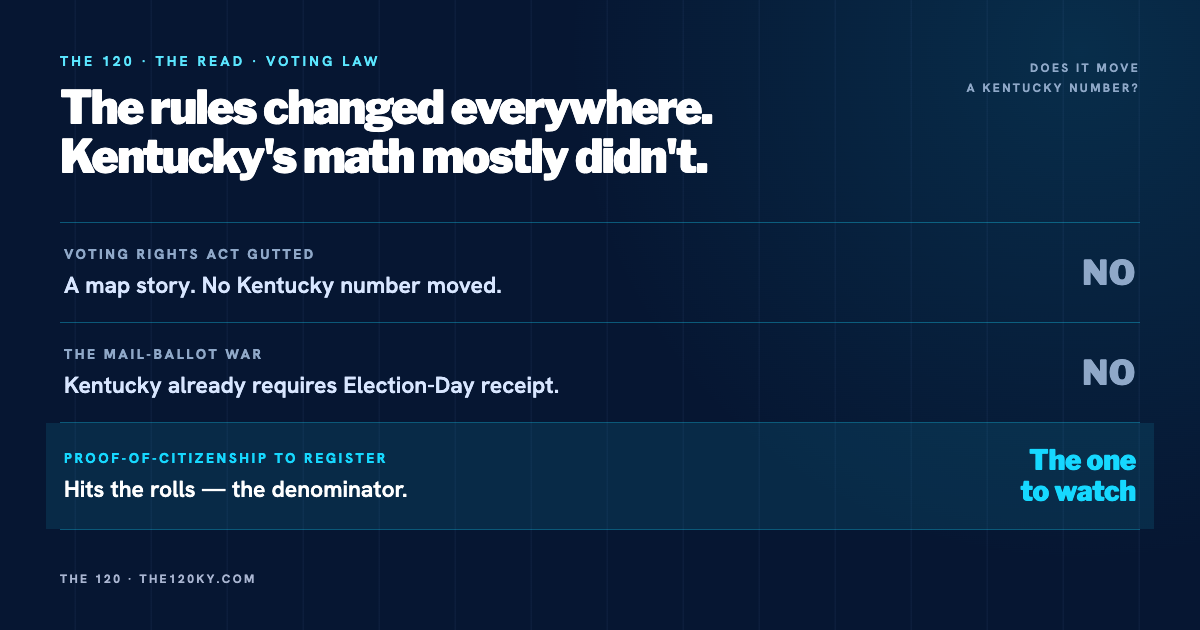
So read the headlines straight. The Voting Rights Act ruling is a map story. The mail-ballot war is a fight over a rule Kentucky already has. Neither one moves a number here. The only thing on this list that would is a registration barrier that isn't law yet and isn't in Kentucky — which is exactly why it is the one to watch.