
2026 primary · U.S. Senate
Two primaries, one map.
Barr swept the state red. Booker swept Louisville. The mountains broke for McGrath.
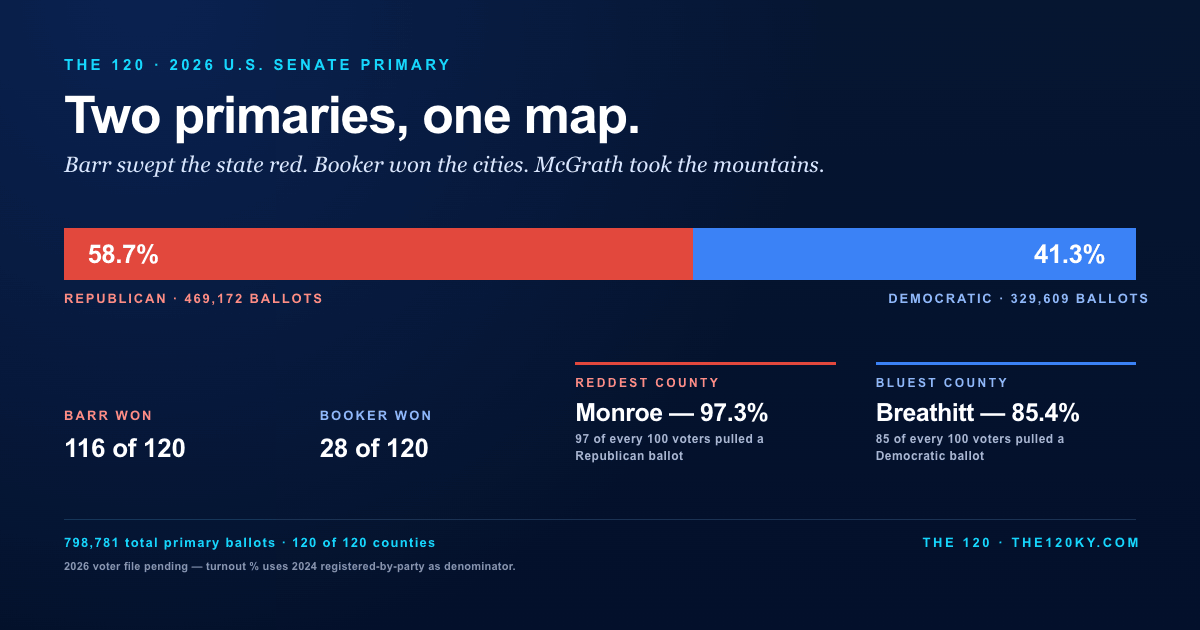
LOUISVILLE — On May 19, Kentucky cast 801,909 votes in the U.S. Senate primary. The headline is in two numbers and two colors.
283,833
Andy Barr — Republican primary winner
Won 116 of Kentucky's 120 counties. Daniel Cameron carried just four — Oldham, Hardin, LaRue and Trimble — finished with 144,592 statewide, and has already endorsed Barr.
155,577
Charles Booker — Democratic primary winner
Won the urban core. Lost the mountains. Amy McGrath finished with 119,296 — only 36,281 votes back of Booker.
The state map shows the partisan shape of the night — light blue where the D primary outvoted the R primary, deep red where it didn't. There is one light blue county.
That light blue county is Jefferson. Booker took it 57,558 to McGrath's 27,018 — a 31-point margin and the only county where the Democratic primary turnout actually exceeded the Republican primary turnout.
Jefferson County · 2026 U.S. Senate primary
East of Lexington, the map flips inside the Democratic primary. McGrath beat Booker in Pike — 1,340 to 1,025 — and across a string of Appalachian counties Booker barely contested. And it is not only the mountains: McGrath also won the Northern Kentucky suburbs — Kenton, Boone and Campbell. Booker's coalition is Louisville and two college towns. Almost everywhere else a Democrat voted, the name on the ballot was McGrath. The progressive lane sells in the cities. It has not yet sold anywhere else.
Pike County · 2026 U.S. Senate primary
That gap is what Barr's general-election campaign will spend the next five months pointing at. He has 120 reliable Republican counties and a runner-up he doesn't have to fight anymore. Booker has Jefferson, two college towns, and an Eastern Kentucky problem.
I'll keep reading the precincts as they come in.