Field notes
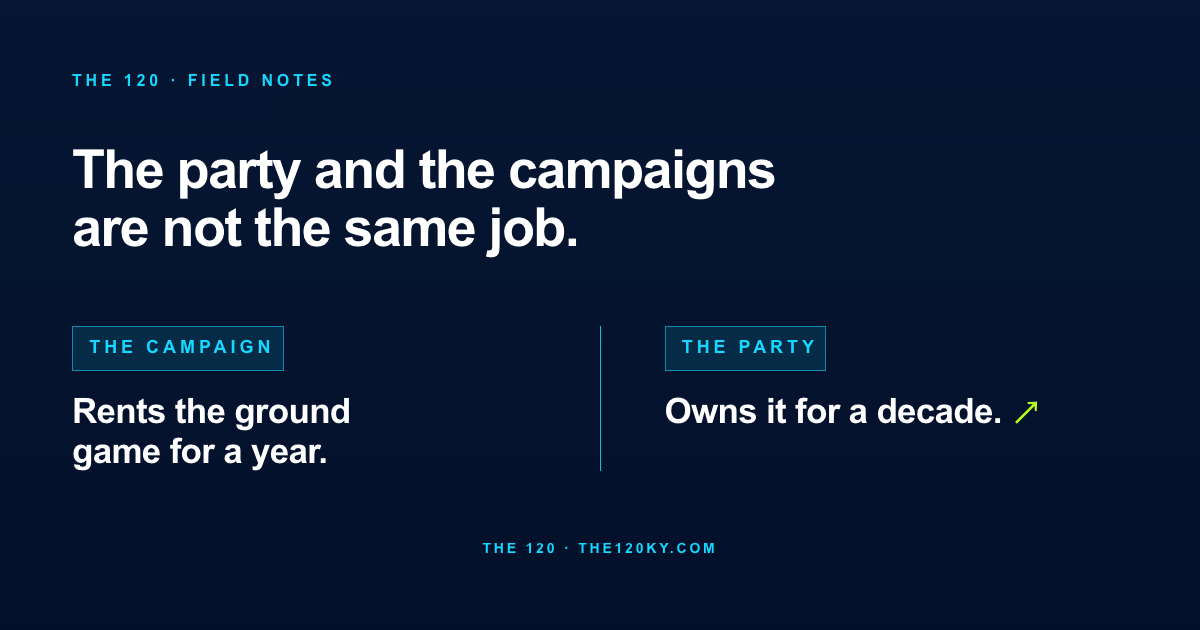
The party and the campaigns are not the same job. That's the point.
When they get confused for each other, both do worse. When they each do their own job, a coordinated campaign actually works.
LOUISVILLE — There's a recurring argument in Kentucky Democratic politics that sounds strategic and is actually just a turf fight: should the party run the field program, or should the campaigns? The answer is that they're two different jobs, and the trouble starts the moment one tries to be the other.
A campaign exists to win one race. It is allowed to be selfish about that. Its targeting, its message, its money — all of it should bend toward the single number that ends its life on election night.
The party exists for the races that aren't on the ballot yet. It carries the voter file forward between cycles. It keeps the precinct captain who knocked in 2024 still answering the phone in 2026. It builds the list of volunteers, the relationships in the eastern counties and the Northern Kentucky suburbs, the infrastructure no single campaign can afford to build and then throw away in November.
A campaign rents the ground game for a year. The party owns it for a decade. Confuse those two and you'll spend a fortune renting what you should have owned.
Here's where it goes wrong. When the party tries to act like a campaign — picking winners early, running message instead of mechanics — it burns the trust it needs to hold a coalition together. And when a campaign treats the party like its personal field staff, it strip-mines a shared asset for one race and leaves the next nominee with nothing.
The coordinated campaign is the answer to that confusion — and it's worth being precise about what it actually is, because the name gets thrown around loosely. It isn't a standing institution. Most cycles with a statewide race on the ballot, the ticket builds a new one from scratch: a single field operation running one turnout plan across all 120 counties on behalf of every Democrat on the ballot. It's stood up fresh, it's torn down in November, and the next cycle does it again. I've helped build and run a number of them over the years — going back to the 2007 governor's race, when I first put all 120 counties on one GOTV plan — and the ones that work all hold the same line: the party brings the infrastructure (the file, the volunteers, the turnout machine that serves the whole ticket), the campaigns bring the persuasion and the candidate, and neither tries to do the other's job. That's when the whole ticket gets lifted instead of one race cannibalizing the rest.
If you're a county committee reading this: your job is not to win the Senate race. Your job is to make sure that whoever's at the top of the ticket inherits a turnout operation that's already warm — and that it's still standing the morning after, ready for the next one. That's not a smaller job than the campaign's. In the long run it's the bigger one.
The campaigns will come and go. The party is what's still here in the off year, keeping the lights on. Fund it like you believe that, and the math in the fall gets a lot friendlier.