The read · money in politics
The Court took the cap off party money. In Kentucky, that changes who runs the coordinated campaign.
On June 30 the Supreme Court let parties spend unlimited money in coordination with their candidates. The sleeper consequence isn't in Washington. It's that a county party can now run an uncapped coordinated campaign — and this is the year Louisville should.
LOUISVILLE — On June 30, in National Republican Senatorial Committee v. FEC, the Supreme Court struck down the limits on how much a political party can spend in coordination with its own candidates. Six to three, Justice Kavanaugh writing, overruling a 2001 case called Colorado II that had held those limits up for a quarter century. Most of the coverage read it as a Washington story — more money, bigger national committees, another crack in what's left of campaign finance law. All true. But the part that matters for anyone doing the work in Kentucky is further down, and nobody's saying it out loud, so I will.
First, what actually changed, in plain terms. A party has always had three ways to help its candidate. It can write the campaign a check — still capped. It can spend money near the candidate but forbidden to talk to them — an independent expenditure, already unlimited, and mostly a guess. And it can make a coordinated party expenditure: party money, spent with the candidate in the room, on the ad or the mail or the field program the campaign actually wants. That third lane is the useful one, and until June 30 it came with a ceiling.
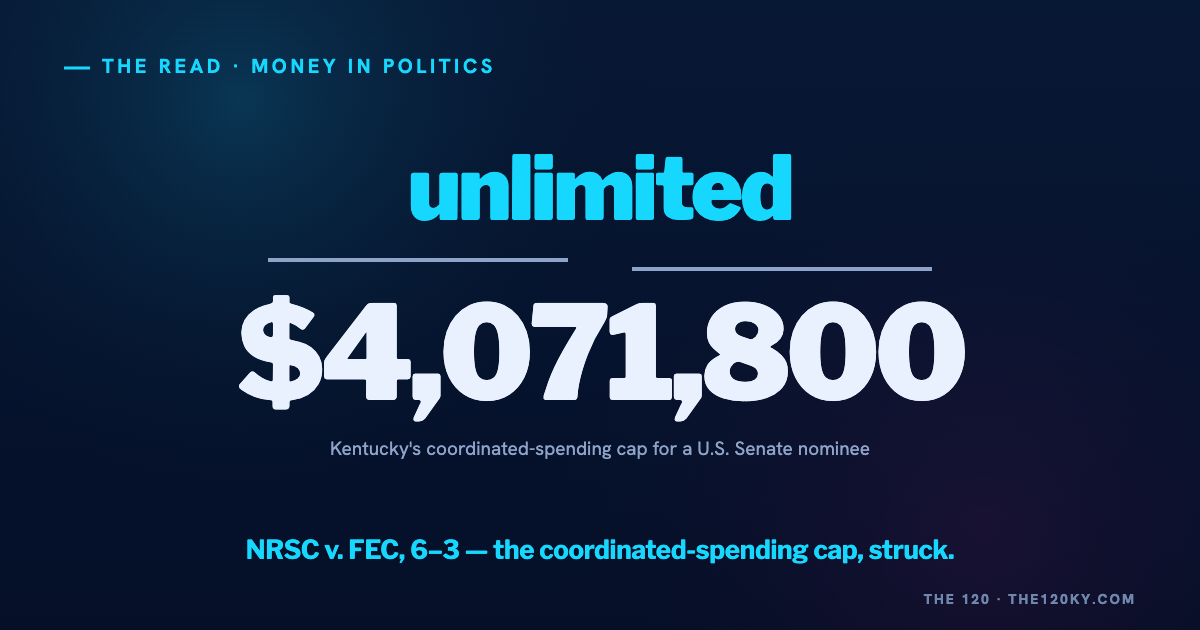
$4,071,800 → unlimited
Kentucky's coordinated-spending cap for a U.S. Senate nominee — before the ruling, and after
The House cap ran $65,300 to $130,600. On June 30, 2026, the Court (6–3) struck the limits under 52 U.S.C. 30116(d) and overruled Colorado II. The ceiling is gone. The floor was never the problem.
Here is the sentence to sit with: the limit was never really about who was allowed in the room. It was about how small the room was. And that's where this stops being a Washington story and becomes a Louisville one.
A county party can open a federal account. It cannot, on its own authority, make a coordinated expenditure — the FEC is explicit that "district and local party units do not have any coordinated party spending authority of their own." What a county party can do is act as the designated agent of the state party, spending against the state party's limit under a written assignment. For fifty years that was a technicality nobody used, because the thing being assigned was a scrap — one small capped pot the state party had to ration across every federal candidate and every county that asked. When there's one small pot, everybody competes for it, and the rational move is not to bother. That competition was the ceiling.
Take the ceiling off and the math inverts. The Kentucky Democratic Party can now deputize every county committee it wants and assign each one unlimited coordinated-spending authority. The county party stops being a mailbox and a Facebook page and becomes a spending vehicle for the whole federal ticket.
A cap you share across every candidate and every county is a cap that teaches everyone not to bother. Take it off, and a county party stops being a mailbox and becomes a machine.
Now the honest correction to the version of this that's already going around — that donors can suddenly write unlimited checks to their county party. They can't. The Court uncapped the spending, not the giving.
$44,300 · $10,000
What one donor can still give a national party, and a state or local party, in a year — unchanged
A donor still maxes at $3,500 to a candidate per election. But the aggregate limit — the ceiling on a donor's total across all committees — died in McCutcheon in 2014, and party-to-party transfers are unlimited. The cap is now per-committee, not on the system.
Read those two rules together and you see the real machine. No single committee takes an unlimited check. But a donor can max out to the national party, to the state party, and to as many county committees as the affiliation rules allow, with no ceiling on the total — and every dollar can then be moved, party-to-party, without limit, to the committee that's actually spending it, and spent in full coordination with the candidate. The network is the uncapped vehicle. The county party is one legal, uncapped node in it.
I could stop there and it would sound like good news for my side. The 120 has to turn the knife on its own best number, so here it is: a ruling that hands power to parties hands it first to the party that already has the money. And in this moment that is not the Democrats.
8x · 11x
How far Republican party cash outruns Democratic — nationally, and in Kentucky
RNC $125.5M cash on hand vs. DNC $14.9M. Republican Party of Kentucky's federal account $2.11M vs. the Kentucky Democratic Party's $0.19M. FEC, through May 31, 2026. An empty vehicle with no speed limit is still empty.
That's the receipt that keeps this piece honest. Unlimited coordinated spending is a gift, and it lands in the lap of whoever already fills the vehicle. Nationally the RNC is lapping the DNC eight to one; in Kentucky the Republican state party's federal account holds eleven times what ours does. Be straight about it: this rule, by itself, helps the Republicans here first and most. (The one place the story isn't lopsided: the congressional committees — the NRSC and DSCC, the NRCC and DCCC — are close, and the Democrats actually out-cashed the RNC as recently as early 2024. So the blowout is specifically RNC-over-DNC, not a law of nature.)
So why do I still think this is the year for a countywide coordinated in Louisville — not despite that money gap, but because of what the gap forces? Because when you can't win the arms race, the only edge left is structure, and the ruling just made the best structure legal at full size for the first time.
Louisville is the Democratic island — the county that banks the party's votes and the party's money in a red state. In 2026 the top of the ticket is federal: an open U.S. Senate seat, a congressional map that finally has a live district in it. A coordinated campaign run through the county party as the state party's agent puts one turf cut, one data spine, one message operation behind that whole federal ticket — instead of every campaign buying its own list, printing its own mail, and guessing at the same doors. The waste I've spent twenty years watching — five campaigns paying five vendors to knock the same street — is exactly the waste a coordinated is built to kill. The ruling didn't invent that structure. It removed the ceiling that made it not worth building.
Two honest limits before anyone runs with this. The ruling is about federal candidates in the general election — it supercharges the federal layer of a coordinated, the Senate-and-House spine. Your Metro Council and statehouse candidates still ride Kentucky's own rules under KRS 121; they run the same field program, but the money that touches them answers to Frankfort, not this opinion. And the FEC has no quorum right now to write the rules that operationalize any of this, so the exact mechanics will lag and the smart move is to build under counsel, not off a blog post. Including this one.
The through-line is the one I keep coming back to: the tool got more powerful, and the side that's better at using tools — not the side with more money — is the one that gets paid for it. Kentucky Democrats are not going to win the cash race in 2026. The question this ruling puts on the table is whether they'll win the structure race, and Louisville is where you'd find out.
I'll be watching one number to see if anyone's serious: whether the county party files to spend as the state party's coordinated agent before the fall, or lets a free tool sit in the drawer for another cycle. It usually sits in the drawer. This is the year it shouldn't.
Disclosure: I work in Kentucky Democratic politics and consult campaigns in this state. I read this race the same way whether or not it's good news for my side — that's the job.